
Can We Use Ancient DNA to Recover Extinct Plants and Animals?
Using DNA to recover lost traits and maybe even whole animals is not out of the question anymore. But should we?
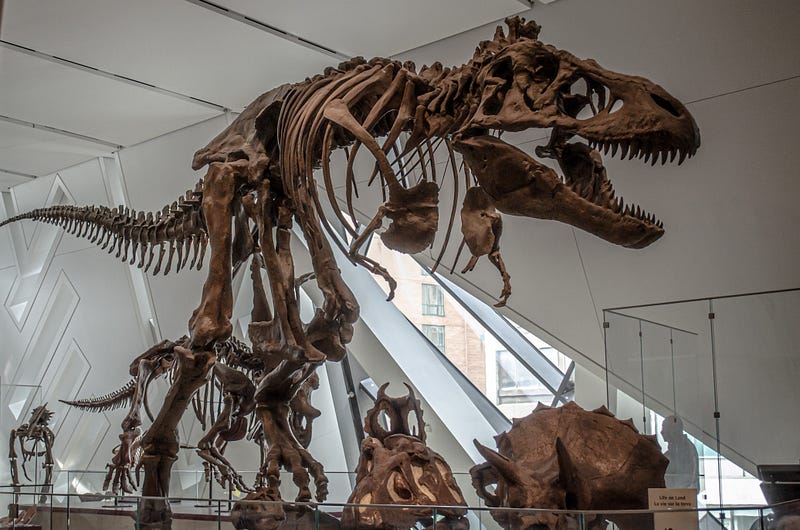
The very word — extinction —it means gone forever. Never to be seen again.
But is that really so anymore?
Modern DNA sequencing technology is able to resurrect genome sequences from ever-smaller amounts of DNA. So how lost are all of these creatures, really?
Think dinosaurs, passenger pigeons, woolly mammoths, the mountain hibiscus from Hawai’i and a host of other creatures. Wikipedia has extensive lists of extinct species both ancient and recent.
I recently read an article in Scientific American by Rowan Jacobsen where he talks about how scientists reclaimed genes from old dried up herbarium specimens. Then they used the genes to recreate plant aromas that haven’t been smelled in over a hundred years!
And that piqued my curiosity.
So I did what I always do when my curiosity gets piqued. I started “sniffing around” the literature and the internet!
And I learned that while the potential to recreate some of these creatures is tantalizing, it’s not as simple as it some are making it out to be.
There are technical scientific obstacles, ethical dilemmas, ecological constraints and fiscal considerations.
As an example, let’s take the passenger pigeon. Say we surmount all the technical scientific obstacles and recreate passenger pigeons. Well, is that ok? Should we have done that?
What about survival? Will they actually be able to live in the current environment?
If so, how will they affect the other species that have replaced them? Will they become an invasive species that would have been better off not being recreated?
If not, why did we bother and what did it cost? Would it be worth it if it cost a million dollars and we only made 10 passenger pigeons? Would those $$ have been better spent on other scientific research?
As I said, it’s not simple!
Let’s delve into bringing back extinct creatures and see if we can get a deeper understanding of the barriers and consequences.
First up is the science involved.
De-Extinction and Resurrection Science*
Also known as species revivalism*, there is a global scientific effort to recover many of the creatures we have previously lost.
* These two designations, Resurrection Science and Species Revivalism sound like fundamentalist religious movements, not serious science! We need to devise better, non-religious descriptive terms! Currently, there are 3 methods for recovering extinct organisms that dominate the field; cloning, gene editing and selective breeding.
Let’s briefly describe them and look at how they are being applied.
Cloning
I’m assuming you have a pretty good idea of what it means to clone an animal. But in case you don’t, you can read all about the famous sheep, Dolly, the first mammal ever cloned. Since Dolly, dogs, pigs, horses and other animals have also been cloned.
So how is it actually done?
Ok, in order to clone an animal, you need to take a nucleus (that’s the organelle in cells where most of its DNA is located) from a preserved body (somatic) cell and transfer it into an egg cell that had its nucleus removed.
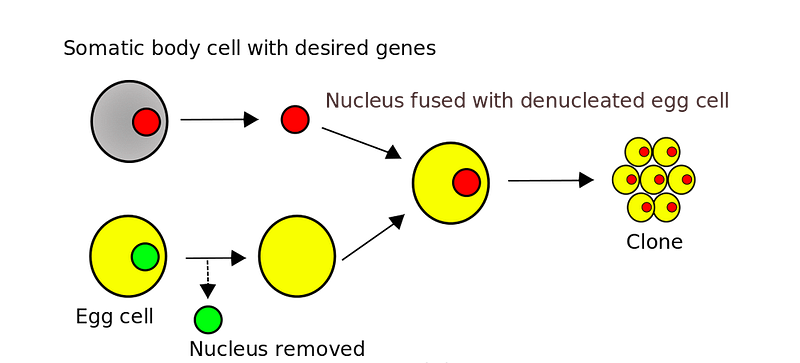
Then you put the egg cell with the donor nucleus into a surrogate host ovary and if all goes well, it develops into the animal you are trying to recreate.
This is how they tried to resurrect the Pyrenean ibex in 2003, pictured below. The tissue culture was taken from the last living, female Pyrenean ibex named Celia. The egg was taken from a goat (Capra hircus) and the nuclei removed to ensure the offspring was purely Pyrenean ibex. The egg was implanted back into a surrogate goat mother for development.
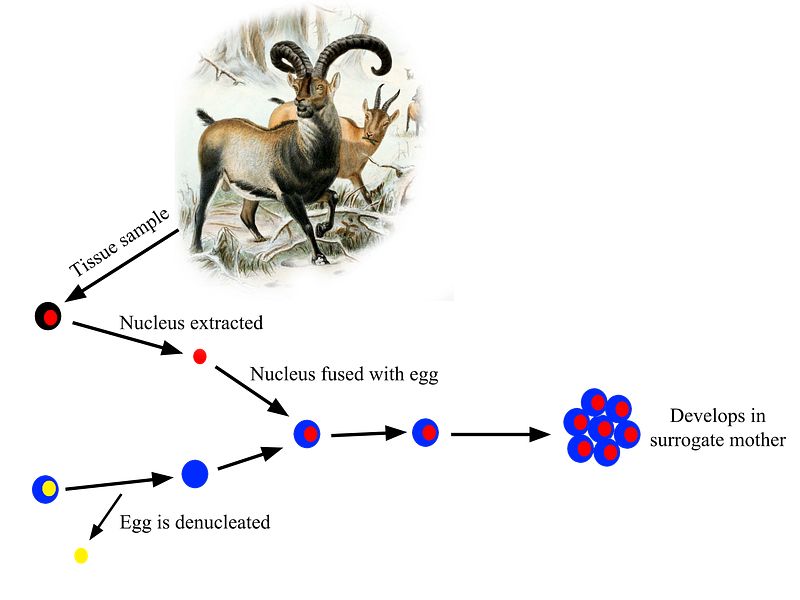
There are a couple of obstacles to overcome here. First, you need a preserved cell that can donate a fully intact nucleus. So if you’re trying to revive a species, the highest rates of success will come from those that were more recently lost as their cells will be less degraded. The Pyrenean ibex, Celia, was the last living member of this species.
In 1999, a sample of tissue from her ear was taken and stored. She died in 2000 after being crushed by a falling tree. In 2003, the cloning technique was used and 208 surrogate goats were impregnated. Only one came to term and that baby only lived for 7 minutes after being born because of a lung defect that prevented it from breathing. Still, this was considered the first triumph for de-extinction cloning as the baby was brought to term and birthed alive.
Another obstacle is immune rejection. As you know from medical science, transplanting tissue from one person to another can result in the host’s immune system rejecting the donor’s tissue and it’s no different in other mammals and creatures. There are ways to overcome this but that requires knowing a lot about the immune system of the animals involved.
And how much do we know about the immune systems of animals that have become extinct? In the case of the ibex, only one out of 208 implants was successful. Were the other 207 failures due to immune rejection? That’s still an unknown. As of 2013, there were still plans to use Celia’s nuclei to continue this effort.
An aside about this ibex. Celia is a female. That means that any cloning using her nuclei will only yield females. As there is no known preserved male Pyrenean ibex tissue, any clones that live and reach a fertile stage will have no resurrected males to breed with. So closely related species may be used which means that successful pregnancies will only yield closely related hybrids. There are back-breeding strategies that may come close to recovering a mostly Pyrenean ibex over many generations but still, it's something to think about.Third, there are ethical issues. Many people object to using cloning techniques in animals as they are now genetically modified organisms or GMOs as they’re commonly referred to.
Which brings us to the next de-extinction method, gene editing, which also yields GMOs.
Gene editing
To describe the scientific details of gene-editing techniques is beyond the scope of this article so I’ll keep it relatively simple.
The main advantage of employing gene editing is that well-preserved cells and tissue are not required. If there is enough material to obtain sufficient DNA from the extinct organism, then sequencing it will provide a reasonably accurate assembly of the creature's genome.
If you have the genome, there are modern biochemical techniques that will let you edit specific parts of a closely related genome to change the sequence to more accurately resemble the one you desire.
Kind of mind-boggling isn’t it?!
So let’s go back to the Pyrenean ibex again. If there were a very closely related species of ibex, and we knew the sequence of the Pyrenean’s genome, then we could use this technique to take nuclei from the related species and alter its DNA to the Pyreanean’s sequence in egg and sperm cells.
Then you can fertilize those eggs outside of the host mother and implant them as in the cloning experiments. Hopefully, this would yield a mostly Pyrenean ibex baby from the closely related ibex. And voila, de-extinction. And if it’s a male that can breed with females recovered from Celia, now we’re talking!
Selective breeding
The form of selective breeding most often used to recover extinct or lost traits is called back breeding. The object here is to breed current related species and select for individuals that exhibit older or ancient characteristics. You have to do this many times for the extinct traits and creature to become common again. For this to happen, several conditions must exist.
The gene or genes for this characteristic must still be present at some low level in the population of a closely related species. The gene(s) must be functional and not mutated. If so, this may recover the particular characteristic you want from the ancient creature but you only get the one characteristic, not a fully recovered extinct creature.
Let’s imagine for a moment that in some modern elephants, there are still some animals that are hairier or “woollier” than other elephants. So they have the gene for woolly that was present in the extinct woolly mammoth. And let’s say we cross-breed a bunch of the hairier elephants and after a few generations, we have elephants that look a lot like woolly mammoths.
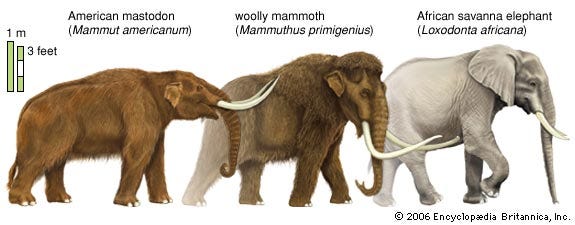
Are they woolly mammoths? Well, not really. They would just be really hairy modern elephants. They would still be missing many portions of the original woolly mammoth genomes.
Is there another way this could be accomplished? It turns out that there is and it’s a combination of gene-editing and cloning to produce hybrids of extinct and living animals.
Let’s go back to the woolly mammoth, the animal that Harvard professor George Church is attempting to restore. Church wants to create a woolly mammoth-elephant hybrid and here’s how he plans to do it.
A fully intact young female woolly mammoth that died about 42,000 years ago was recovered from thawing ice in Siberia by reindeer herders.
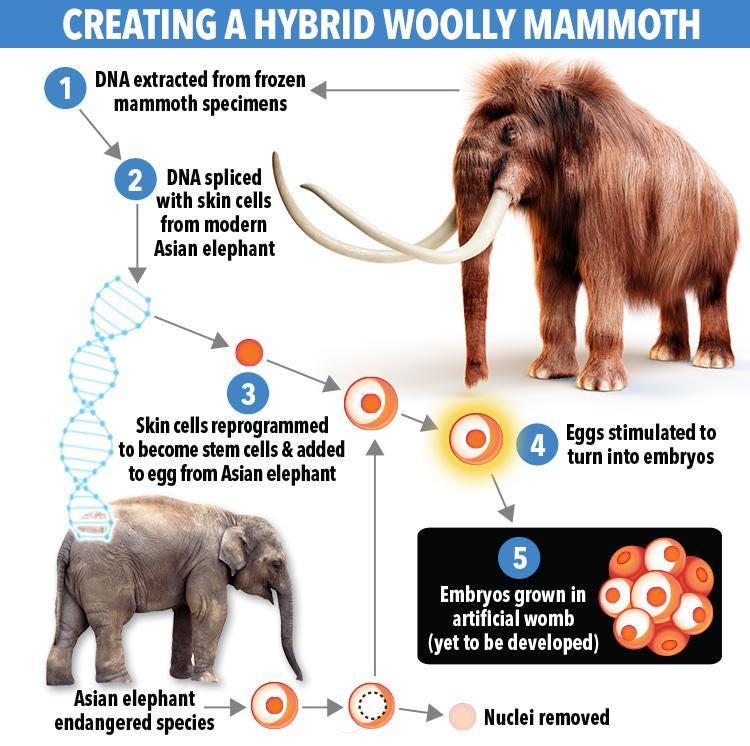
Church’s plan is to (1) take DNA from her cells and (2) use a modern gene-editing technique called CRISPR/cas9 to put it into the genome of skin cells of a modern Asian elephant. Then (3) the gene-edited skin cells will be treated to turn them into stem cells, their nuclei removed and put into Asian elephant egg cells whose nuclei have been removed. The eggs with the transferred nuclei (4) will be stimulated to produce embryos with hybrid mammoth-elephant genomes and then (5) grown in artificial wombs.
That‘s a quick overview of the scientific technology currently being used for reviving extinct species.
De-extinction ethical considerations
I’m going to stay away from any religious or spiritual considerations and just look at some of the pros and cons of de-extincting a plant or animal.
One of the arguments in favour of de-extinction has to do with the reason for the plant or animal going extinct. If humans were directly responsible for its disappearance, then one line of thought suggests that we need to morally set things right again by bringing it back if we can and it has a reasonable chance to thrive and multiply.
Some of the human-caused reasons for extinction include altering environments due to extracting resources for economic prosperity, overhunting for food, pleasure or profit, and altering environments due to climate change.
A little known example of humans altering the environment is the story of the hau kuahiwi, the mountain hibiscus that inhabited the dry lava fields of volcanoes in Haleakalā on Maui. The last known tree died about 1912 and hadn’t reproduced in the years prior to that. That’s because the lava fields had been essentially destroyed by colonial cattle ranches which substantially altered the structure and composition of the lava fields. Any seeds that the hibiscus had produced were eaten by rats and the cattle rubbed up against the rough bark to “scratch” themselves, which ended up stripping the bark from the trees, thereby killing them.
In 1912, the botanist that “discovered” and named this tree a few years earlier returned and collected its last flower, some twigs and leaves. These were added to Harvard’s herbarium collection and there it sat until it was recently “rediscovered”.
And as fortune would have it, scientists were able to recover and sequence DNA from this specimen. More about that later.
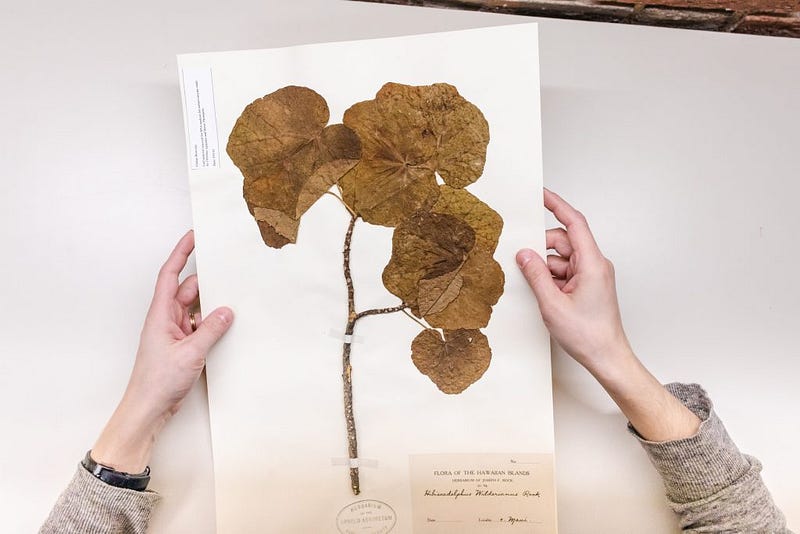
So if you did resurrect this tree, where would it live? Would it be able to thrive and expand its population to become self-sustainable or would humans have to continually monitor it, help pollinate it. It’s not likely that the cattle ranchers are going to voluntarily give up their ranches to help a few “worthless” trees to survive.
Can you ask people to take land that is economically productive and let it return to its natural state so you can try to re-establish a plant that went extinct more than a century ago? With no guarantee that the venture will be successful?
Or what if you brought a creature back and it was so successful it became an invasive species. Think rabbits in Australia or kudzu weed in the Southern USA.
These are not easy questions to answer. And there are many more. I’m sure you can come up with a few yourself.
Ok. What about the Passenger Pigeon and the Woolly Mammoth?
These are two animals that scientists think are worth recovering. Why is that?
As noted above, Dr. Church would like to recover the Woolly Mammoth. He contends that it will help us combat the effects of climate change and help restore the arctic tundra. This is the scenario he is predicting.
Since Woolly Mammoths are grazers, they would remove a lot of vegetation that has begun growing on the tundra. The vegetation has grown because it is a bit warmer due to climate change but also because it is not currently being grazed by any other animals. And the vegetation serves as an insulating barrier that helps prevent the snow beneath from freezing.
If the Woolly Mammoth grazes on it, the patches would have their “insulation” removed and be more exposed to arctic cold and would freeze. Thus the Mammoths would thrive and at the same time, help to restore the arctic tundra environment to its former condition.
And the Passenger Pigeon?
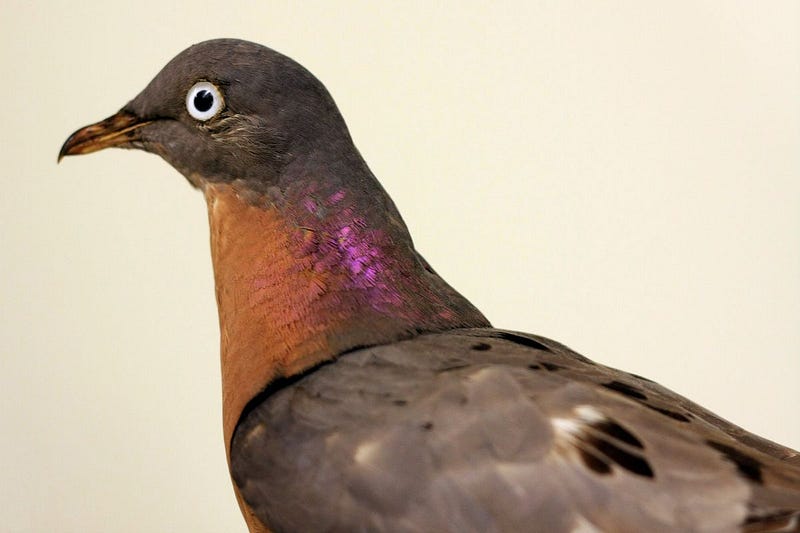
Their extinction is a story that many North Americans are familiar with. Passenger pigeons used to number in the billions and they were the most abundant bird in North America. When their flocks flew over an area during migrations the skies would actually darken there were so many birds.
A combination of factors led to their ultimate extinction. In the mid to late 1800s, they were aggressively hunted for many decades to supply a commercial source of cheap meat. This lowered the breeding population.
"...human hunters... used nets, guns, fire, and even toxic fumes to kill tens of thousands of birds in a single day. Some individual hunters shipped millions of birds each year to East Coast cities, selling them for as little as a penny per bird. They were most commonly eaten in pigeon pie."
And the forests that they lived in were cut down. Their main sources of food were beechnuts, acorns, chestnuts, seeds and berries, along with worms and insects in the spring and summer. With deforestation, the environment they inhabited was drastically reduced.
When the wild populations had virtually disappeared, there were attempts to breed them in captivity but these failed.
So why do we think we can bring them back now? Does passenger pigeon de-extinction have a real chance of succeeding? And what stands in the way of success?
Scientist Ben Novak thinks so.
Novak’s plan is to take passenger pigeon DNA from museum specimens and add back in any missing pieces of DNA taken from a closely related species, the band-tailed pigeon. Then he will use the same cloning techniques we described above but since he is taking DNA from multiple passenger pigeon specimens, the revived birds will be genetically distinct from each other and not be actual clones of a single animal.
That’s a very good thing because genetic diversity will yield a much stronger population, especially if they start breeding and reproducing.
But. There are major obstacles to overcome. Many of the forests they inhabited are still gone and the acorns and nuts they depend on to nourish themselves during the breeding season will be in short supply.
So even if they did survive and grew in numbers, the expectation is that flocks would probably number in the thousands, not the millions or billions as in former times. And they would still be susceptible to predation, another common cause of their deaths in the past.
But Novak and Revive and Restore think there is a good chance for success.
You can hear what Novak has to say about these plans in his TedX DeExtinction Talk, which I highly recommend! (it’s 15 minutes long and packs a powerful punch)
Ok. That’s two species with strong public appeal, the Woolly Mammoth and the Passenger Pigeon, both with a strong potential for a successful revival.
What’s happening with the hau kuahiwi mountain hibiscus?
There is no effort to try to restore this plant. What they are doing is rescuing specific genes. And what genes are those?
Odour genes.
It turns out that Gingko Bioworks, a company that designs and produces custom organisms, is always on the lookout for new scents for the fragrance industry and they were curious if they could recover the scent of the mountain hibiscus.
So they were given permission to remove a small piece of the herbarium specimen to use for DNA isolation and sequencing.
How they finally managed to recover and sequence this DNA is a story in itself and if you’d like to read more about it, check out this article.
Ok, back to recovering the scent. Once they extracted its DNA they looked for genes likely to produce scent molecules.
They identified 11 possible scent genes from the hau kuahiwi.

Then they used a modern DNA printer, made synthetic copies of those genes, and inserted them into specially engineered strains of brewer’s yeast. Yup, that’s the same yeast that makes beer and other wonderful things for us.
So what did they smell like?
“Some samples had flashes of citrus or thyme. All had a woody core of bark and juniper that must have been the essence of hau kuahiwi. “I like the lightness,” …“It feels ethereal.”
Lurking in the background of several samples was a smoky hint of sulfurous dirt…eyes twinkled as he held one under his nose. “This is pretty magical, to be honest”.
As this was Gingko’s first recovered fragrance, it established the protocol and benchmark for recovering other lost essences.
They were subsequently able to recover fragrances from two other extinct plants; Falls-of-the-Ohio scurfpea, a legume that grew only on a few rocky islets in the Ohio River that were drowned by dams in the 1920s, and the Wynberg conebush — a five-foot-tall flower with white petals and a yellow head that grew in the granite hills above Cape Town and disappeared in 1806.
Maybe someday, we can de-extinct these and additional plants and animals as our knowledge and bioengineering technology improve.
But even if we don’t there’s good reason to be optimistic because even if we don’t recover a whole organism, we can still resurrect important genes, organs and biochemicals. And who knows what benefits they might yield in the future?
I, for one, am looking forward to seeing what de-extinction efforts bring us in the future!
Until next time, happy exploring!
Rich
Hey! If you enjoyed this article subscribe to my newsletter and get a free ebook.
P.S. I wrote the whole article without ever once mentioning the movie Jurassic Park like so many of my source articles!
Sources for this article:
- Fragrant Genes of Extinct Flowers Have Been Brought Back to Life by Rowan Jacobsen.
- 100 years ago, the very last passenger pigeon died by Joseph Stromberg.
- The Revival of the Passenger Pigeon? by Sarah Pruitt.
- Scent of Extinct Maui Mountain Hibiscus Revived by Science by Wendy Osher
- Woolly mammoths could come back to life and SAVE the Arctic by Phoebe Weston
- List of animals that have been cloned, Wikipedia
- Passenger Pigeon, Wikipedia
- De-extinction, Wikipedia
- Pathways to de‐extinction: how close can we get to resurrection of an extinct species? by Beth Shapiro
- Ancient DNA Calling Out for “De-Extinction” — How far can or should we go? by F. Javier Carmona


