
Can We Reach Other Universes?
Navigating the Hypothetical Multiverse

If you’re a Marvel fan like me, you probably caught the first trailer for WandaVision, an upcoming TV series that will follow the relationship between Scarlet Witch and a newly resurrected Vision. Many fans expect Vision to have returned as part of a pocket universe created by Scarlet Witch to cope with the pain of losing him in Infinity War. If you’re not a Marvel fan, odds are none of that made sense to you. However, all you need to know is that WandaVision is expected to be the latest sci-fi story to employ the concept of multiple universes, a.k.a. the multiverse.
The multiverse is a fun storytelling device for writers, but it’s also a concept taken very seriously by theoretical and experimental physicists. You’ve probably heard of at least one multiverse hypothesis, but there are actually quite a few. Most of these hypotheses aren’t mutually exclusive, so we may currently exist in more than one type of multiverse. However, science demands that a hypothesis have experimental evidence before it can be considered a full-fledged theory. To that end, we’re left to ask if it’s at all possible to detect the existence of another universe. If so, could we ever go there? To answer these questions, we need to look at several multiverse ideas and their testable predictions.
The Quilted Multiverse
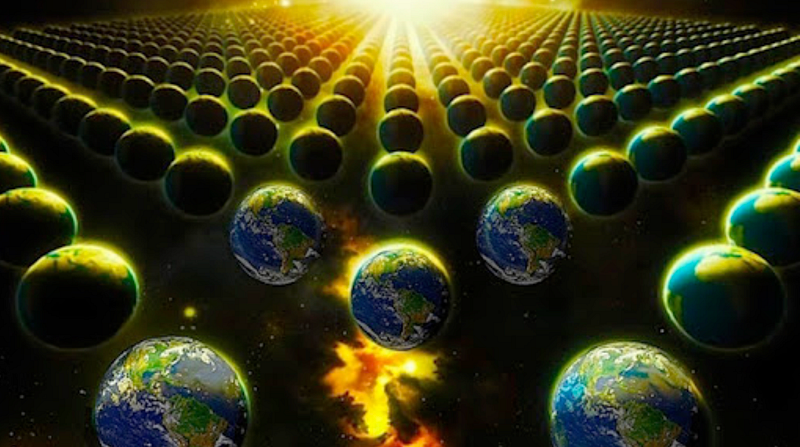
The Quilted Multiverse is the most straightforward hypothesis as it arguably doesn’t introduce multiple universes at all. Rather, this concept predicts that in an infinite universe, every possible arrangement of matter and energy will occur somewhere. This includes an infinite number of Earths, an infinite number of human civilizations, and infinite versions of you. We’d expect this to occur in an infinite universe because of the Infinite Monkey Theorem, which states that an infinite number of monkeys typing randomly on keyboards will eventually type out the complete works of Shakespeare infinite times. No, seriously. The logic behind that thought experiment is that with enough opportunities, any incredibly unlikely event should happen so long as it has a probability greater than zero. Given infinite opportunities, all possible events will occur with infinite repetition. It stands to reason that in an infinite universe, every possible combination of particles will exist in some region of space and repeat infinitely as well. The starting conditions of any region of spacetime is determined by fundamentally random quantum processes, so the starting conditions for any arbitrarily unlikely arrangement of matter and energy should repeat infinite times through an infinite universe.
This concept is referred to as a multiverse because an infinite universe would contain an infinite number of observable universes. We refer to the observable universe as everything in the universe whose light has had time to reach us. However, the universe is almost certainly larger than just what we can see. According to general relativity, the universe can have three types of overall curvature: positive, negative and flat. Out of the three, only positive curvature produces a universe of finite size. Most measurements of the cosmic microwave background and the density of matter and energy in the universe suggest that our universe is geometrically flat, and therefore infinite. This conclusion combined with the laws of quantum physics suggest that the Quilted Multiverse should exist. Of course, the universe may have a slight positive curvature within the margin of error of cosmologists’ measurements, and therefore it may be finite. Recent measurements of the CMB by the Planck telescope actually suggest that this is the case, yet these measurements themselves may have contained significant errors. It may also be invalid to extrapolate the laws of physics we experience in our section of the universe out to infinite spacetime. Regardless, the Quilted Multiverse idea is still firmly set in our current best picture of reality. We can even calculate how much space we’d have to search through before we’d expect to see at least one copy of the Earth using the Bekenstein Bound, which gives the maximum number of configurations any region of space can have.
You check out this video by PBS Spacetime to learn more about the Quilted Multiverse and to be sure I didn’t just make up that monkey example:
Even if the universe is infinite, we may never know because we’ll likely never be able to travel an infinite distance in finite time. We could attempt to travel just far enough that we run into alternate versions of ourselves, but that may be just as impossibe. First of all, the universe is constantly getting bigger. At the largest scales, its expansion pulls galaxies apart faster than the light can travel between them. The boundary past which light coming from our region of spacetime can never travel is known as the Particle Horizon. Since nothing we know of can travel faster than light, we may never be able to pass that barrier. Some ancient light from beyond the Particle Horizon may still reach us, but there’s a boundary from beyond which even ancient light can’t be seen called the Cosmic Event Horizon. In theory, we could pass these barriers by traveling many times faster than light, which could hypothetically be achieved by altering the topology of spacetime. But even if we discover a way to do so, the energy requirements to travel the insanely long distances we’d need to explore before finding our cosmic doppelgängers would probably be unattainable. Alternatively, we could wait for one of those doppelgängers to come find us, but they’d run into the exact same problem.
You can get a better idea of the limits of even hypothetical space travel from this video:
So unless we manage to travel at truly ludicrous speeds or develop infinite patience, we’ll probably never see direct confirmation of the Quilted Multiverse.
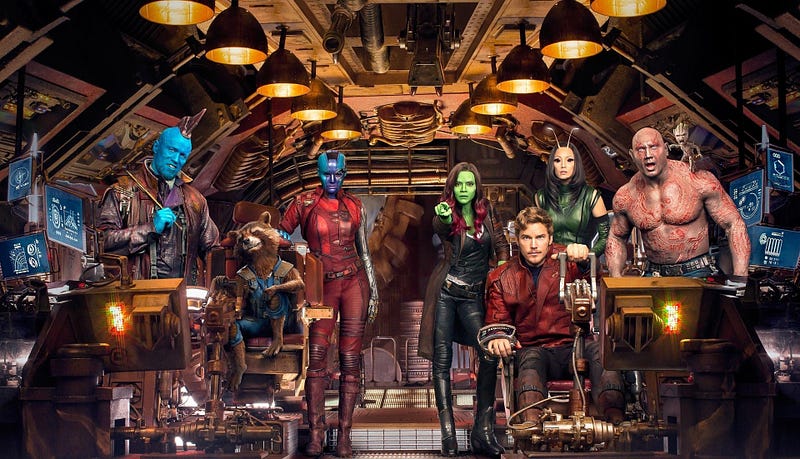
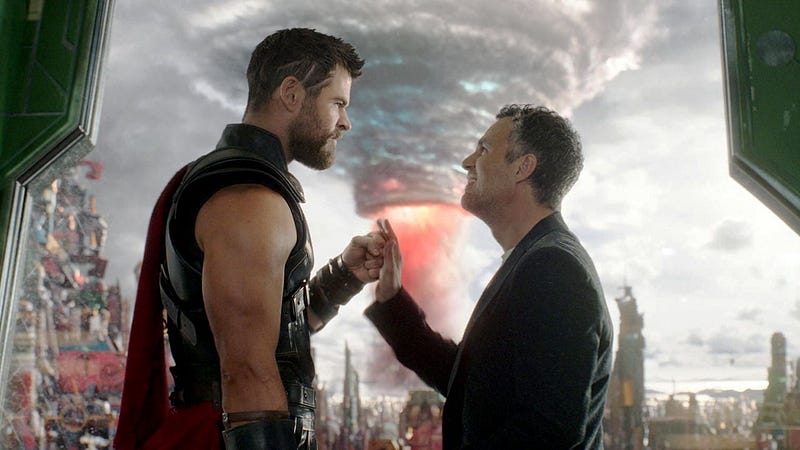
The Quilted Multiverse doesn’t seem to be the most common example of a multiverse from pop culture, but it may actually be hiding in countless sci-fi stories. In franchises like Doctor Who and the Marvel Cinematic Universe, aliens often look exactly like humans despite evolving on completely separate planets. One explanation for this is that in a large enough universe, you’d eventually expect to see species that just happen to look similar. You’d also expect to see regions of this universe where look-alike species just happen to be close enough to interact with one another. Those regions can be thought of as the ones where these types of sci-fi stories take place.
The Inflationary Multiverse
The Inflationary Multiverse is a byproduct of the theory of cosmic inflation. Cosmic inflation is the idea that all of spacetime was expanding at a much higher rate before the region that would become our universe slowed down enough to cool and form galaxies. This expansion is different from the Hubble expansion of the universe caused by dark energy, and the transition from inflation to dark energy presumably happened as a result of the energy density of space(a.k.a. the vacuum energy) dropping dramatically during the Big Bang. You can learn more about how and why that event may have happened from the video above. Most cosmologists expect some version of cosmic inflation to be true, which has major implications for the existence of other universes. If our universe was just one region of spacetime that stopped inflating, then there could very well have been many other regions that did the same. Each of these regions will have evolved into an independent universe, usually referred to as bubble universes. A good example of a bubble universe from science fiction is in the episode of Doctor Who titled The Doctor’s Wife.
These bubble universes might have undergone different changes in vacuum energy and evolved under different physical constants. Therefore, they may all have different laws of physics. However, if the inflating spacetime that spawned these universes is infinite, then eventually you’d expect to see infinite repetitions of the same physical conditions like in the Quilted Multiverse. Regardless, we shouldn’t expect to be anywhere near other bubble universes that can support life as we know it. Additionally, the space between these universes and us would be constantly inflating. Any two universes that are close to one another at one point in time will be unthinkably far apart the next instant.
Nevertheless, bubble universes can still collide with one another. For example, a new universe might form right next to the edge of our universe. In which case, the two may still be expanding fast enough for their edges to overlap very briefly. Observations of the cosmic microwave background show that this may have already happened to our universe shortly after the Big Bang.
However, if another universe were to begin forming right on the boundary of our own today, we’d likely never see it. That’s because of what we mean by the edge of the universe. We don’t mean the edge of the observable universe caused by the finite speed of light. We instead mean the edge to the whole universe, including the parts too distant to see. At first it may seem like this model of a multiverse only works if each universe is finite in size. After all, an infinite universe wouldn’t have an edge beyond which other bubble universes could be found, right? Actually, no. It is possible for a universe to have an infinite volume but be contained within a finite edge.
As it turns out, the nature of quantum fields can be determined at an infinite distance away from some starting location. Solving the formulas of quantum field theory at that distance allows you to determine the quantum fields behavior at the 2D boundary surrounding an infinite volume. Mathematically, you can fit an infinite volume within the bounds of a finite 2D edge using tessellation and hyperbolic geometry, which you can learn about from the video above. Doing so allows you to fully describe an infinite universe by examining its finite edge. The holographic principle supports this concept. It states that all the information about a 3D region of space can be encoded upon a 2D surface surrounding that region. This fact was discovered by physicists like Stephen Hawking and Jacob Bekenstein as they studied the thermodynamics of black holes.
According to the holographic principle, an infinite universe contained within a finite edge may be physically valid. All its information can be described on the surface of its finite edge. In his book The Hidden Reality, Brian Greene describes bubble universes similarly. He claims that an individual bubble universe may look finite from the outside but infinite on the inside. Therefore, their boundaries can still collide. Of course, bubble universes could also be finite in size. The point here is that the internal size of bubble universes isn’t what makes or breaks the validity of cosmic inflation.
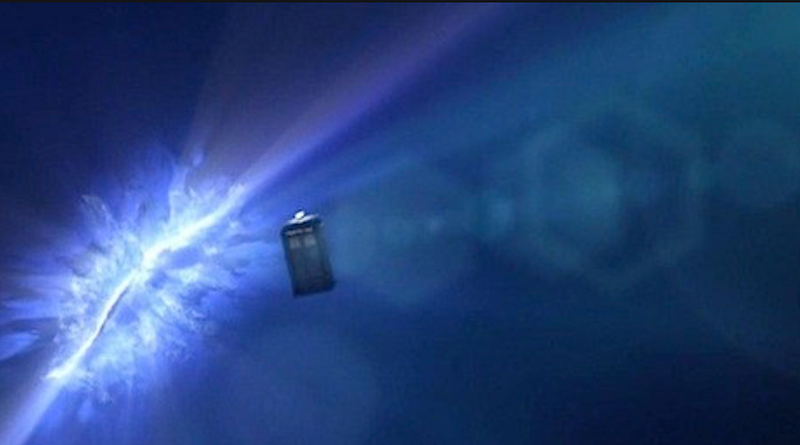
So the inflationary multiverse could very well exist, and we can search for evidence of it in the cosmic microwave background. But could we ever visit another one of these bubble universes? Trying to reach one by traveling a great distance leads us to a similar issue as with the Quilted Multiverse. If bubble universes are finite, they’d still be unthinkably large and expanding so fast not even light could cross them. And even a faster-than-light object capable of overtaking the expansion within a bubble universe might not be fast enough to overcome the exponentially increased expansion occurring between bubble universes.
An alternative approach would be traveling back in time to before our universe’s spacetime stopped inflating. At that point in time, the nearest bubble universes would have been much closer and could be reached while traveling at much slower speeds. In fact, the nature of inflation means that any two points in the inflationary multiverse can be found arbitrarily close together by rewinding time. Of course, you’d still need to navigate with insanely accurate timing or else you’ll find yourself at a moment in time where space was far too compact or expansive and miss the window where your desired bubble universe was in reach.
There are a myriad of different hypothetical ways to travel backwards in time, but the simplest is to warp the fabric of spacetime and move faster than light. The video below explains how faster-than-light travel is equivalent to backwards time travel:
Warping the extremely dense, exponentially expanding spacetime from the time period before the Big Bang would be insanely difficult, perhaps even impossible. Altering the topology of spacetime may be impossible in and of itself. Therefore, exploring the Inflationary Multiverse won’t be feasible anytime soon, except via cosmology.
The Black Hole Multiverse
The Black Hole Multiverse comes from the hypothesis that black holes lead to new universes. If that hypothesis is correct, it could explain why information about matter falling into a black hole seems to disappear from our universe. The first place we see this idea manifest is in the Penrose diagram. That’s a graph of space and time that encompasses infinite space in all directions and all of time from an infinite past to an infinite future. The diagram also includes an eternal Schwarzschild black hole and an eternal white hole, a region of outflowing spacetime that nothing moving at light speed or slower can ever enter. Eternal black and white holes are ones that have existed since the infinite past and will exist into the infinite future. For reasons explained in the video above, the existence of these objects would suggest another universe that can be reached by plunging towards the black hole singularity faster than light. However, eternal black holes almost certainly don’t exist. Instead of entering another universe, it’s more likely plunging into a real black hole at faster than light speed would cause you to exit another event horizon somewhere else in our universe.
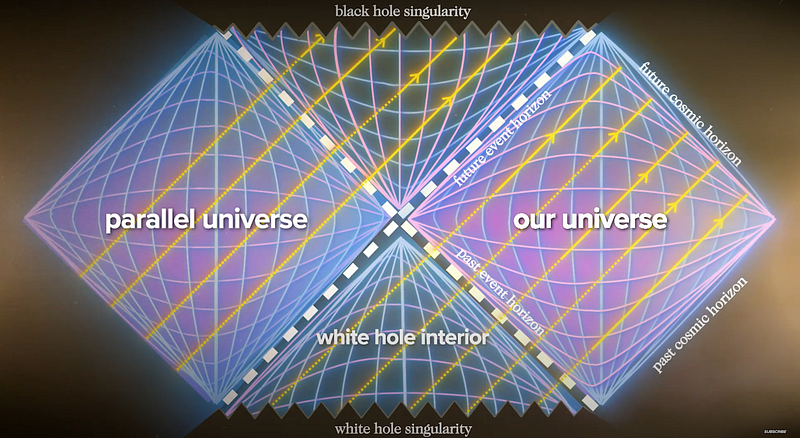
However, non-eternal Schwarzschild black holes likely don’t exist either because of the conservation of angular momentum. The conservation of angular momentum dictates that the momentum inherent to a rotating or revolving object cannot just disappear. For black holes, this means they must have an angular momentum equal to the overall angular momentum of all the matter that has ever fallen into them, including the matter that initially formed them. Therefore, we should expect all black holes in our universe to spin. This fact is significant to our discussion because the physics of a spinning black hole, also known as a Kerr black hole, are very different from that of a non-spinning Schwarzschild black hole. Most interestingly for our purposes, Kerr black holes may be legitimate gateways to other universes.
In a Kerr black hole, the central singularity becomes a ring of infinite density sometimes called a ringularity. There exists a region around that ring where the outward pressure caused by the black hole’s spin counteracts the inwards flow of spacetime. This process is analogous to how centrifugal force pulls you outwards on a merry-go-round. This weird region of the Kerr black hole is below what’s called the inner event horizon, where the outwards pressure from the black hole’s spin balances out the inwards flow of spacetime. Within this region, it’s possible for objects to stop falling towards the ringularity. Attempting to pass through the ringularity anyway subjects objects to an immense anti-gravitational force that works to force them back outwards. However, an incredibly fast moving object could overcome this antigravity and push through the ringularity. In the case of an object passing through the ringularity, it enters a new region of spacetime where the only part of the Kerr black hole still visible is the ringularity. Here, spacetime is spun around fast enough to allow faster-than-light travel. You can use this immense speed to travel to travel back into your own past before passing through the ring. I should note that the causality breaking nature of this region suggests that it can’t actually exist, and there are ways to avoid invoking it in the math of general relativity.
Regardless, exiting this even weirder region of spacetime ejects you from the inner event horizon into a hypothetical white hole, and this white hole releases you into a new universe. Voilà! We’ve just navigated the multiverse, right? Not so fast. Even if Kerr black holes do connect different universes, they’re likely impossible to traverse in this way. That’s because below the inner event horizon there exist two regions of spacetime where time flows in opposite directions. For reasons explained in the video above, these contrasting flows create a bath of energy comparable to the Big Bang whenever matter is present below the inner event horizon. This runaway energy effect probably causes the passageway to another universe to collapse before it ever existed in the first place. And even if you could reach this other universe, you wouldn’t be able to return to the universe you started in. That’s because the white hole exit is instantly replaced by another black hole once you leave it. This new black hole leads to yet another parallel universe. Anyway you slice it, the dive into a Kerr black hole is a one way trip.
Another possibility for a Black Hole Multiverse is that black holes actually create new universes.
More specifically, spacetime collapsing towards the central singularity of a black hole may rebound and expand to form a new universe. If black holes did create new universes, we’d expect to find ourselves in a universe with physical constants fine tuned to produce as many black holes as possible. That’s assuming that each new universe has very similar physical constants to its parent universe, but not exactly the same ones. Most universes would have been born from parent universes that are the best at producing black holes, and therefore best at producing new universes. Therefore, most universes would have inherited the physical constants for maximum black hole formation.
Our universe has plenty of black holes, but we can imagine alternate universes that would be even better at producing them. For example, a universe that quickly expanded to be much larger than our own(assuming that universes are finite) would have a greater chance of forming black holes from random quantum fluctuations. That’s for the same region an infinite universe would produce every possible configuration of matter: even unlikely events like spontaneous black hole formation increase in likelihood as the space they could occur in also increases. Our universe didn’t expand fast enough to have a high likelihood of immediately producing these spontaneous black holes, which means we don’t live in one of the more typical universes we’d expect to if black holes created new universes. That alone doesn’t rule out this idea, but it also means that we don’t have any significant observational evidence for it. And even if black holes did create new universes, we’d likely run into a lot of the same issues we discussed earlier when trying to use them as passages between those universes.
Finally, there could be very large black holes out there with just the right conditions for hospitable universes to form inside them. If so, someone outside of one of those black holes could enter its interior universe by crossing the event horizon. If that person had access to faster than light travel, they could also cross the horizon in the opposite direction for a return trip. They might even discover that they exist within an infinitely nested set of habitable black holes within habitable black holes.
We’ve now examined four proposed versions of the Black Hole Multiverse, and none of them have given us much reason to believe it exists. Even if it did, the warping of spacetime necessary to explore this type of multiverse would likely be extraordinarily, if not impossibly, difficult.
The Quantum Multiverse
I’ve talked a lot about the Many-Worlds interpretation of quantum mechanics across this blog. Its version of the multiverse is probably the most famous. Essentially, the MWI claims that every possible outcome of an event happens in its own version of reality. Since the universe is one colossal quantum system, it should have countless possible histories that correspond to countless parallel realities. If you think of each of these realities as an individual universe, the system they emerge from can be thought of as a multiverse. The MWI isn’t without its detractors, but it does seem to get around a lot of the problems plaguing other interpretations of quantum mechanics.
One potential issue of Many-Worlds is that it might prevent the emergence of conscious beings. If the universe is split into multiple timelines whenever a single quantum interaction occurs, then it would be splitting countless times in-between every firing of the neurons in a human brain. Therefore, no one timeline would exist long enough before splitting for the neural activity responsible for conscious awareness to occur. If consciousness did somehow snake along just one possible timeline, it would imply consciousness is some physical thing that can exist without continuous neural activity. This notion goes against the more plausible idea that consciousness is an emergent property created by patterns of neural activity in the brain.

I see two resolutions to this issue. The first is that consciousness doesn’t snake along just one timeline and instead splits to fill all of them. For each version of reality, i.e. each chain of particle interactions and subsequent pattern of firing synapses, a new consciousness emerges similar yet noticeably distinct from those in other timelines. The second is that consciousness is an emergent property across multiple timelines. The splitting of timelines doesn’t split consciousness, rather it superimposes it. In the double slit experiment, we think of an unobserved particle as traveling through two slits at once. That corresponds to two different histories. However, the particle wasn’t duplicated. It just existed in a superposition of two different states. It was still one particle, even though it acted like two. The same concept applies to any physical system, including the brain. It exists in a superposition of every possible history at once. Under this interpretation, the versions of you in alternate timelines aren’t separate individuals. They’re just different slices of the same being.
The reason we don’t experience each of our histories is likely due to decoherence. That’s the physical process where information about all the possible states of a system becomes harder to fully gather the more complex and massive the system gets. On the scale of human brains, so much information becomes hopelessly diluted among all the particles that only the information consistent with the greatest number of timelines is retainable. You can think of the initial superposition of states as a blurry picture that your brain can only sort of make out. In theory, measuring the quantum states of all the particles in your environment would allow you to improve the resolution of that image and see more than one of the timelines you exist in.

In quantum physics, it’s actually possible for these separate histories of a particle to interact with one another. That’s what causes the interference pattern from the double slit experiment. This implies contact with the other versions of reality may indeed be possible. As I mentioned above, the collapse of the wavefunction wouldn’t happen from your perspective if you gathered enough information about the quantum states of particles in a system. You could see more branches of the overall wavefunction of your environment. I think that’s exactly how travel to a parallel world in the quantum multiverse would be achieved.
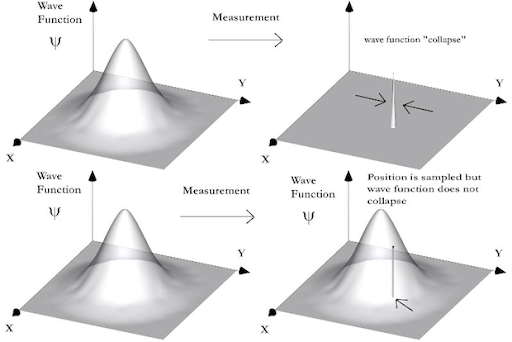
However, eliminating decoherence only lets you see more possible timelines. To choose a specific one to experience, you’d need to shift the probability distribution of different events. Then, an effect known as einselection would take place, where the version of reality experienced on the macroscale can be thought of as the sum of interactions between all possible versions of reality. That einselected reality would be determined by the relative positions and properties of all the particles in the environment. No individual particle has a well defined set of properties, but together they manifest macroscopic properties that match whatever history in their collective wavefunction best fits with all of their most likely states.
Changing the einselected version of reality would mean altering the wavefunction so certain histories are more likely to be observed than others. Those histories would be einselected and manifest on the macroscale. You can achieve this effect by introducing new elements to your environment that change the way histories interfere with one another. In the case of the double slit experiment, you can change the placement of the slits. But as you can imagine, it’s going to be much harder to alter the interference patterns that create our entire reality.
You’d need an incredible amount of precision and energy to create all the necessary starting conditions for your environment’s wavefunction to evolve in an unusual way. The best example of this type of multiversal travel comes(unofficially) from the show Stranger Things. In the show, a girl named Eleven possesses powerful telekinesis. If she could use her powers to take very precise measurements of her environment, she’d be able to see more than one version of reality at the same time. In fact, that’s exactly what we see her do when she makes contact with the Upside Down.
She also opens gateways to this world, which I take to mean she’s provided the physical conditions for both versions of reality to have a nearly equal chance of being observed on the macroscopic scale. She puts the environment around her into a permanent superposition of existing as Hawkins, Indiana and the Upside Down. When the state of one system depends on the state of the other, they’re entangled. In Stranger Things, Eleven is entangled to her environment, including all the conscious beings around her like people and demigorgons. That’s what allows them to experience both the Hawkins and Upside Down versions of reality. It’s also what allows these realities to interact with one another in a way they otherwise wouldn’t. Scarlett Witch is probably causing something very similar to happen in WandaVison. She’s put her environment of a small town into a superposition of states using her ability to manipulate matter.

You could argue this isn’t truly traveling to another universe but rather rearranging your own, and you’d be right under the Copenhagen or Pilot Wave interpretations of quantum mechanics. However, the Many-Worlds interpretation suggests that all possible histories continue to exist even if they aren’t all easily visible on the macroscale. Changing your experience to be closer to one set of timelines than another doesn’t stop all timelines from existing. Think of it like changing the channel on your TV. You’ve changed which display ends up on the screen, but all the channels are still being broadcast.
So is this type of multiversal travel within reach? Well, we currently struggle to prevent the wavefunction collapse of small systems, so creating the conditions to put systems as large as towns or planets into prolonged superpositions may never be in reach. Even reading and manipulating the overall quantum state of a single person would require very advanced technology. You can find out how advanced from this post I did covering the technology of fictional civilizations:
The String Theory Multiverse
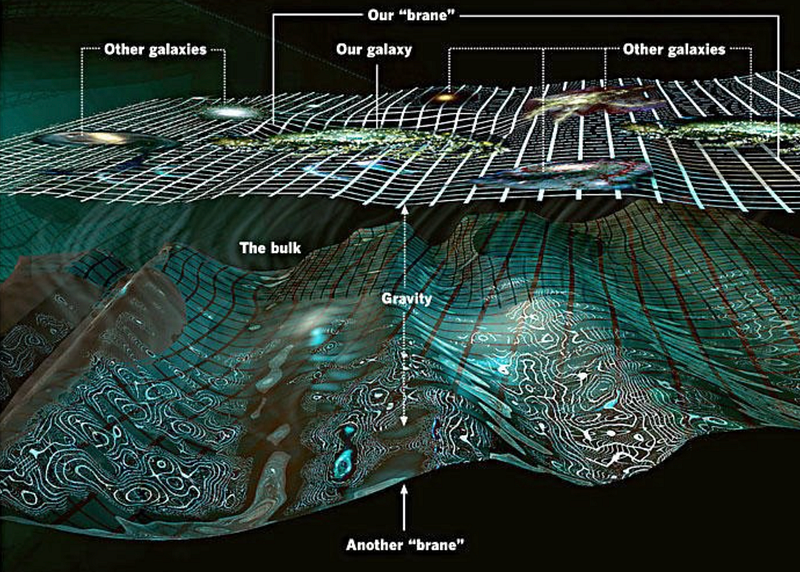
String cosmology is a branch of string theory that gives us yet another way for multiple universes to exist. It hypothesizes that the universe exists in nine dimensions of space, but only extends a great distance in the familiar three. The universe has very little distribution across the other dimensions, making it analogous to a flat plane in 3D space. It’s conceivable that other universes exist as the same type of higher dimensional structure. We call these structures branes. The space between different branes is known as the bulk, and they may be attracted to one another across the bulk by a higher dimensional form of gravity. Some string theorists hypothesize that the Big Bang was actually the result of a collision between another universe’s brane and our own.
There are a couple ways we might reach other brane universes. The first possibility is wormholes connecting the spacetime of one brane to another. Another possibility is that quantum tunneling allows matter to pop from one brane to another the same way it allows particles to pop from one side of a physical barrier to another. Both creating wormholes and controlling quantum tunneling may be possible for highly advanced civilizations, and our current civilization might be able to detect particles moving between universes via naturally occurring wormholes and quantum tunneling. However, physicists have been trying to find experimental evidence of string theory for decades. Their lack of success may be do to the incredible energy requirements for detecting the effects of incredibly minute higher dimensional structures, or it may be a sign that modern string theory is simply incorrect.
The Simulated Multiverse
Assuming consciousness can be computer-generated, it’s very possible that the world we live in is a simulation on a powerful computer. It stands to reason that an even more powerful computer would be able to simulate multiple worlds with their own intelligent civilizations. For example, a computer the size of Jupiter might be able to simulate every human life ever lived thousands of times over in less than two microseconds.
A hyper-advanced civilization may be able to go beyond planet-sized computers and construct computers on the verge of becoming black holes, which form when the information density of a region of space reaches its theoretical limit. That limit is called the Bekenstein Bound. Such a computer could go beyond simulating conscious experience and actually simulate the particles and quantum fields making up an entire universe. According to the formula for the Bekenstein Bound, a simulation of every atom in our observable universe could be performed using a spherical computer barely over 200 kilometers in diameter. Imagine how many universes could be simulated on a Bekenstein Bound computer the size of a planet.
I got the numbers above from these videos:
If our universe is one of many simulations on a giant computer, it may be the easiest multiverse to navigate. We could make contact with the beings running our simulation and ask them to upload us to other universes. Alternatively, we could learn to communicate directly with the computer generating us. One way to do this would be deciphering its programming language from the physics of our simulation. We could even learn how a simulated universe operates by creating our own. And the other simulated universes we’d travel to could operate according to different laws of physics, allowing their residents to produce other worldly technologies.
Which Type of Multiverse Could We Detect First?
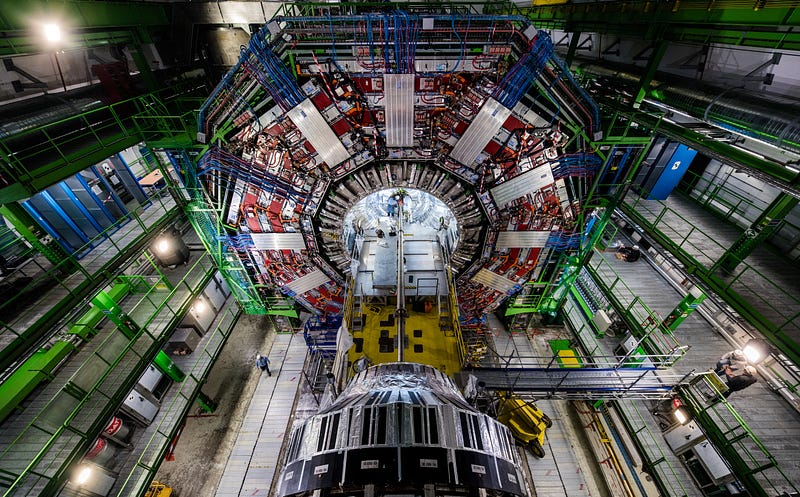
I’d say the multiverse we’re closest to finding is the one we may have already detected: the Quantum Multiverse. Quantum Field Theory is already the most experimentally supported theory in physics. Though not without its issues, the Many-Worlds interpretation does fit with the mathematics we use to describe our universe as well as the observations we’ve made of it. Next in line would probably be the Inflationary Multiverse, since evidence of that can be found from studying the night sky with our ever improving telescopes. The other types of multiverse would be hidden behind event horizons or separated in higher dimensions we can’t yet perceive. However, innovations in particle physics may reveal the existence of brane worlds or universal source code in the next few decades. Before that we may even find definitive evidence of parallel universes I didn’t mention, like those mirrored in space or reversed in time.
Which Type of Universe Could We Travel to First?
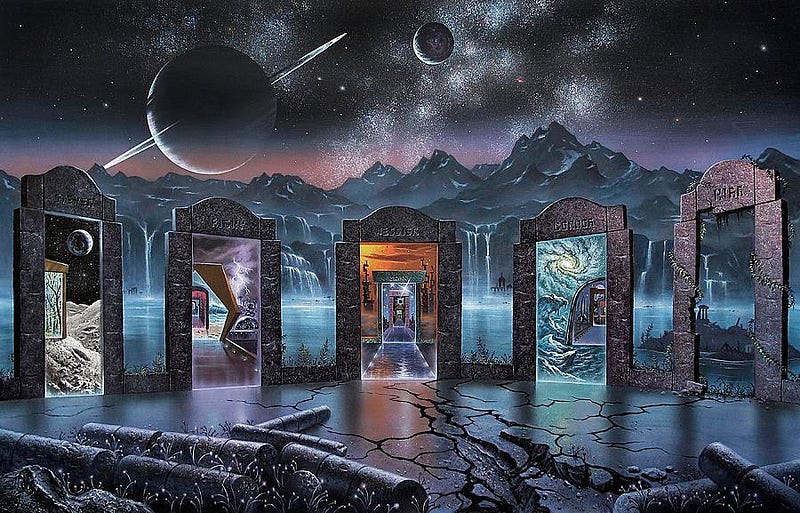
The easiest type of parallel universe to travel to would probably be a quantum one. That’s because this type of universe could be reached by probing the familiar scales of atoms and subatomic particles. We could send information between quantum universes via the same types of quantum experiments we already perform in labs. Of course, performing these transfers of information on a macroscopic scale could potentially be even harder that opening up the wormholes necessary to reach other brane universes or black hole universes. Nevertheless, it only makes sense that the first multiverse we directly observed would be the first one we learn to traverse.
Conclusion

With so many different ways for parallel universes to exist, it’d be genuinely surprising if none did. I think some version of the Quilted, Quantum and Simulated multiverse is all but guaranteed. The Inflationary Multiverse also has a sound theoretical basis. We might never be absolutely sure if any of these parallel universes exist until we set foot in one. However, we’ll likely find experimental and observational evidence for them many years in advance. Maybe we already have. Now, if we could just find some evidence of a spiderverse…

Works Cited
Greene, B. (2013). The Hidden Reality: Parallel Universes and the Deep Laws of the Cosmos. New York: Vintage Books.
Jones, A. Z., & Robbins, D. (2010). String Theory for Dummies. Hoboken, NJ: Wiley Publishing.
O’Dowd, M. (Producer). (2020, February 3). Are there Infinite Versions of You? [Video file]. Retrieved September 28, 2020, from https://www.youtube.com/watch?v=qT110-Q8PJI
Reich, H. (Producer). (2017, July 20). What Is The Shape of Space? (ft. PhD Comics) [Video file]. Retrieved September 28, 2020, from https://www.youtube.com/watch?v=oCK5oGmRtxQ
O’Dowd, M. (Producer). (2015, September 30). What Happens At The Edge Of The Universe? | Space Time | PBS Digital Studios [Video file]. Retrieved September 28, 2020, from https://www.youtube.com/watch?v=AwwIFcdUFrE
O’Dowd, M. (Producer). (2019, August 6). What Caused the Big Bang? [Video file]. Retrieved September 28, 2020, from https://www.youtube.com/watch?v=xJCX2NlhdTc
O’Dowd, M. (Producer). (2019, December 2). Is The Universe Finite? [Video file]. Retrieved September 28, 2020, from https://www.youtube.com/watch?v=F2s7vyKucis
How Close Are We to Finding a Parallel Universe? [Video file]. (2019, October 23). Retrieved September 28, 2020, from https://www.youtube.com/watch?v=EXPzFzFYRok
Ouellette, J., & Quanta Magazine moderates comments to facilitate an informed, S. (2014, November 10). Multiverse Proof Possibility From Colliding Universes. Retrieved September 28, 2020, from https://www.quantamagazine.org/multiverse-proof-possibility-from-colliding-universes-20141110/
O’Dowd, M. (Producer). (2019, April 3). The Edge of an Infinite Universe [Video file]. Retrieved September 28, 2020, from https://www.youtube.com/watch?v=tJevBNQsKtU&vl=en
O’Dowd, M. (Producer). (2019, April 10). The Holographic Universe Explained [Video file]. Retrieved September 28, 2020, from https://www.youtube.com/watch?v=klpDHn8viX8
O’Dowd, M. (Producer). (2019, July 18). Did Time Start at the Big Bang? [Video file]. Retrieved September 28, 2020, from https://www.youtube.com/watch?v=K8gV05nS7mc
Scientific American. (2003, April 07). Sidebar: The Holographic Principle. Retrieved September 28, 2020, from https://www.scientificamerican.com/article/sidebar-the-holographic-p/
O’Dowd, M. (Producer). (2017, March 22). Superluminal Time Travel + Time Warp Challenge Answer | Space Time[Video file]. Retrieved September 28, 2020, from https://www.youtube.com/watch?v=HUMGc8hEkpc
O’Dowd, M. (Producer). (2020, March 31). What’s On The Other Side Of A Black Hole? [Video file]. Retrieved September 28, 2020, from https://www.youtube.com/watch?v=T4oYvSH6jJ8&t=705s
O’Dowd, M. (Producer). (2019, December 17). Do Black Holes Create New Universes? [Video file]. Retrieved September 28, 2020, from https://www.youtube.com/watch?v=rFgpKlcpzNM
O’Dowd, M. (Producer). (2020, May 18). Mapping the Multiverse [Video file]. Retrieved September 28, 2020, from https://www.youtube.com/watch?v=4v9A9hQUcBQ
Reich, H. (Producer). (2015, January 22). What IS Angular Momentum? [Video file]. Retrieved September 28, 2020, from https://www.youtube.com/watch?v=iWSu6U0Ujs8
O’Dowd, M. (Producer). (2020, March 24). How Black Holes Spin Space Time [Video file]. Retrieved September 28, 2020, from https://www.youtube.com/watch?v=UjgGdGzDFiM
Dettmer, P. (Producer). (2018, April 22). The Black Hole Bomb and Black Hole Civilizations [Video file]. Retrieved September 28, 2020, from https://www.youtube.com/watch?v=ulCdoCfw-bY&list=LL9qZxTQ4P30wQITZQ-XY4Ng&index=488
O’Dowd, M. (Producer). (2016, October 26). The Many Worlds of the Quantum Multiverse | Space Time | PBS Digital Studios [Video file]. Retrieved September 28, 2020, from https://www.youtube.com/watch?v=dzKWfw68M5U
Muller, D. (Producer). (2020, March 6). Parallel Worlds Probably Exist. Here’s Why [Video file]. Retrieved September 28, 2020, from https://www.youtube.com/watch?v=kTXTPe3wahc
O’Dowd, M. (Producer). (2020, February 24). How Decoherence Splits The Quantum Multiverse [Video file]. Retrieved September 28, 2020, from https://www.youtube.com/watch?v=GlOwJWJWPUs
O’Dowd, M. (Producer). (2020, March 16). How Do Quantum States Manifest In The Classical World? [Video file]. Retrieved September 28, 2020, from https://www.youtube.com/watch?v=vSnq5Hs3_wI
Ball, P., & Quanta Magazine moderates comments to facilitate an informed, S. (2018, October 18). Why the Many-Worlds Interpretation of Quantum Mechanics Has Many Problems. Retrieved September 28, 2020, from https://www.quantamagazine.org/why-the-many-worlds-interpretation-of-quantum-mechanics-has-many-problems-20181018/
Hill, K. (Producer). (2016, August 11). Could Stranger Things’ “Upside Down” Really Exist? (Because Science w/ Kyle Hill) [Video file]. Retrieved September 28, 2020, from https://www.youtube.com/watch?v=R7IUd7217Xc
O’Dowd, M. (Producer). (2018, May 23). Why Quantum Information is Never Destroyed [Video file]. Retrieved September 28, 2020, from https://www.youtube.com/watch?v=HF-9Dy6iB_4
O’Dowd, M. (Producer). (2016, November 30). Pilot Wave Theory and Quantum Realism | Space Time | PBS Digital Studios [Video file]. Retrieved September 28, 2020, from https://www.youtube.com/watch?v=RlXdsyctD50
O’Dowd, M. (Producer). (2020, May 27). Does Gravity Require Extra Dimensions? [Video file]. Retrieved September 28, 2020, from https://www.youtube.com/watch?v=z91oGI5aP0A
Hill, K. (Producer). (2020, April 29). PLANET-SIZED Computers — Technological Endpoints of Civilization [Video file]. Retrieved September 28, 2020, from https://www.youtube.com/watch?v=Rmb1tNEGwmo
Dettmer, P. (Producer). (2017, September 21). Is Reality Real? The Simulation Argument [Video file]. Retrieved September 28, 2020, from https://www.youtube.com/watch?v=tlTKTTt47WE
O’Dowd, M. (Producer). (2018, October 10). Computing a Universe Simulation [Video file]. Retrieved September 28, 2020, from https://www.youtube.com/watch?v=0GLgZvTCbaA
Steele, Z. (2020, August 31). Fictional Civilizations and the Kardashev Scale — Types II and III. Retrieved September 28, 2020, from https://readmedium.com/fictional-civilizations-and-the-kardashev-scale-types-ii-and-iii-d9184edb9c5
O’Dowd, M. (2022). Could The Universe Be Inside A Black Hole? PBS Digital Studios. Retrieved March 30, 2022, from https://www.youtube.com/watch?v=jeRgFqbBM5E.


