
Essay | LGBT+ Civil Rights
Can We Find Common Ground on Gay Rights And Religious Liberty?
Pity the “horrified” religious conservatives who feel the “net of cultural and legal intolerance tightening around them”
(Not a Medium member? Click to read this story, gratis.)
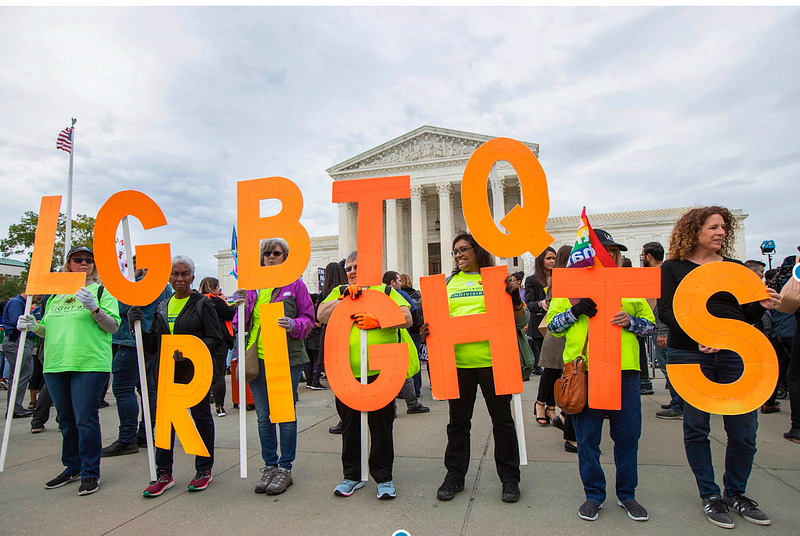
Yesterday, 22 June 2020, there appeared an optimistic opinion piece in the New York Times titled We Can Find Common Ground on Gay Rights and Religious Liberty. Co-authored by friends self-described as a gay atheist (Jonathon Rauch) and a straight Christian (Peter Wehner), the piece champions the Fairness for All Act, a bill (HR 5331–116th Congress (2019–2021)) introduced in December 2019 in the House of Representatives by Rep. Chris Stewart (R UT).
In the opening two paragraphs, the authors wrote that Bostock v. Clayton County, Georgia, 590 U.S. ___ (2020) (PDF copy available at SupremeCourt.gov) (Title VII prohibition against discrimination on “the basis of … sex” includes sexual orientation and transgender status as protected classes)
horrified many social and especially religious conservatives, who see a net of cultural and legal intolerance tightening around them.
‘It is hard to overstate the magnitude of this decision, and the size of the loss to religious and social conservatives,’ the Christian blogger Rod Dreher wrote. ‘There is no safe place to hide from what’s coming.’
We Can Find Common Ground …, supra.
I struggle to describe in measured terms and tone the immediate, visceral, and incandescent outrage those three sentences evoke.
I am a 72-year-old, gay Baby Boomer. I came of age in the ’60s when the good Christian doctrinaires dominating American society declared with unbridled fervor the perversity and deviancy I embodied. As a gay preteen in elementary school and a gay teen in junior and senior high schools and on into college, I was a deeply closeted, tortured soul at war with himself on the most elemental level. That was because society and the church told not only me but everyone that it must be so.
That might strike you as histrionic, just so much hyped melodrama from another, common gay activist. But, my distress at the time was a real, deeply-seated anguish exquisite in its ability to plague even one’s dreams. It was of neither melodramatic nor histrionic dimensions. It was a palpable threat to my well being. It had consequences, emotional, mental, and physical.
Homosexuality was an unnatural, wicked depravity, a rude stain on God’s otherwise clean creation. Homosexual love was the love that dare not speak its name. Homosexual acts were criminalized. Homosexual bars, where like-minded people engaged in nothing more than socializing, were raided by the police, and the clientele humiliated or non-to-gently arrested. As inordinate a stigma attached then to the epithet homosexual as would, nearly a quarter-century later, attach to the designation HIV+. And for the same reason — homophobia that yet survives in conservative evangelical religious enclaves.
Can one sense the irony attendant upon the “horrified” religious conservatives who feel the “net of cultural and legal intolerance tightening around them?” To my mind, it’s their net that ensnared me and my kind for 60 years being cast off and thrown back upon them.
Whether there will be common ground between gay civil rights and religious liberty will depend on the conservative Christian right. For it is they who have weaponized ‘religious liberty.’ It is they who would enshrine in secular law their ‘religious right’ to discriminate not just at the doors to their homes and churches but rather also at the doors to their hotels, fast food chains, home-improvement stores, and business offices. That Bostock has told them they can no longer do.
Perhaps the Fairness For All Act will become law, a monument to political compromise between competing conceptualizations of society. But, like the antebellum Great Compromise of 1850, it will go the way of all attempts at a middle course between two fundamentally, diametrically opposed visions for society. In our democratic, secular society, when the one is founded on acceptance, celebration of diversity, and equal civil rights, while the other is informed by dogmatic religious intolerance and narrow-mindedness, the one will ultimately trump the other even if it should take another 60 years.
Can there be common ground between gay civil rights and religious liberty? Can the Fairness For All Act establish that common ground? Can there be an enduring compromise between the fundamentalist, Christian right’s concept of ‘religious liberty’ and the full attainment of equal civil rights for LGBT+ people?
One submits that, no matter how apparently fair, such a compromise is not viable in the long term. Like the 1850 Compromise, it will succumb to the forces of change.
A people denied some part of their individual civil liberties will not be content with the apportioned measure. No more so will an oppressor granted only so much leave be content with partial paramountcy.
One begs forgiveness for one’s ill-temper, but one has little empathy for the righteous, conservative, Christian blogger who bewails the “magnitude of the loss” visited on him, and who can find “no safe place to hide from what’s coming.”
What’s coming is the march of time.
What’s coming is Dylan’s truth when he wrote
For the loser now Will be later to win For the times they are a-changin’
The Times They Are A-Changin’, undated, retrieved 2020.06.23.
What’s coming is the realization of the prideful declaration, “We’re here, we’re queer, get used to it.”
I know that this is not the conciliatory tone that Mssrs Rauch and Wehner were hoping for. You will excuse one please, for one is still roiling at Christian blogger Rod Dreher bemoaning having no safe place to hide. Perhaps we should go back 60 years. He can join one in the closet.
© Steve Alexander 2020


