
Can We Ease Depression, Addiction, and Mental Illness With Psychedelics?
Exploring alternative means of pain management and helping people die more peacefully

We all know somebody battling mental illness, addiction, or cancer. It might be you. Sadly, these are all part of life's experience, and we can't escape them. Or can we?
If you knew about a new miracle treatment that proves to fight depression, cure addiction, and make end-of-life transitions peaceful and painless, would you consider it? I would at least explore the evidence and science surrounding a revolutionary remedy.
What if the treatment was in the form of psychedelic drugs? Would that make a difference if the results proved positive? Most people seem to be willing to look into any alternative means of treatment if it leads to a remedy for relief of physical pain, mental anguish, or freedom from addiction.
Michael Pollan investigates this revolutionary treatment in his book How to Change Your Mind. Pollan personally experiments with these mind-expanding drugs himself, once considered dangerous, toxic, and a sure road to danger.
Whatever your position is on alternative medicine and psychedelic drugs, this book will have you rethinking some of those notions. Some preliminary testing suggests that psychedelics could be more effective than pharmaceuticals in treating forms of depression.
Mazatec Indian tribes of Mexico introduced mushrooms containing psilocybin to Western travelers.
When we think about psychedelic drugs, what comes to mind is illegal substances synthesized in some remote lab. We might also think of shady deals conducted in some dark alleyway by street thugs in hoodies. It's easy to forget that the true origins of these drugs are found in nature and that they are organic.
It was during the 1950s in southern Mexico when Western travelers first saw mushrooms containing psilocybin. The Mazatec Indians have used the mushrooms for centuries as part of their spiritual rituals and agents for healing.
It wasn't until later that decade that chemists began to synthesize psilocybin in laboratories artificially. And nearly ten years later, people started to view these substances as a danger to society. This was the beginning of the war on drugs.
Few people saw that humans consumed this natural drug to provide a mystical, spiritual experience. However, it takes expertise to identify a true mushroom from a deadly kind. It's not recommended to forage for these mushrooms on our own.
We actually are seeing things we usually can't see during a hallucinatory experience.
Have you ever heard somebody describe their hallucinatory, psychedelic trip experience? You might hear them talk about seeing changing colors, melting objects, and otherworldly lights. Does this mean we can see things that we normally can't, or are we just hallucinating?
In 2014, there was a study on psychedelic drugs conducted at the Imperial College in London. Neuroscientist Robin Carhart-Harris and his colleagues used brain imaging technology to gather more details on how psilocybin affects brain activity. They provide a side-by-side comparison of how different brain areas typically interact while under the influence of psychedelics.
The test showed that psilocybin dramatically rewires the brain. Areas that generally function independently from one another begin to communicate.
Each specialized section becomes less contained, and the brain becomes more integrated as a single unit. Many neuroscientists believe this interconnectedness produces a profound and visual drug trip experience that can be magical and mind-blowing.
So, if you can imagine areas of the brain normally dedicated to emotion, visual, and memory all suddenly interacting together, this prompts a whole new way of seeing things vividly. When the event is positive, it can lead to new insights and ideas and can be transformative.
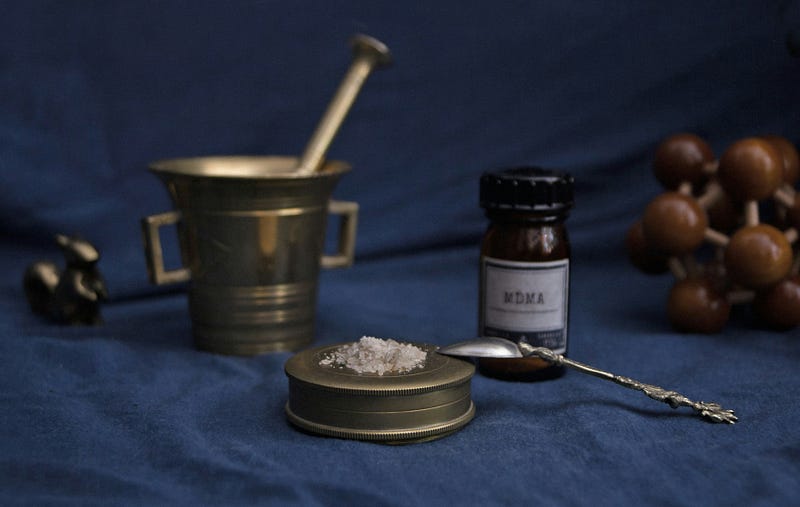
By creating a new sense of connection, psychedelics can help alleviate depression.
Psychedelics are becoming increasingly more acceptable and mainstream. As recently as 2017, the US Food and Drug Administration (FDA) called for a study that would demonstrate the effectiveness of psychedelics in treating those with depression.
Despite the many prescription pharmaceuticals available, depression remains one of the most widespread illnesses in the country. So far, there's a good body of evidence to confirm that psychedelic drug treatment is an effective means of alleviating depression.
The first evidence to support this came again from a 2016 study by Robin Carhart-Harris and the London's Imperial College team. Of the participants in the study sample, 80 percent reported an improvement in their symptoms, while more than 60 percent said that their depression was gone completely.
This was a small sample of 20 people, all receiving a week of treatment. Much testing is still required to assess the treatment's lasting duration and sustainability.
But what is almost certain is that one of the ways psychedelics work to ease depression is by allowing patients to find a new sense of connection in their lives.
People with depression can look at beauty in nature and fail to feel a sense of happiness. However, according to some of the test participants, psilocybin has some properties that can reconnect them more to the world and the people in their lives. And in the end, isn't this something we are all seeking to do while on our short journey through this life?