
Can We Consider AI as Creative? Some Technical Insights.
Beyond Philosophical Considerations, what is Generative AI creativity?
The question of whether AI can be considered creative remains a topic of debate. In this blog post, we will explore some simplified technical aspects of AI and how they could explain generated creative content.
Can we consider AI as Creative?!
If you like this topic, please consider supporting us: 🔔 clap & follow 🔔
In recent years, we have witnessed the rise of AI in various fields, including the creative industry. AI-generated content has been making headlines, with examples of
- paintings,
- music,
- and even short movies (see tweet below),
- Not mentioning ChatGPT…
This technology has even been recognized for its creative output, with some AI-generated content winning prestigious awards for its originality and beauty.
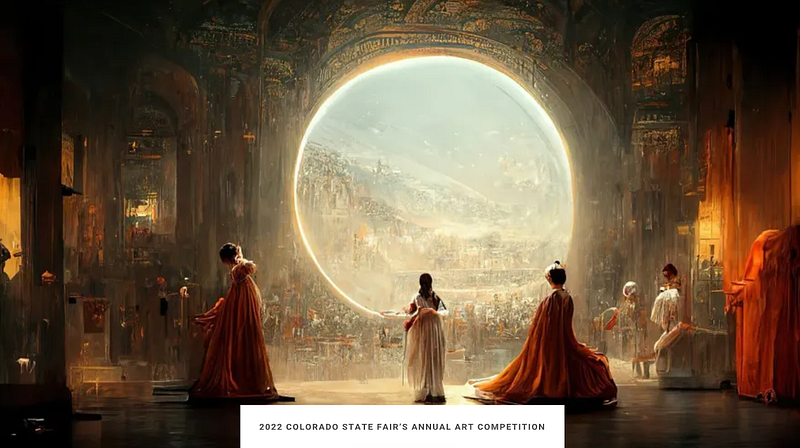
However, despite these achievements, there are still some who believe that creativity is a uniquely human trait that cannot be replicated by machines.
Do you agree?
First, What is Creativity?
Before delving into this debate, it is important to define what we mean by creativity.
Cambridge definition of creativity: “the ability to produce original and unusual ideas, or to make something new or imaginative”.
So at its core, creativity is the ability to come up with new and valuable ideas that are not solely based on existing knowledge. It involves a combination of inspirations, imagination & originality!
- Inspiration: Creativity doesn’t spontaneously occur from thin air, we have a background, references and external stimulus that influence our thinking process. That’s were inspiration comes from.
- Imagination: “the faculty or action of forming new ideas, or images or concepts”. Thus exploring new possibilities.
- Originality: Imagine and converge towards something that combines, or goes beyond, your sources of inspiration.
Would an AI generated content be able to meet all three of them?
What’s Happening in the Brain of an AI? The Technical Analysis!
AI Internal representation
Simplifying: Deep neural networks are powerful machine learning models that create a “latent mathematical space” where every data point can be represented as a vector of numbers in that multi-dimensional space (see image below).
This means that the model can learn to map the high-dimensional input data (e.g., images, text, and so on) onto a lower-dimensional space, where patterns and relationships can be more easily detected.
Close concepts (e.g., images of dogs, sentences about travel, positive sentiment, negative sentiment, etc.) will have a close vector representation. It will also maintain a relationship between concepts, e.g., man & king vs woman & queen.
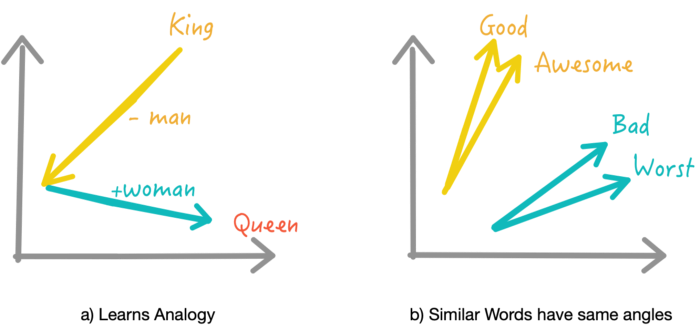
In large deep neural network models, this latent space can have thousands of dimensions (instead of the two represented in the image above)!
Exploring new data points outside of the learning dataset
Great, we know how input data points are learned and “stored”.
But can it explore new data points?
Short answer: yes!
To understand this better, we can take the example of two faces learned by a deep neural network. The latent space is designed to be continuous and will not only encode the two faces, but it will also naturally be able to explore all variations in between. The data points explored in between might not make sense, or be aesthetically appealing though, but still, they are there and you can explore them.
Here’s what it means when looking at faces and exploring variations in between. Thus you can go from one data point to another seamlessly.
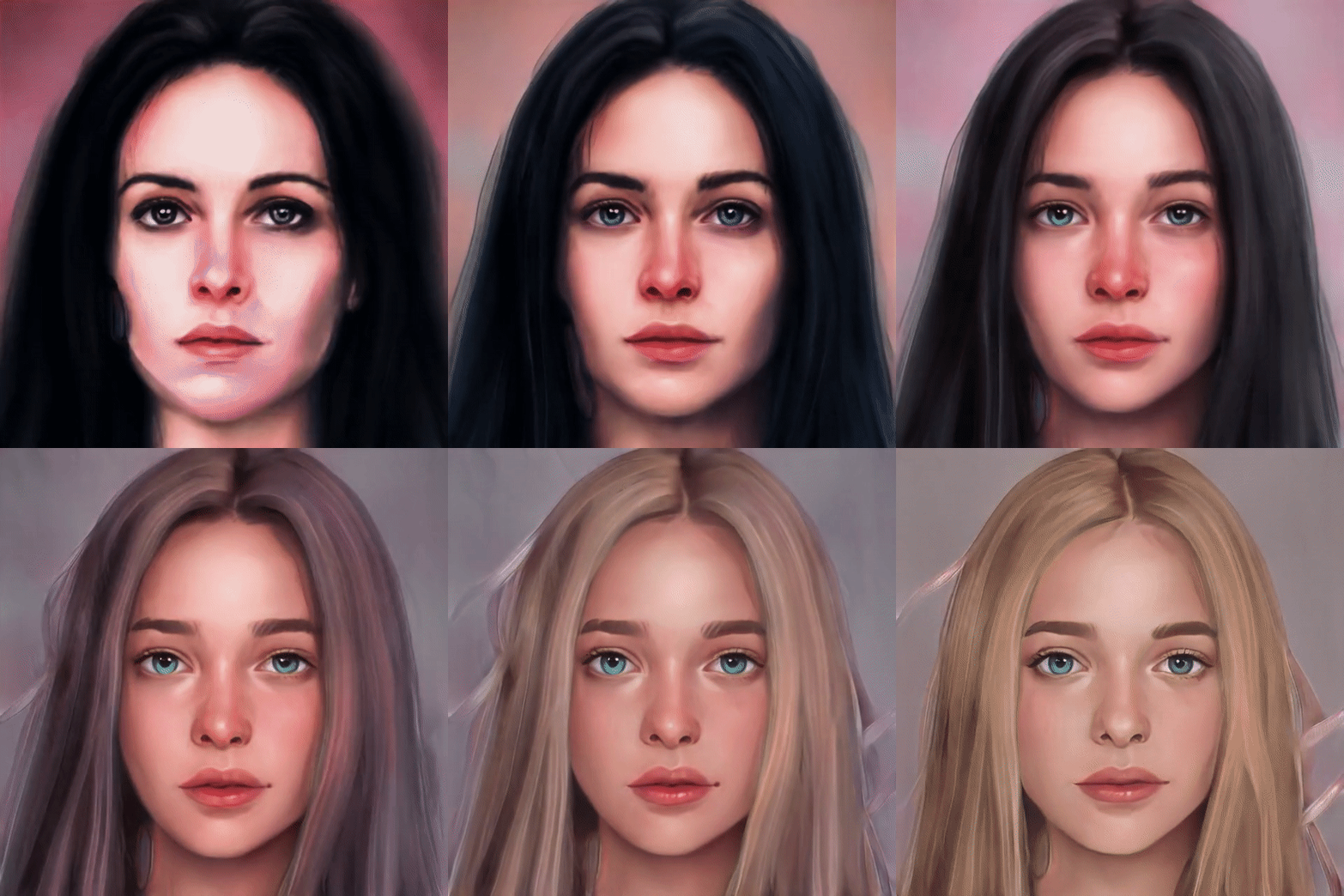
So, by feeding the model billions of data points, it can create an internal representation of these data points, and can explore a large spectrum of concepts combining all these elements!
Multimodal models, combining a rich data set of text, images, videos, etc., are even more fascinating, since they can build a multimodal representation (e.g., text & image concepts). This approach enables generating totally new image concepts based on their textual representation for instance!
Creativity & Generative AI: is all about finding the sweet spot
AI generative models are trained to converge towards aesthetically appealing images or coherent output with regard to the data type (text, image, music, etc.).
Inspiration, Imagination, Originality. What would this look like for AI then?
Well:
- Inspiration: the training data is the inspiration starting point from which AI will be able to extrapolate. The more we feed it with data, the more it can improve and enrich its internal representation.
- Imagination: extrapolating beyond the training data points could be considered as imagination. After all can we really imagine things beyond what we’ve already experienced to some extent?
- Originality: Finding the sweet spot! Within the large spectrum of possibilities available, generate some content that is new, appealing, combining a subset of styles available as inspiration.
Per this definition, Generative AI can base its output, freely, relying on its learned concepts ; it can explore new combinations and converge towards a content that makes sense and original from a human perspective!
Generative AI can over-fit : privacy and copyright issues.
Generative AI is still a young technology and there is still much to learn.
As a matter if fact, generative AI can fail at generalizing and sometime it encodes an input data point with enough accuracy to output it (almost as an identical image)

Explanation: in reality, deep neural network are not suppose to fully encode each data point ; it would be considered as over fitting. It’s supposed to keep a generalized internal representation that can extrapolate beyond the training dataset. That being said, if an input data point is too unique, it happens to see models replicating exactly that image or text as part of its outputs (see image above).
Conclusion, Is AI Creative or Not?
Based on the technical analysis presented above, we can argue that AI can be considered creative in the sense that it can generate new and original content that is not solely based on existing knowledge. By creating an internal representation of the input data, AI can explore a large spectrum of concepts and extrapolate beyond the training data points to generate new content.
However, it is important to note that AI-generated content is still limited by the training data it receives, which means that the creativity of AI is limited by the quality and quantity of the training data. Moreover, generative AI can sometimes over-fit the input data, which means that it can replicate the input data points almost identically, leading to issues such as privacy and copyright concerns.
While AI can be considered creative to some extent, AI-generated content should be viewed as a tool that can augment human creativity and productivity rather than replace it entirely.
If you like this topic, please consider supporting us: 🔔 clap & follow 🔔