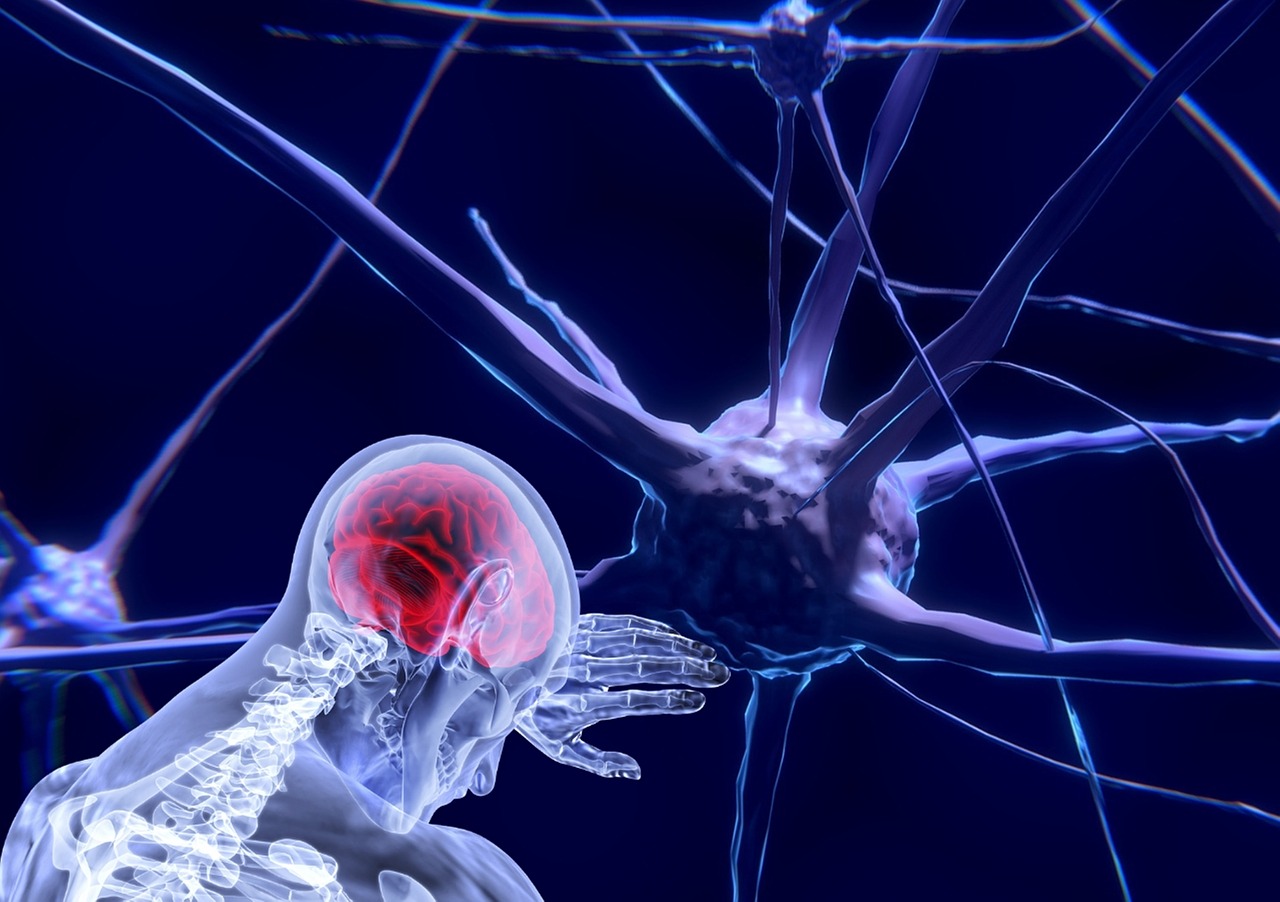
Can we build artificial brain networks using nanoscale magnets?
What happens when nanoscale magnets are made to mimic the synchronized activity of brain neurons.
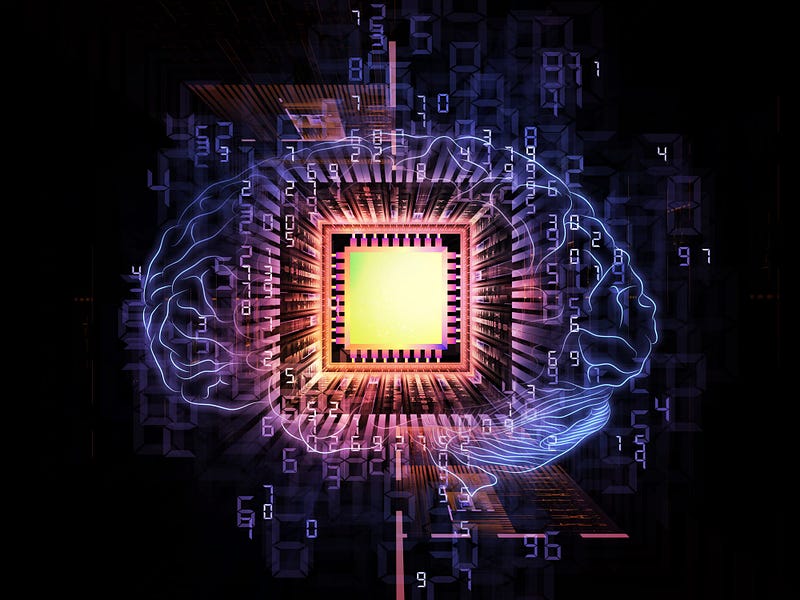
Neuromorphic computing
Artificial intelligence software has increasingly begun to imitate the brain. Algorithms such as Google’s automatic image-classification and language-learning programs use networks of artificial neurons to perform complex tasks. However, because conventional computer hardware was not designed to run brain-like algorithms, these machine-learning tasks require orders of magnitude more computing power than the human brain does. The brain, and biological systems in general, are able to perform high-performance calculations much more efficiently than computers, and they do it quickly and with minimal energy consumption
Building artificial neural networks is an emerging field of research in bio-inspired computing. Here, researchers look to nature for inspiration in the development of bio-inspired chips based on natural computing architectures. Neuromorphic chips are being designed to specifically mimic the human brain — and they could soon replace CPUs.
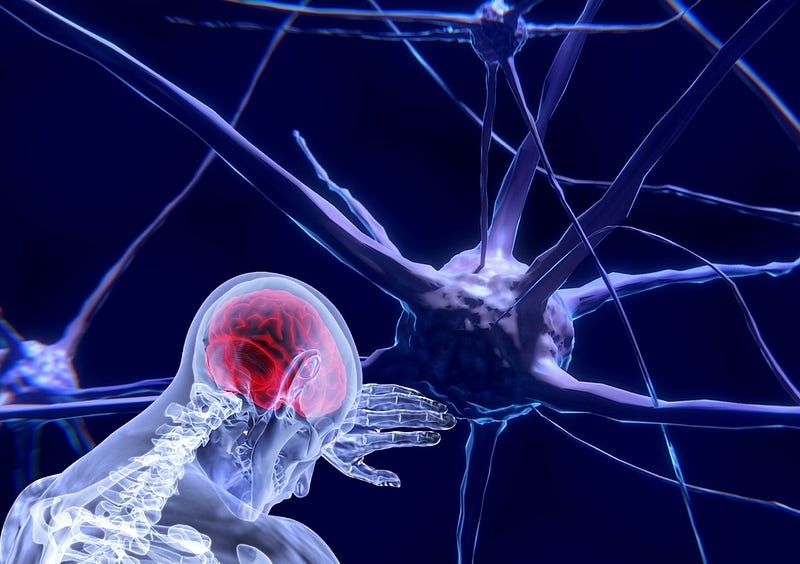
Neurons in the brain behave as non-linear oscillators, which develop rhythmic activity and interact to process information. Taking inspiration from this behavior to realize high density, low power neuromorphic computing will require huge numbers of nanoscale non-linear oscillators. Indeed, a simple estimation indicates that, in order to fit a hundred million oscillators organized in a two-dimensional array inside a chip the size of a thumb, their lateral dimensions must be smaller than one micrometer.
Interestingly, recent advances in nanotechnology and materials science are finally making it possible to envision designing and building networks based on multifunctional nanodevices that approach the complexity of biological systems.
From nano-magnets to neural networks
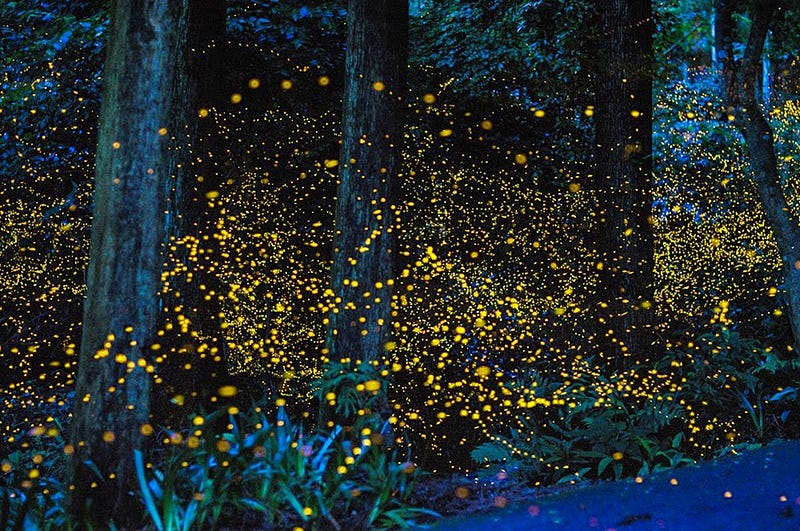
BRAIN NETWORKS: Examples of synchronized activity can be found many places in nature — for example fireflies starting to flash in unison, or humans breaking into rhythmic applause after a concert. Examples can also be found in the brain, where synchronous electrical activity has been found between neurons in distinct brain regions. Research has shown that this activity might play an important role in performing cognitive tasks and in forming memory.
Although these phenomena might be interesting, what do they have to do with nanoscale magnets? As it turns out, these various phenomena share a common denominator in that they are connected via “the mathematics of synchronization”.
Even though they are vastly different, these phenomena can actually be described remarkably well using the same mathematical equations, all connected by the common concept of synchronization.
Interaction: The key to complexity
We are now getting closer to our initial question, “Can we build artificial brain networks using nanoscale magnets?” Crucial to achieving this is to understand what happens when you put a lot of these magnetic oscillators together and allow them to interact with each other.
These oscillators measure only a few hundred nanometres. In comparison, a human hair has a thickness of approximately 100,000 nanometres (one nanometre is 0.000000001 meter, so they are pretty small!). Fabricating such nanoscale oscillators is tricky, and as a result they will all be slightly different from the fabrication process. Due to this, they tend to oscillate at slightly different frequencies.
This is bad news for several of the interesting applications mentioned previously, where the ability of the oscillators to synchronize is crucial. As a means to solve this, one can try to put several of these oscillators closely packed together, allowing them to interact and ”talk” to each other. By doing this, they tend to adjust their individual frequencies and ”agree” on a common rhythm with their neighbors: i.e. they become synchronized.
This kind of synchronization transition is similar to something you have probably experienced yourself: when a theater audience spontaneously starts clapping in unison. The audience ”talk” to each other and interact via the clapping sounds, where people tend to slightly adjust their own clapping rhythm to that of the surrounding audience. This can sometimes spontaneously result in the well- known rhythmic applause. The crucial ingredient here, is that they are able to interact by hearing the clapping of the neighboring audience. Without this kind of interaction, it is highly unlikely that everyone in the audience spontaneously start clapping at exactly the same pace.
This is similar also for the magnetic oscillators: In order for them to ”agree” on a common frequency, they need to be able to interact with each other. In their case, the interaction is of course not through clapping, but through the magnetic fields produced by the individual oscillators. This means that by putting several of them closely packed together, the interactions among them could result in a collective behavior of all the oscillators.
This is where things get interesting: Understanding the behavior of a single oscillator is not that hard (although it can be complicated enough), it is the collective behavior when you put a lot of them together which is the real challenge to understand. The study of such phenomena belongs to what scientists refer to as “complex systems”. The main consideration is that in these systems, ”more is different”, and the collective behavior cannot be derived simply from the behavior of the individual elements.
Putting a lot of ”simple” elements which are well understood on their individual level together and allowing them to interact, it gets very complicated and non-intuitive to understand how they will behave collectively. At the same time, this complicated collective behavior is also what makes these systems interesting.
A mathematical model
This leads us to one of the main questions we wanted to address in our research: What happens when you closely pack a lot of these oscillators together, allowing them to interact? Will they synchronize to a collective rhythm, or might some other interesting effects occur?
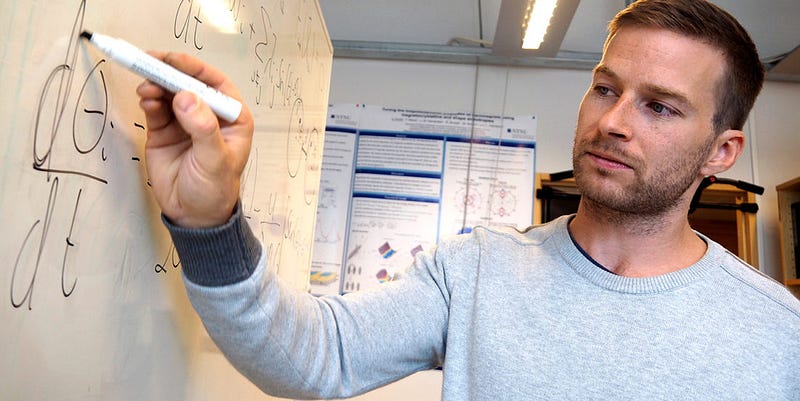
We studied this by using mathematical equations we could solve on our computers. One of the more well-known mathematical models used to study synchronization is the Kuramoto model. The Kuramoto model has been used to describe the essential features of oscillations in a vast set of biological and physical phenomena, where an oscillator in this sense is any system that shows periodic behavior. A swinging pendulum, for example, returns to the same point in space at regular intervals, where these intervals correspond to the oscillator’s frequency.
Inspired by the successful use of the Kuramoto model in describing a vast set of different phenomena related to synchronization, we wanted to see if a similar “simple” mathematical model could be found for a large number of interacting magnetic oscillators. The short answer here is yes, we think so.
In our previous research, we show how this mathematical model could be used to describe the collective behavior in large networks of these magnetic oscillators. Then we presented an analogy between systems of interacting oscillators, e.g. in neuroscience, and these magnetic oscillators, as they both can be described by similar mathematical equations.
Possible to build
So, returning again to our initial question: building an artificial brain, in the sense of a human brain, might be difficult. However, being able to build artificial neural networks that perform computations inspired by how the brain performs cognitive tasks is a more likely outcome.
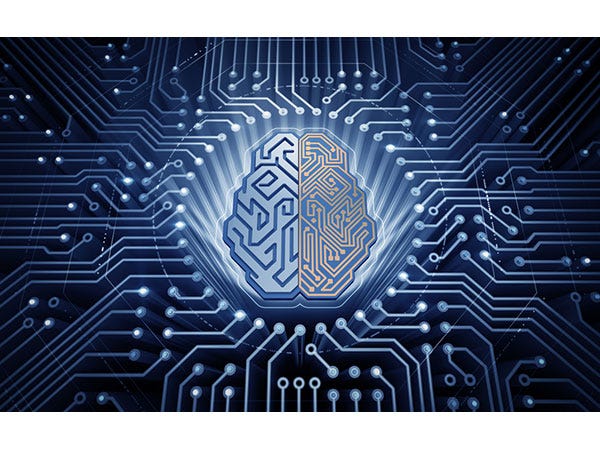
Part of the puzzle in achieving this goal is to identify suitable elemental building blocks. In this context, nanoscale magnetic oscillators show promise for implementing neural networks based on neuron-emulating nanodevices.
Recent work has now been able to show experimentally the use of nanoscale spintronic oscillators for computing, and demonstrate that they can achieve spoken digit recognition with accuracies similar to state of the art neural networks.
However, with many issues yet to overcome and problems to solve, only continued hard work over the coming years will show whether such devices will become a reality in the future. Taking the important leap from lab experiments to mainstream applications might still be a few years away. In the meantime, we are just excited to contribute our small piece of the puzzle to this field of research.
Read our scientific article HERE. Recent work demonstrating the use of nano-oscillators for computation can also be found through the links below:
- Neuromorphic computing with nanoscale spintronic oscillators ([1], [2])
- Scaling up electrically synchronized spin torque oscillator networks ([3])
- Neural-Network Computation Using Spin-Wave-Coupled Spin-Torque Oscillators ([4])
- Spintronic Nanodevices for Bioinspired Computing ([5])
- Training coupled spin-torque nano-oscillators to classify patterns in real-time ([6])