
Can We Believe in Beliefs Anymore?
I was raised in a Roman Catholic community where most people went to church. Early in my teens it struck me that although most people seemed to be strong believers, outside of church they would talk about non-Catholics with no sense of dissimilarity or inequality. Being Jewish, Baptist, or nothing in particular was no different than being Irish or being an accountant. Our system of beliefs in the most important things in life was just one among others outside of church.
I liked this live-and-let-live attitude. But on another level, I didn’t understand how belief worked (as I did not share my family’s religious sentiments, I had little insight into this). Did this mean that my community didn’t really believe the unique and weighty things they attested to in church? Or was there a superseding belief in tolerance and pluralism? Neither seemed likely.
Looking back, I don’t think this arrangement I observed was anyone’s conscious decision. It was their normal way of living. I do, however, think there was a tacitly accepted, combination of factors at work. On the one hand, my fellow congregants held strong beliefs that on the surface seemed inflexible, but deep down were clearly more adaptable. On the other hand, most people carried an implicit commitment to a well ordered, congenial community. These paired senses of religious and secular beliefs made for easy connections in potentially conflictual situations. I was not privy to adult political conversations, but I suppose the same went for politics as the community had a variety of yard signs in election season. In our current era whatever held together this anomalous brew of personal commitments has fallen apart.
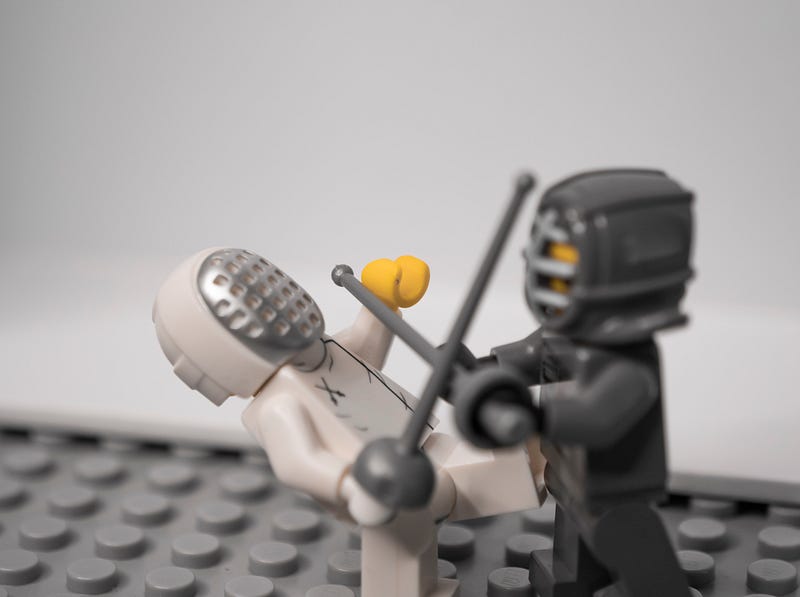
These days personal belief of the more abstract type, such as religion, politics, or ethics, put you in immediate conflict with anyone holding opposing views. People used to avoid these topics to get along (the adage “don’t discuss politics, religion or the weather” was taken seriously). Now, thanks to the internet and social media, we can wear our beliefs like a uniform, find crowds of fellow believers, and express all the disdain we’d care to towards any opposition. All while remaining safely anonymous.
But then a funny thing happened: the internet spilled onto the streets. Even the election season yard signs of my youth were no longer safe. Signs might disappear and houses become defaced. It would not be a stretch to say we are now at war with ourselves. Other realms such as religion and ethics are expected to fall in line with politics.
The final steps in this social unraveling involve what we consider to be moral and to be true. If you disagree with me, I may question your very character. Treason! Evil! And other labels have suddenly entered policy debate.
And finally, If I disagree with you, I can question your commitment to basic facts. You’ve got it all wrong and are spreading fake news. Lies. Disinformation.
What has happened to produce these dramatic social changes? Are these labels we toss at each other correct? Is more at stake than 50 years ago? Let’s begin to address these questions by breaking down the problem.
What is a belief? Many things are called belief: opinions, preferences and sensory experiences These more basic, noncontroversial things are beliefs that. I believe that I saw a deer. Joe believes that this is the best way to drive to his house. She believes that The Beatles are better than The Rolling Stones.
But when we get into higher, more abstract thoughts, our brains take a lot of information and organize it into conceptual schemas. Not beliefs that, but beliefs in. These are political, religious, psychological, and moral systems. He believes in western democracy, Christianity, active parenting, and being a good friend. She believes in candidate Smith to get things done, Buddhism, and also being good friend.
It is the beliefs in where our problems lie. We feel very strongly about these, but among all our beliefs they are the least supported by evidence. When challenged we tend to ignore facts that dispute our beliefs in and only hear those that support them.
How do we get to belief ins? We tell ourselves that we have seen and thought about the relevant information, but that is mostly a story. What usually happens is that we believe what our community believes and what our trusted sources reliably report. Even very educated people are not really examining, for example, the science. They believe scientists and journalists they trust. Education certainly helps to make these choices. But in the end belief ins are strongly social in their formation.
It may come as no surprise at this juncture to point out that society has changed in our modern era. Social bonds are fragmented among families, friends, neighbors and acquaintances. Social groups such as churches, civic organizations, and even leisure groups have almost trivial attendance.
It is these bonds and organizations that help form our identity. Social groups, based on ethnicity, religion, interests, and community, carry the traditions and values which help us become who we are. They also inform us about the world through their practices and beliefs. The internet and informative articles may help us learn, but it is people and the groups they represent that help us believe.
Paradoxically, it is the consistency of your community and culture that allow you enough confidence in your beliefs that those of others do not threaten you (obviously having a very parochial and narrow background will have the opposite effect). A multiplicity of such cultures breeds a pluralistic and tolerant society. These communities are mostly gone.
Education is not entirely different from this social process. You need to have choices with which to confront beliefs; a sense about reasonable paths to truth; and ways to judge expertise. But with all these individual skills you need a community of people who are educated with whom you can discuss possible beliefs. This becomes your community. We should strive to develop the first three skills and remain aware of our proneness to use them only to reinforce what our community believes.
Knowing what we do about the social nature of beliefs, it is a small step to assume that without these communities the process of belief-holding will go awry. The broken social structure of modern society cannot support a multiplicity of mutually tolerant beliefs.
In our new, socially fractured society we have seen extremism and orthodoxy spread like wildfire. It is the belief ins which have fallen victim to this shift in thinking and its us-versus-them attitude. This move towards more extreme versions can take several forms: more devout, more radical, more orthodox. Many manifest in a move towards conservatism and traditionalism.
This is understandable as a return to tradition or more conservative ways attempts to recreate an era when beliefs were more easily maintained and justified. We need only to look at the daily news for evidence that this is happening. The more extreme, dogmatic nature of many people’s beliefs is everywhere on display.
Others call for a concentrated focus on the principles of pluralism and inclusion that, although a national ideal, have powerfully excluded certain groups. The full inclusion of these excluded groups animates this political perspective.
Some groups may make progress in their particular agenda, but not on the problem of beliefs itself. We will remain polarized in our beliefs as long as our personal bonds remain minimal and our social groups are tiny and without influence.
What to do? As individuals each of us must do intentionally what happened automatically in the past. We must form attachments: large and small. Intimates and morning waves. Loyal neighbors, casual office mates, friendly postal carriers. This is now part of the work of living in the modern era.
To break the logjam of extremism and dogmatism we must inform ourselves. Find out what the other side thinks, not to criticize but to understand. Study their beliefs as if you had to teach them, not denounce them. This process must become more than a habit; it must become a modern virtue.
These are individual projects. Otherwise I see no easy solution to the social disintegration we have suffered nor to the polarization of beliefs. But until major changes in society come along our most important work must be to foster our democracy as it is the only path to evolutions of a society. Some will push for revolution in the way we do things. As long as done within a democracy they should push away.
We must remake ourselves, our communities, and our country by policing the integrity of our beliefs. They will always be social and never perfect, but always amenable to an open, informed mind.


