
GAZA
Can Shared Suffering Unite Palestinians and Jews?
The politics seem impossible, but what about the spirituality of shared grief?

The Palestinians in Gaza and the Jews who live in Israel share a common enemy: the people who govern them.
As the suffering of the people in Israel and Gaza mounts, will they find common ground?
Is it possible they’ll reach into their respective religions to reject the toxic lie of an eye for an eye that their leaders seem to rely on when imposing endless warfare on their people?
As both sides suffer, will their tears form a bonding river that asks them to cling to each other while the river runs wild, powered by the acts of malevolent leaders who turn the river into blood, its banks into the bones of their children?
There is no such thing as an eye for an eye: it’s a myth
Their leaders are determined to call on the old notion of an eye for an eye as one side destroys the other in an endless loop of tragedy. This has been going on for a very long time.
Martin Luther King once said, “The old law of an eye for an eye leaves everyone blind.”
The notion of an eye for an eye was corrected in Isaiah of the Hebrew Bible (the Tanakh) :
I, I am he who blots out your transgressions for my own sake, and I will not remember your sins.
— Isaiah 43–25
Further, many Jewish scholars insist that the famous line about an eye for an eye in Leviticus is an allegorical reference to monetary compensation.
The Holy Qu’ran says:
But if the thief repents his crime and amends his conduct, Allah turneth to him in forgiveness; Allah is Oft-Forgiving, Most Merciful.
— Qu’ran 5:39
And the Christian Bible, quoting Jesus, says this:
You have heard that it was said, ‘An eye for an eye and a tooth for a tooth.’ But I say to you, Do not resist the one who is evil. But if anyone slaps you on the right cheek, turn to him the other also. And if anyone would sue you and take your tunic, let him have your cloak as well. And if anyone forces you to go one mile, go with him two miles. Give to the one who begs from you, and do not refuse the one who would borrow from you.
— Matthew 5:38–42
Fundamentalists of all religions reject peaceful coexistence in favor of violence. They are, by nature, predators. They’d rather pluck out an eye than discuss their disputes over a cup of Turkish coffee.
But at some point, human suffering becomes a call to action. Resistance to religious fundamentalism becomes the only path to salvation.
As Gaza’s pain continues, I’m seeing some cracks of support on each side toward those who govern them. A tiny sliver of agreement seems to be emerging, breaking through the hardened vitriol and hate. Right now, it’s barely a whisper in the fog of war, but maybe, just maybe, the collective soul is awakening.
Palestinian children are carrying white flags as they flee through the rubble of their bombed neighborhoods while many Israelis call for the ouster of its prime minister, Benjamin Netanyahu.
But if the thief repents his crime and amends his conduct, Allah turneth to him in forgiveness; Allah is Oft-Forgiving, Most Merciful — Qu’ran 5:39
Perhaps, as both sides share stories of their unimaginable horror and grief, they will make a common discovery.
And it is this: The leaders of both Israel and Hamas have caused endless misery to innocent civilians on both sides for decades.
Today, I saw an article quoting a Hamas leader, Khalil al-Hayya, who said that the purpose behind his group’s brutal attack against civilians was to “change the entire equation and not just have a clash.”
Taher El-Nounou, a Hamas media adviser, said:
“I hope that the state of war with Israel will become permanent on all the borders, and that the Arab world will stand with us.”
Meanwhile, Netanyahu digs in, leveling entire city blocks.
The terror of Netanyahu and his cronies
Hamas leaders knew that their attack would unleash Israel’s Gorgons, led by Netanyahu, who has been itching for a fight since his descent as a world leader.
A serious student of English might raise an eyebrow at the word “descent” in this case. Didn’t I mean ascent?
Normally, we credit a rise to leadership as an “ascent.” But since his takeover of Israeli politics, Netanyahu has been the political equivalent of Yigal Amir, the right-winger who assassinated Yitzhak Rabin in 1995 because he was unhappy with the Oslo Accords, which was a peacekeeping effort virulently opposed by right-wingers on both sides.
Netanyahu’s ascent to the world stage has been a descent into hell for Palestinians, but it’s been extremely harmful to Israelis, as well.
Just as the assassin Amir created a political climate that eventually led to the rise of Israel’s conservative Likud and Netanyahu, Netanyahu has in turn steadily steered his country away from peace toward war during his nearly three decades in (and sometimes out of) office.
His aggressive settlement policies have become increasingly provocative. When Donald Trump was president, Netanyahu was further emboldened after Trump moved the American embassy from Tel Aviv to Jerusalem.
Initial reports about the attack suggest Netanyahu willfully ignored Egyptian warnings that it was coming. Prior to the attack, he gladhanded Hamas leaders in order to sow dissension across the Palestinian body politic, and brazenly ignored security issues so that he could focus on his intimidation tactics in the West Bank:
This included attacks by Israeli settlers on Palestinians in the West Bank and ordering Israeli police to occupy the Aqsa Mosque in Jerusalem. Netanyahu also encouraged conservative Jewish clerics like Rabbi Yehudah Glick to pray at Temple Mount, despite a previous agreement that forbade such prayers.
The grounds of the Aqsa Mosque and Temple Mount are sacred to Jews and Muslims, so of course that agreement seems stupid on its face to me. Anybody who wants to pray there should be able to.
But an agreement was in place. Netanyahu gave it the middle finger. And sending police onto Mosque grounds was an inflammatory middle finger to Islam itself.
The terror of Hamas
Hamas, meanwhile, has always refused to recognize the right of the nation of Israel to exist on any level. Their formal charter of 1988 is full of genocidal references that make it pretty clear why the October 7 attacks in Israel were unleashed with such viciousness:
Israel will exist and will continue to exist until Islam will obliterate it, just as it obliterated others before it (The Martyr, Imam Hassan al-Banna, of blessed memory).
and
The Day of Judgement will not come about until Moslems fight the Jews (killing the Jews), when the Jew will hide behind stones and trees.
Article Eleven of the document declares that all of Palestine should be governed by strict Sharia law:
This is the law governing the land of Palestine in the Islamic Sharia (law) and the same goes for any land the Moslems have conquered by force, because during the times of (Islamic) conquests, the Moslems consecrated these lands to Moslem generations till the Day of Judgement.
If you’re an American, imagine the United States governed by a fundamentalist dictatorship helmed by Marjorie Taylor Greene, and you’ve got a pretty good idea of the primitive nature of Hamas’ aims.
Hamas and Netanyahu make one hell of a team
So on one hand, you have Hamas using as its governing document a series of genocidal statements regarding Jews.
On the other hand, you have an extreme right-winger, Netanyahu, who has clearly declared the same attitude toward Palestinians by engaging in a program of slaughter that has so far killed thousands of Palestinians in response to the October 7 attacks.
He cut off electricity in Gaza and shut down the internet after telling its people to flee south. Then he bombed the crap out of the place.
I can’t claim to know what’s going on in Netanyahu’s head, but I know this. Israeli intelligence, with Mossad at its core, is so good that movies are made about it. The dialogue goes something like this:
American spy to British spy: You really want to mess with Mossad? British spy: “Good God, no.”
So the people of Israel, Palestinians and Jews, are supposed to believe Netanyahu didn’t know what was coming?
I’m not a conspiracy enthusiast. I’ll leave that kind of stuff to Marjorie Taylor Greene and her band of merry misfits.
Logic, however, dictates that it is much more likely that a finely tuned intelligence apparatus like Israel’s not only knew about the attack before it occurred, but very possibly helped create it by infiltrating an already hysterical Hamas leadership with moles.
I don’t normally cry out, “False flag operation!” but in this case, I’m tempted.
Even if that is fiction (I’m very imaginative, a personality attribute that has been known to work against me), Netanyahu was clearly itching to blow up thousands of Palestinians.
If you wonder how people like Netanyahu can sleep at night, I hate to be the bearer of bad news, but my sense is that he falls asleep with a gleeful smile, delighting in the images of mortar falling on top of Palestinian toddlers.
The same holds true of Hamas leaders, who blitzed their way into a Kibbutz to kill women and children, and who shot unarmed rave revelers to pieces with enough glee that they proudly displayed snuff films on the internet, all in the name of jihad.
The impossible mess that is Jerusalem
When Israel enacted the Jerusalem Law in 1980, the Israeli Supreme Court considered East Jerusalem, which had been under Arab control, officially absorbed into Jerusalem proper, and therefore part of the capital of Israel.
I want you, no matter how you view this crisis, no matter whose side you are on or for whom you have empathy, to look at the map of East Jerusalem below and tell me there’s a way for one side to prevail over another.
Go ahead, take your time. If you think it is possible for one side to prevail without ethnic cleansing or genocide, leave a comment.
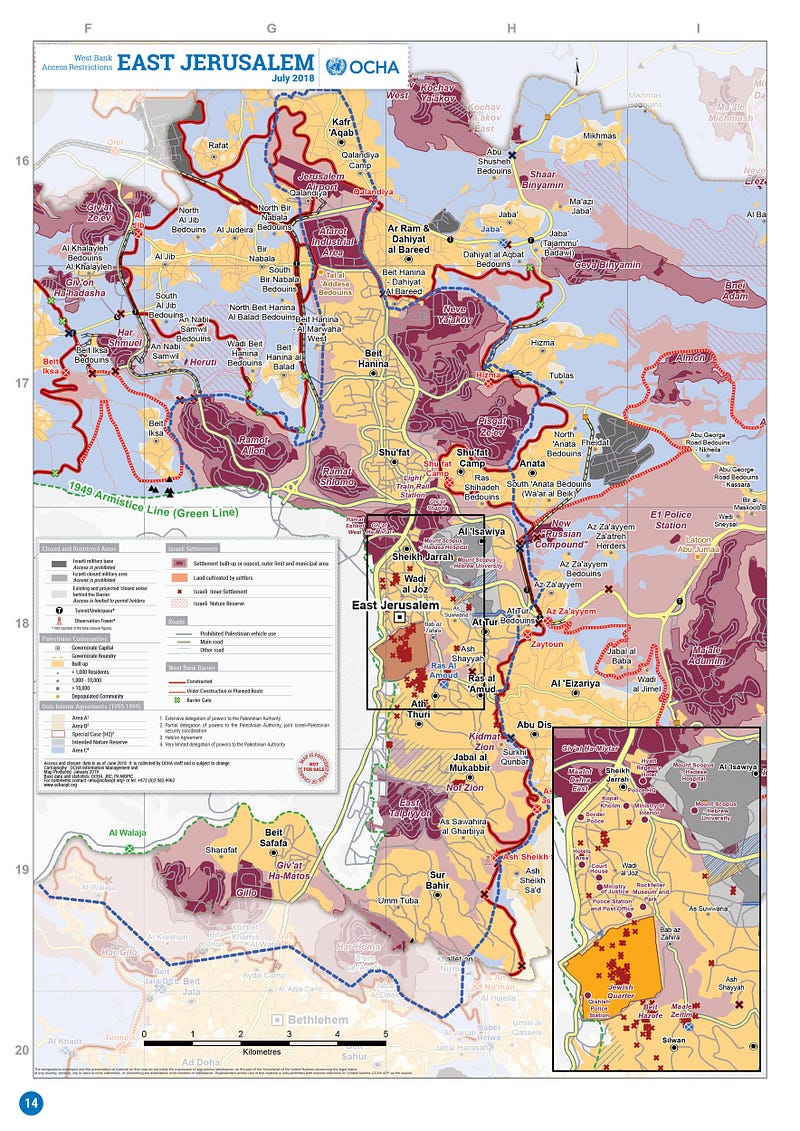
Study the map. Study the icons, the walls, the forts, the boundaries, the settlements, the churches, the mosques, and the temples.
Now. Propose your solution.
The bottom line is that the people who live there need to find a way to exist peaceably together without barbed wire and guns.
Easier said than done, of course. Perhaps, even, a childish dream of an unrealistic idealist. Yet, I will persist.
Yes. It’s a bleak scenario because Palestinians have known only violent conflict since they were children, and Israelis, surrounded by hostile Arab nations who have never fully accepted the imposition of the Israeli state by Western powers after World War II, have lived under a siege mentality for generations.
How much suffering do two groups of human beings need to endure before they reject their leaders and coalesce into a united front that opposes their leaders’ affinity for perpetual conflict and mutual slaughter?
The idealist in me thinks that we may finally find out.
The common good of a shared spirit
There are groups on both sides that have worked together for years, including former combatants:
I’m getting along in years, but my soul is still an optimistic one. I can’t change that. I believe in a world in which we are all connected. I believe in a soul of the universe that cries when power-hungry men slaughter innocent people in the name of their God.
And I believe in a world where a true unity government is possible in the Holy Land. This can only happen if we all link our hands together and pray to whoever our God is, no matter what form he or she takes, so that the people who are suffering the most can throw off the chains of their real enemies: their leaders.
Thanks for reading.
Notes
Technically, the Hamas covenant was updated in 2016 or so as a publicity effort to try to win votes among Palestinian moderates, but Hamas leaders have made clear since the October 7 attacks that they are still bound to the original document.
My apologies if the cover image of Netanyahu makes it appear that I’m taking sides. Netanyahu is targeted for the image because he has a face more people recognize than the Hamas leaders. And I just kind of dig making Photoshop smashups. And he looks a little like Satan.
I am on the side of both peoples. I am on the side of the Jewish people. I am on the side of the Palestinian people. And I am against war and violence in the name of any God.
Subscribe to my newsletter, get freebies!
You can subscribe to my fiction newsletter here (non-Medium link) and get freebies, including a free PDF download of my short story collection, Quantum Blues, available only to my subscribers!

This story was written by a human, not by AI or Grammarly GO (More Info).


_(cropped).jpg)
