
Can Personality Predict Success?
Expand your personality type & transform your life

Here you are.
Granted a set of personality configurations at birth and if you’re lucky that set of attributes is functional in the society you grow up in so you are able to find your niche and successfully make use of your personality traits.
But its not always the case that the niche you’re most suitable for is currently stable or economically reliable as a career choice.
What then?
Do we just accept it and live with what we were given at birth? Or is there a way to change the outcome?
In better words — Is it possible to change your personality?
Absolutely. And I will tell you exactly how.
But first, let’s take a closer look at the different types of personality traits that exist and the various factors that contribute to the development of personality traits.
What Exactly Predicts Lifetime Success?
The top predictor for success is intelligence but other than proof of physical exercise preventing the drop of fluid IQ past the age of 20, there is no solid research to prove the possibility of increasing the level of intelligence.
But certain personality traits have also proven to be correlated with higher salaries, more frequent promotions, and overall higher life satisfaction.
While personality is relatively stable, there is a plasticity principle that makes it amenable to change. Factors including environmental influences can cause slight shifts in personality over time.
One way of looking at it is, our job in our initial phase of our lives is to recognize our personality type and understand who we are, then find a niche where they’re valued. After all, this is what universities were supposed to teach us.
Personality Traits and The Differences in Personality Between Men & Women
According to the big five model, personality is composed of five main dimensions. Each of these traits represent a continuum. Some people are high in certain traits and low in others or somewhere in the middle of many or most of these characteristics.
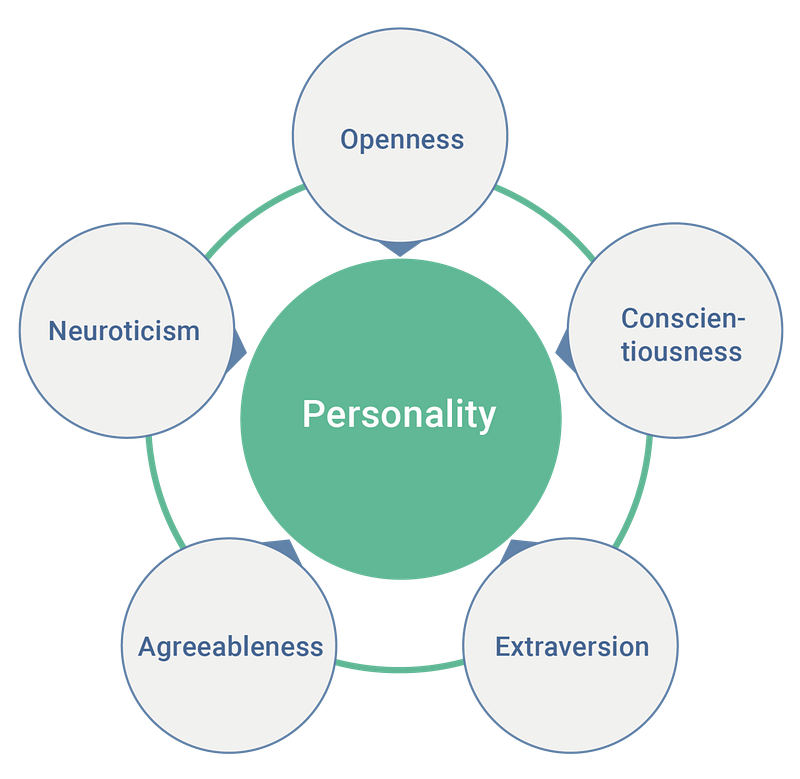
1 — Conscientiousness: Made up of two main characteristics of industriousness & orderliness.
Industriousness — Goal oriented, high levels of thoughtfulness, not easily distracted, good at following orders & schedules
Orderliness — disgust sensitive, bothered by disorder, likes routines, and wants everything to be just “right”
2 — Extroversion: Sociability, talkativeness, assertiveness, positive emotion associated with enthusiasm & excitability
3 — Agreeableness: Trust, passion, politeness, compassion, more cooperative than competitive
4 — Openness: Creative, open to trying new things, interested in abstract concepts & aesthetics
5 — Neuroticism: Negative emotion, emotional instability, proclivity towards anxiety and emotional pain, withdrawal
Both nature and nurture play a role in the development of personality, although a number of large-scale twin studies suggest that there is a strong genetic component.
Among these personality traits, conscientiousness is the biggest trait that predicts success & openness is the trait that is highest correlated with IQ.
According to Business Insider, one NIH study found the link between conscientiousness and career success.
The industrious dimension of conscientiousness people allows them to delay gratification, are great at setting goals and sticking to routines that help them achieve those goals.
They find it unsettling to not be doing something. They simply can’t stand sitting around doing nothing.
There is a theory that suggests the reason conscientiousness people feel bad for not constantly working may have an evolutionary background as there has always been an ethical obligation to share labor so the ones who did not contribute were wiped out.
The orderly dimension simply means they are annoyed by mess before other people.
Women are generally more orderly than men, which partly contributes to the uneven distribution of housework. Because even if you happen to be triggered by mess by 30 seconds before your partner, you will end doing most of the cleaning.
Conscientiousness & neuroticism are negatively correlated. The more conscientious you are, the less you are likely to suffer from anxiety. By being conscientiousness you stabilize your environment. So it leads to less emotional pain.
But with conscientiousness the probability of depression also increases since highly conscientiousness people tend to be judgmental and hard on themselves so they will assume if things are not going well for them, it is certainly their fault.
Agreeableness is great for getting along with others but being too agreeable will negatively affect your success in the business world.
While it’s a vital trait when caring for infants who require unconditional love and support, being too agreeable may not be the best strategy when dealing with adult men, most of which happen to be highly disagreeable.
In order to get ahead in business you need to be able to stand your ground and not settle for less than you deserve. Agreeable people tend to avoid conflict and negotiations and that often leads to them being taken advantage of.
Disagreeable people tend to be somewhat self centered and harsh. While this may be a helpful strategy in the business world, it’s certainly not useful when attempting to pursue a romantic relationship.
On average, women tend to have higher levels of neuroticism and are more sensitive to negative emotion. They also have higher levels of agreeableness.
But even considering the general differences in personality of each gender, there is a lot of individual variability which is why personality tests matter.

Once you have a solid understanding of where you stand based on the big five dimensions, you can build your life such that it matches your temperament.
For example if you are high in extroversion a career in sales might be suitable for you as it requires a lot of social interaction.
But if you fall on the extremes of any traits in a way that it may disrupt your personal or professional life, there are ways you can shift them to some degree.
Now … How Exactly Can We Expand Our Personality?
There are general principles such as maturity & environmental factors that naturally cause shifts in personality. For example people tend to become more agreeable, emotionally stable, and socially dominant as they grow older.
But there are also ways we can consciously expand our personality by learning certain skills that help us shift our traits.
If you are high on neuroticism — stabilize your diet and sleep schedule. It helps stabilize your emotions. Shield yourself from negative news. If you have are suffering from extreme anxiety or similar negative emotions, consider counseling to help you gain control over your emotions. Incorporate meditation into daily life to access a peaceful state of mind.
If you are too agreeable — consider assertiveness training. Learn to communicate your opinions and viewpoints without fear of conflict. Practice standing up for yourself and not letting people to take advantage of you.
If you are too disagreeable — learn to take others into consideration more. Once a week plan to do something for someone else. Altruism may not come naturally to you but you can certainly learn the skill by practice.
If you are highly introverted — plan social interactions. While you may not enjoy it, you can learn to adapt to the skill and use it in your favor. Plan a social strategy. Plan to have a meal with someone once a week. Schedule social activities for yourself and practice the skill.
If you are highly extroverted — spent time on your own to learn how to enjoy your own company. Plan dates with yourself and spend time away from crowds to learn enjoying the silence and your own presence.
If you are low on consciousnesses — build a goal structure and turn that into micro routines to know what to do day to day. Set the schedule like you are doing it for someone you care for.
Compare Yourself to Who You Were Yesterday, Not to Who Someone Else is Today — Jordan Peterson's #4 rule in 12 Rules for Life
Ask yourself about the ratio of responsibility to reward. Negotiate with yourself and not tyrannize yourself into following a prison like schedule.
And lastly, don’t be hard on yourself. It takes practice. If you hit it with only 20% accuracy on day one, instead of giving up just aim for 21% the next day.
If you are hyper conspicuousness— learn to relax and make it a priority. Set times in your schedule to just relax and not do anything. Allow yourself to take breaks and not work for a change. You do not have to be productive every single second of your life.
If you are high on openness — commit to something. Try to focus on one thing and develop expertise in one area. If you score too high in openness you tend to jump from one thing to another as there is a constant flow of new ideas and possibilities. In order to take that aspect under control, practice sticking to one task for longer periods than you usually do.
If you are low on openness — join a book club. Open yourself to new experiences. Meet new people. Watch more movies. Read one book a week. You will naturally increase your level of openness by exposing yourself to situations that can spark new ideas and concepts.

To Conclude —
Your personality affects every aspect of you life including finding a long term partner and career success.
Your temperaments puts you in certain place but you should be able to increase your adaptability to not be constraint tightly by your biological distribution.
It’s certainly possible and important to widen our skill sets by expanding our personality to be able to aim at the highest possible life satisfaction.


