avatarElla Harris

Free AI web copilot to create summaries, insights and extended knowledge, download it at here

3865

Abstract

embed&display_name=YouTube&url=https%3A%2F%2Fwww.youtube.com%2Fwatch%3Fv%3DOqi7kP_Xb34&image=https%3A%2F%2Fi.ytimg.com%2Fvi%2FOqi7kP_Xb34%2Fhqdefault.jpg&key=a19fcc184b9711e1b4764040d3dc5c07&type=text%2Fhtml&schema=youtube" allowfullscreen="" frameborder="0" height="480" width="854"> </div> </div> </figure></iframe></div></div></figure><p id="d7f6"><b>The video below is after she made the documentary:</b></p> <figure id="55a6"> <div> <div> <img class="ratio" src="http://placehold.it/16x9"> <iframe class="" src="https://cdn.embedly.com/widgets/media.html?src=https%3A%2F%2Fwww.youtube.com%2Fembed%2FFdcvWdlmYtU%3Ffeature%3Doembed&amp;display_name=YouTube&amp;url=https%3A%2F%2Fwww.youtube.com%2Fwatch%3Fv%3DFdcvWdlmYtU&amp;image=https%3A%2F%2Fi.ytimg.com%2Fvi%2FFdcvWdlmYtU%2Fhqdefault.jpg&amp;key=a19fcc184b9711e1b4764040d3dc5c07&amp;type=text%2Fhtml&amp;schema=youtube" allowfullscreen="" frameborder="0" height="480" width="854"> </div> </div> </figure></iframe></div></div></figure><p id="8fc2">By comparing the two, you can clearly see how her behaviours are miles apart. In the first video, she is quite aggressive towards the overweight member of the audience, even offering to “fight” her.</p><p id="b11c">In the second video, however, from her body language to her words, everything about her attitude towards the woman struggling with obesity is different. She is visibly empathic and compassionate, which even the presenter points out in surprise.</p><blockquote id="fa48"><p>This is an entirely different Katie Hopkins than the one we have had sitting on this sofa. I’ve never seen you be so warm. I’ve never seen you be so caring. I’ve certainly never seen you be so empathetic with someone.</p></blockquote><h2 id="1962">How did her attitude change so drastically?</h2><p id="8344">Aggression comes from lacking in empathy — if we cannot understand and relate to someone else’s problems, we are more likely to be angry at them for their behaviours and failures in general. However, when we learn how to empathise with people, there will be a reduction in our hostility towards them.</p><p id="7dd7">In her documentary <i>My Fat Story, </i>for the first time, Hopkins experiences what it is like to be overweight. Throughout the series, she gets emotional, cries, feels unattractive and is ashamed to go for a run when she first starts to lose weight, as she believes people outside will judge her just like how she used to judge overweight people in the past. In other words, by going through these struggles herself, she was able to relate to the struggles of those who are overweight. This is the reason for her change in attitude and newfound ability to empathise with overweight people.</p><h2 id="5819">Is there clinical evidence to support narcissists’ ability to feel empathy?</h2><p id="ba01">Otto Kernberg, a well-known psychoanalyst for his theories on borderline personality organization and narcissistic pathology, explains an interesting phenomenon in his book <i>Treatment of Severe Personality Disorders — Resolution of Aggression and Recovery of Eroticism</i>. For one of the chapters, he re-interviewed his past patients with NPD, who had lost a spouse and then remarried. This was to investigate whether this experience had had any effect on them. Surprisingly, he found that they had;</p><blockquote id="d62b"><p>a general attitude of tolerance of conflicts, a greater degree of understanding the viewpoints of others with whom they had experienced themselves in a serious conflict, and increased capability for forgiveness towards others who had disappointed them or treated them with hostility. All this seemed to go hand in hand with greater tolerance for the ambiva

Options

lence of human relations in general, an increased curiosity in the experiences and motivations of other persons, and a sense of greater understanding and greater freedom to be of help to other persons who were undergoing a mourning process.²</p></blockquote><div id="b0bf" class="link-block"> <a href="https://www.amazon.co.uk/Treatment-Severe-Personality-Disorders-Resolution/dp/1615371435?crid=VRYRHX92H955&amp;keywords=otto+kernberg+treatment&amp;qid=1690384417&amp;sprefix=otto+kernberg+treatment%2Caps%2C74&amp;sr=8-1&amp;linkCode=ll1&amp;tag=ellaharris-21&amp;linkId=558842d1ac9a76d2ee1a098661f0054c&amp;language=en_GB&amp;ref_=as_li_ss_tl"> <div> <div> <h2>Treatment of Severe Personality Disorders: Resolution of Aggression and Recovery of Eroticism</h2> <div><h3>Buy Treatment of Severe Personality Disorders: Resolution of Aggression and Recovery of Eroticism 1 by Otto F. Kernberg…</h3></div> <div><p>www.amazon.co.uk</p></div> </div> <div> <div style="background-image: url(https://miro.readmedium.com/v2/resize:fit:320/)"></div> </div> </div> </a> </div><p id="8e88">It is indeed interesting that a spouse passing away could have such an effect and this highlights the importance of experiencing something that allows narcissists to mentalize and relate to others’ pain. When narcissists learn how to mentalise, they become more <i>emotionally</i> empathetic and this has a positive effect on their relationships.</p><h2 id="1da4">References:</h2><p id="67bd">[1]: American Psychiatric Association. (2013). <i>Diagnostic and statistical manual of mental disorders</i> (5th ed.). <a href="https://doi.org/10.1176/appi.books.9780890425596">https://doi.org/10.1176/appi.books.9780890425596</a></p><p id="c8db">[2]: Kernberg, O. F. (2018). Treatment of Severe Personality Disorders — Resolution of Aggression and Recovery of Eroticism. Amer Psychiatric Pub Inc.</p><div id="85dc" class="link-block"> <a href="https://readmedium.com/character-analysis-narcissistic-personality-disorder-b14b88ae857"> <div> <div> <h2>Character Analysis: Narcissistic Personality Disorder</h2> <div><h3>The psychology of the narcissistic personality</h3></div> <div><p>medium.com</p></div> </div> <div> <div style="background-image: url(https://miro.readmedium.com/v2/resize:fit:320/0*BuQFx71g55jj1vD7.jpeg)"></div> </div> </div> </a> </div><div id="2948" class="link-block"> <a href="https://readmedium.com/abuser-typologies-narcissists-psychopaths-and-borderlines-5a82aad9db71"> <div> <div> <h2>Abuser Typologies: Narcissists, Psychopaths, and Borderlines</h2> <div><h3>Differentiating between personality types that engage in abusive behaviour in intimate relationships</h3></div> <div><p>medium.com</p></div> </div> <div> <div style="background-image: url(https://miro.readmedium.com/v2/resize:fit:320/0*oziaRSAEQFpIzLr3.jpeg)"></div> </div> </div> </a> </div><p id="2a35"><i>If you enjoyed this post and would like to read more, you can subscribe here — <a href="https://medium.com/@Ella_Harris/subscribe">https://medium.com/subscribe/@ella_harris</a> to get an email whenever I publish a story. You can also buy me ☕ via — <a href="https://ko-fi.com/ella_harris">https://ko-fi.com/ella_harris</a></i></p><p id="0b41"><i>This post contains affiliate links. If you use these links to buy something I will earn a commission. Thanks.</i></p></article></body>

CLUSTER B PERSONALITY DISORDERS

Can Narcissists Feel Empathy?

Well, yes but it’s complicated…

Photo by Alex Green from Pexels

Psychopathy is the only personality disorder where the capacity for emotional empathy is significantly lacking. Narcissists can feel full-fledged empathy like healthy people, however, there is a problem with their ability to mentalize, which prevents them from feeling it in many situations.

Mentalizing is the ability to understand the mental state — of oneself or others — that underlies overt behaviour. Mentalization can be seen as a form of imaginative mental activity that lets us perceive and interpret human behaviour in terms of intentional mental states.

Let’s analyse Katie Hopkins as an example. For those who haven’t heard of her, she is an English media personality, who was labelled the biggest b**ch in Britain. She has expressed many controversial views on UK politics, social class, migrants and race and attracted a lot of criticism as a result.

Why Katie Hopkins has a narcissistic personality?
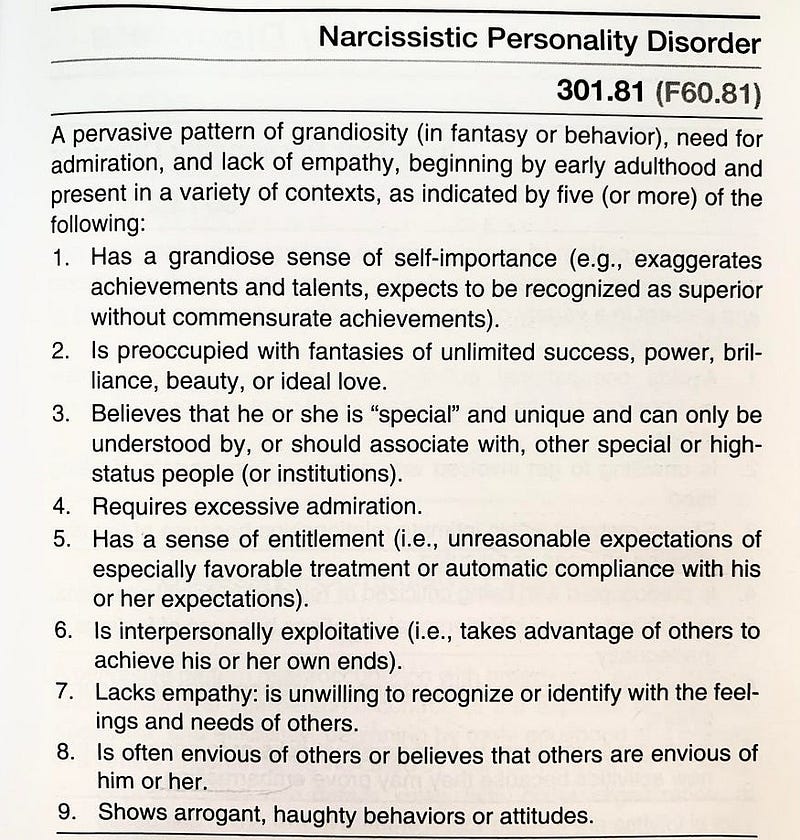
The Diagnostic and Statistical Manual of Mental Disorders (5th ed.; DSM–5; American Psychiatric Association, 2013)

Katie Hopkins is a compulsive attention seeker and goes as far as expressing very extreme opinions to obtain it. She clearly lacks empathy, which is shown in her attitude towards others’ suffering.

“I think overweight people are lazy and that they are bankrupting the country.”

“Rescue boats? I’d use gunships to stop migrants.”

“Like being bullied, being depressed is a fashionable thing to be… The ultimate passport to self-obsession.”

She regularly displays arrogant and haughty behaviours when talking to people to the point of being derogatory towards them. She openly admits that she stole her husband from his previous wife — they started sleeping together when he was still married.

“If you don’t look after your husband then I’ll take him — so do a better job…”

In general, she is grandiose and seems to believe that she is more unique and high-class compared to others and therefore entitled to special treatment.

Regardless, Hopkins has shown a capacity for empathy.

She has highly controversial views on obesity, such as it being the result of laziness and not being willing to hire overweight people. In 2015, she made a documentary called My Fat Story to prove that weight loss is relatively easy and overweight people are just lazy by putting on nearly 20kg and then losing it.

Here is a video of her prior to the documentary, which shows her hostile attitude towards overweight people:

The video below is after she made the documentary:

By comparing the two, you can clearly see how her behaviours are miles apart. In the first video, she is quite aggressive towards the overweight member of the audience, even offering to “fight” her.

In the second video, however, from her body language to her words, everything about her attitude towards the woman struggling with obesity is different. She is visibly empathic and compassionate, which even the presenter points out in surprise.

This is an entirely different Katie Hopkins than the one we have had sitting on this sofa. I’ve never seen you be so warm. I’ve never seen you be so caring. I’ve certainly never seen you be so empathetic with someone.

How did her attitude change so drastically?

Aggression comes from lacking in empathy — if we cannot understand and relate to someone else’s problems, we are more likely to be angry at them for their behaviours and failures in general. However, when we learn how to empathise with people, there will be a reduction in our hostility towards them.

In her documentary My Fat Story, for the first time, Hopkins experiences what it is like to be overweight. Throughout the series, she gets emotional, cries, feels unattractive and is ashamed to go for a run when she first starts to lose weight, as she believes people outside will judge her just like how she used to judge overweight people in the past. In other words, by going through these struggles herself, she was able to relate to the struggles of those who are overweight. This is the reason for her change in attitude and newfound ability to empathise with overweight people.

Is there clinical evidence to support narcissists’ ability to feel empathy?

Otto Kernberg, a well-known psychoanalyst for his theories on borderline personality organization and narcissistic pathology, explains an interesting phenomenon in his book Treatment of Severe Personality Disorders — Resolution of Aggression and Recovery of Eroticism. For one of the chapters, he re-interviewed his past patients with NPD, who had lost a spouse and then remarried. This was to investigate whether this experience had had any effect on them. Surprisingly, he found that they had;

a general attitude of tolerance of conflicts, a greater degree of understanding the viewpoints of others with whom they had experienced themselves in a serious conflict, and increased capability for forgiveness towards others who had disappointed them or treated them with hostility. All this seemed to go hand in hand with greater tolerance for the ambivalence of human relations in general, an increased curiosity in the experiences and motivations of other persons, and a sense of greater understanding and greater freedom to be of help to other persons who were undergoing a mourning process.²

It is indeed interesting that a spouse passing away could have such an effect and this highlights the importance of experiencing something that allows narcissists to mentalize and relate to others’ pain. When narcissists learn how to mentalise, they become more emotionally empathetic and this has a positive effect on their relationships.

References:

[1]: American Psychiatric Association. (2013). Diagnostic and statistical manual of mental disorders (5th ed.). https://doi.org/10.1176/appi.books.9780890425596

[2]: Kernberg, O. F. (2018). Treatment of Severe Personality Disorders — Resolution of Aggression and Recovery of Eroticism. Amer Psychiatric Pub Inc.

If you enjoyed this post and would like to read more, you can subscribe here — https://medium.com/subscribe/@ella_harris to get an email whenever I publish a story. You can also buy me ☕ via — https://ko-fi.com/ella_harris

This post contains affiliate links. If you use these links to buy something I will earn a commission. Thanks.

Psychology
Mental Health
Narcissism
Personality Disorders
Empathy
Recommended from ReadMedium