
Can Music Save Us From Ourselves?
How music can bring a divided nation together.

If you think abortion should be illegal, then you also probably think that we should have stricter immigration.
While it might be fun to guess your views, this prediction is symptomatic of the most devastating issue of our time: political polarization.
You might think that I am being dramatic with such a conviction. But the truth is that anything and everything in our lives is affected by polarization. Need to send states money to fight COVID-19 so Grandma doesn’t die? Sorry, Democrats and Republicans don’t feel like agreeing. Need to save children from dying at school due to weak gun control? Sorry, the NRA’s not having it.
Whether it’s the climate’s future hanging on a thin thread or fighting gun violence, it’s impossible to do anything without cooperation. Cooperation — the keystone of American democracy — is becoming long lost.
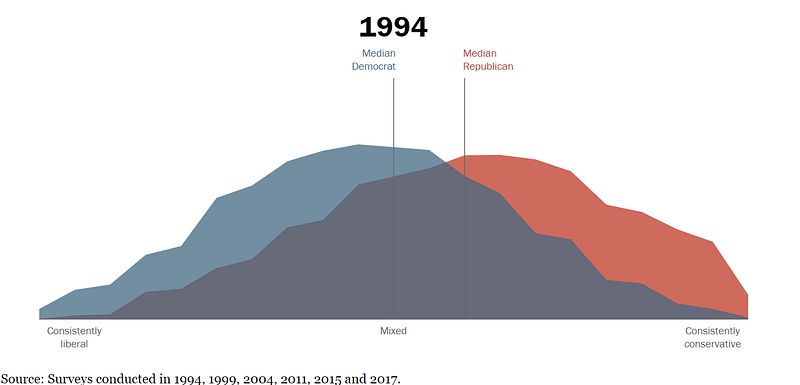
A 2017 Pew Research Center survey on political polarization found that Americans are becoming more ideologically divided over time. It was not always the case that all Republicans were conservative and all Democrats were liberal. As of the 1990s, in fact, the nation’s parties were still ideologically diverse. In 1994, the median voter of each party was largely mixed in their views.
Fast forward to 2017, and things look a lot worse. While this was three years ago, I’d reckon that the trend hasn’t reversed.
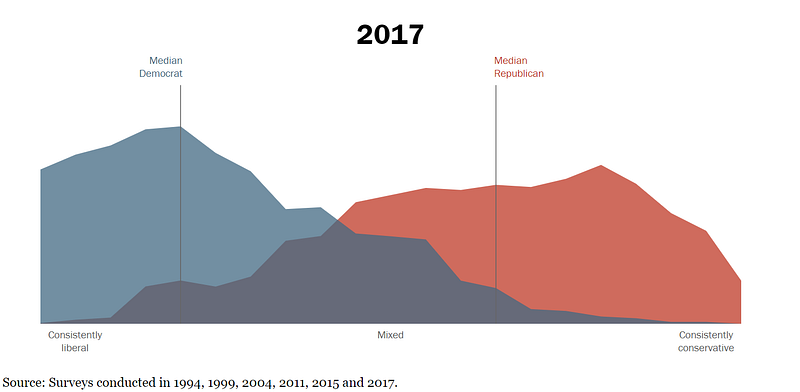
The American people have disagreed on the issues more than ever. When I say the issues, I literally mean all of them. We disagree on so much that the only thing we agree on is how much we disagree. You read that right.
Need to send states money to fight COVID-19 so Grandma doesn’t die? Sorry, Democrats and Republicans don’t feel like agreeing.
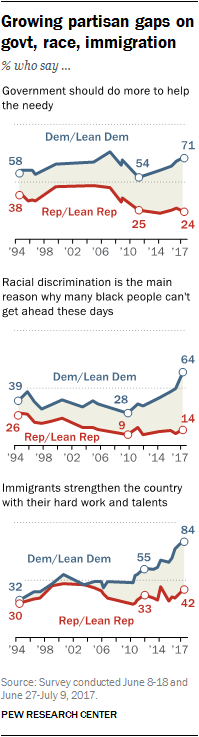
No one knows what the future holds, but if we depend on cooperation to solve the issues, the issues won’t be solved.
We need to come together sooner rather than later. Climate change, gun violence, and rigged elections won’t resolve themselves.
What can we do to come together amidst crisis? Play and listen to music.
Music is the beacon where, no matter what you believe in or where you come from, we all enjoy it. Especially together.
A study by researchers from McMaster University found that people enjoy music more when they are together than when they’re alone. Apparently our brainwaves synchronize in a way that makes us feel part of something bigger than ourselves.
“Dr Grahn’s research also shows some evidence that one of the reasons music evolved is because it allows large groups of people to synchronize their movement. When people move together, there is evidence they feel a sense of community and more altruistic, she explains.” — International Live Music Conference, April 2018
This makes a ton of sense considering my past experiences at concerts. Whether it was Bon Jovi or Guns N’ Roses, being in a crowd and chanting “living on a prayer” makes me feel one of a bunch. We’re water molecules converging together to make a wave that we call ballads. There’s not a better feeling than being in that wave.

Here’s where things get interesting: in addition to making us more communal, music has the power to make us more empathetic.
A 2018 study by academics from SMU, UCLA, and KU Leuven examined the connection between music and empathy. They had 20 university students get an fMRI scan…
“While listen[ing] to very short clips of music — some familiar and some unfamiliar to them, and some they might like or dislike, according to what the researchers could gather about their musical tastes. The idea was to see how people’s brains responded to these different kinds of music and then to compare those neural patterns.
Afterward, people rated the music they heard and reported on how empathic they were in everyday life — meaning, how much they tended to feel sympathy for others in distress and were able to take someone else’s perspective . The researchers suspected that empathy — an important factor in developing social relationships, which creates a distinct pattern in the brain when people are experiencing it — might influence how we process music.” — Jill Suttie, Greater Good Magazine, October 2018
The scientists found what you’d might expect: music and empathy are tied tighter than your shoelaces.
“Afterward, people rated the music they heard and reported on how empathic they were in everyday life — meaning, how much they tended to feel sympathy for others in distress and were able to take someone else’s perspective . The researchers suspected that empathy — an important factor in developing social relationships, which creates a distinct pattern in the brain when people are experiencing it — might influence how we process music.” — Jill Suttie, Greater Good Magazine, October 2018
A piece of the puzzle that we’re missing is empathy. Without empathy, we cannot understand each other. And without understanding each other, we cannot trust one another.
How can we expect to make any progress without trust?
Do you think the Bulls won six championships without trusting Michael Jordan? Do you think the Beatles achieved their success without trusting each other? I’d beg to differ. Even the financial system, something that is regularly criticized in the public eye, is based on trust. Without trust, it’d be damned.
It’s upsetting to write this to begin with. It’s as if we lost our love for each other. If we loved each other — as Americans — we would come together in times of crisis. Instead we don’t trust each other. Everything we do in Congress has to have a political goal.
One of my favorite shows to binge (unnamed to protect you from spoilers) covered this issue perfectly. The President of the United States keeps on trying to pass legislation to save various people of various circumstances. One time an American territory had an earthquake that led to a tsunami, and the president needed to pass a stimulus bill but Congress would barely budge. Congress gave the president three million dollars for an issue that required billions — with a b — in relief. Even when the president tried to pass an executive order to circumvent this, the political animals of the U.S. Capitol wouldn’t let him have it.
It’s almost as if the show didn’t have to create new plots at all. I’m surprised that the Obama Administration did not sue the producers for copyright. But I digress.
This show is akin to the current. Our elected officials have every opportunity to save American lives but don’t. They care more about their egos and getting reelected than they do about their constituents. It’s okay if communities are vulnerable to a contagious virus, as long as the Dow doesn’t drop then the worms should stay in their can, right?
Empathy for the People
If Ivanka Trump had the coronavirus, I’d bet everything I have that the president would’ve taken more serious action.
But this isn’t a criticism of the president as much as it speaks about empathy.
If our leaders felt the pain that most Americans do, then we’d pass more legislation for the good. It’s not a coincidence that we’re not proactively fighting income inequality when, for example, about half of Congress comprises of millionaires when only 12% of Americans fall under that category. What’s the rush for them? They have what they want. All they need to do is let us eat cake so they can get reelected.
It’s harder to take care of us when we’re struggling and they’re not.
We can’t expect anyone to care unless they feel empathy. They need to have a connection with what we’re going through. Because, if they don’t, good things won’t happen. If the country were a river and Dems and Reps were on the opposite sides, trust and empathy make up the bridge that for some reason doesn’t exist.

Rocker Politicians: Empathy for Each Other
So where does music fit within the lens of polarization?
We should optimize with what we have: 435 members of Congress plus the White House. And what do we have here? Politicians who rock for their constituents.
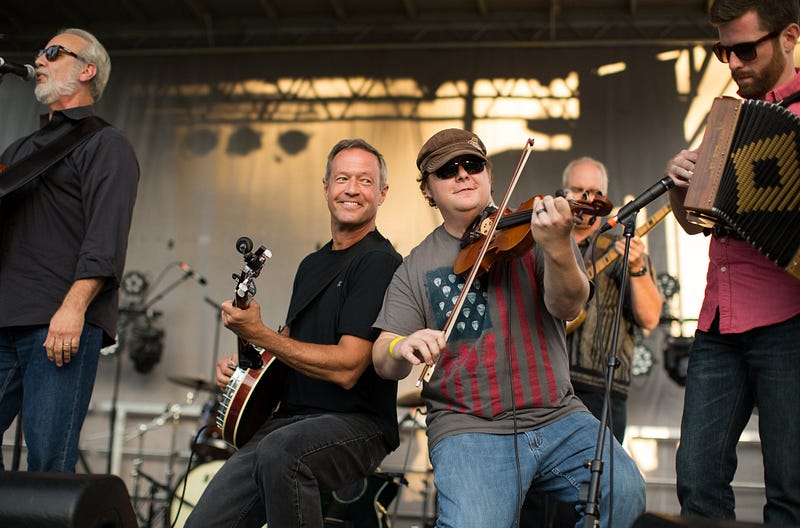
From Martin O’Malley to Bernie Sanders, there’s a considerable amount of officials in state and federal governments who know a thing or two about rhythm.
Music can be a potential activity for members of Congress to do together.
A good question to ask ourselves is how much time do members of Congress actually spend with each other, outside of work. Work in this case is pretty ubiquitous, as politicians — well — never take a break from being politicians.
In the grand scheme of things, the American Congress is simply put an organization. It has two corporate divisions: the Senate and the House. Its CEO is Donald Trump, its COOs are Pence and Pelosi. This company is powered from bottom to top: its members in the two divisions are supposed to make the products and the CEO just rubber stamps them (and sometimes suggests and/or works on product, depending on how proactive the president is).
Imagine being at a company where the product developers work together — to work against each other. Instead of collaborating to make product, the House (Democrats) and the Senate (Republicans) flick each other off at every chance they get.
American voters — not agreeing on anything — is only symptomatic of polarization: it’s the U.S. government’s job to keep standards high.
What is it like to not only not do anything fun with your coworkers, but also hate their freaking guts?
Music can be the solution to our problem.
After digging around on the Web, I found that there isn’t a lot of room for members of Congress to spend time with each other. This is how members of Congress spend their time, according to this report.
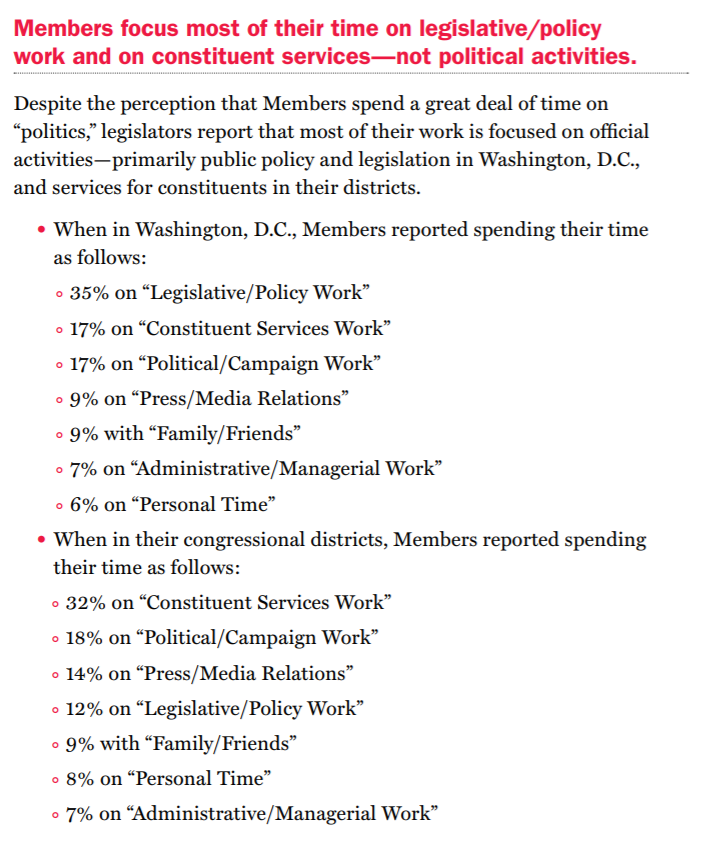
Maybe if they sacrificed some of their ‘campaign work’ for, let’s say, what normal organizations do (have regular gatherings of their employees) — members of Congress can reestablish trust. Not just among the American people, but also among themselves.
The irony of campaigning is stupendous. Why would you need to spend so much time advertising for your job when you’re already good at it? Isn’t marketing for losers? Shouldn’t your actions speak louder than words?
Yet again, I digress.
If they spent less time running against each other and more time playing music with one another, that could build the bridge of empathy they need. Music can restore trust in the system.
Trust in the system is the antidote of a divided nation. And music can empower it.


