
Can Mac Gaming Actually Be a Thing?
It’s kind of a chicken and egg problem.

Introduction
Mac and gaming, are the two words that do not bode very well. What about the future? It is… kind of complicated.
Traditionally, Apple did not want to market their Macs as specially ‘game-able’. They focused on promoting their productivity side of things, and it indeed does it well. Mac and productivity do seem to bode well, at least among the mass volume of productivity videos on the internet.
However, among gamers, Mac is kind of a forbidden word. Well, technically, it’s not forbidden, it’s just probably forgotten. In a more stereotypical generalization, most Mac users do not typically game. Thus, as time goes forward, Mac users kind of gain the reputation of being ‘non-gamers’.
Questions like, ‘But can you game on Mac?’ may occasionally pop up in conversations or forums, and the answer is also quite simple. Gaming on a Mac is simply just, kind of limited. The options are limited, and you may need some additional software just to run some games.
If the game is not officially supported on MacOS, the journey to play the game itself may be challenging for not-so-tech-savvy users.
But something seems to be slowly changing in recent years…
But Listen: What about... Ray Tracing in iPhones?
With the introduction of the iPhone 15 Pro and Pro Max, it ships with the A17 Pro chip, which supports Ray Tracing Graphics. Ray tracing is generally a technique used to generate the way light works; hence, the graphics in-game would have a significant increase in realism.
Ray tracing needs a lot of parallel computation power, hence the need for GPUs. Since phones have a smaller screen compared to laptops, some people would argue that ray tracing support on a phone is quite an overkill.
However, looking from a different perspective, one may say that this is just an initial step into something much larger. With the introduction of ray tracing in their phones, I think it should be inevitable for their future desktop chip (M series) to include the same feature.
Thus, what we are seeing here is that Apple M3 chips may potentially start to support ray tracing too, and it seems that Apple kind of wants to commit to their gaming aspect on their platforms, incentivizing game developers to help move or port their games into Apple’s existing ecosystem.
However…..
Games Moving From Windows to MacOS
Porting games across different computer architectures is no easy feat, and in the game industry, time and resources are a lot of money.
Normally, games developed in Unity Engine would be available on Mac natively, as the game engine provides an easy way to just compile the game in Mac native format.
However, this is not the same for other games using other game engines or their company’s internal game engine.
Here’s a simple analogy: you can think of Windows and MacOS as different language speakers. If game developers want to move their games across different platforms, they would need a significant change as the two platform uses different terms (API) for the same function, hence requiring a lot of translation (aka effort).
Besides, it is not just the development itself that needs time and resources. The whole testing process, bug-fixing, and maintenance effort is also huge and is some kind of ‘hidden’ effort that developers would not notice in early phases.
Thus, normally we would also see game companies outsourcing other companies to help ‘port’ their games to other platforms like Nintendo Switch, or in our case MacOS.
So, assuming that Apple is now assisting game developers by potentially covering up the development expenses, what’s the catch?
A Deeper Look Into the Problem
If we take a look deeper, we may find that the problem itself is not as easy as covering the development expenses. It also involves a main issue, which is the sustainability and market share of Mac users in the gaming sector.
According to the Steam Survey September 2023, these are the stats of the platforms that are gaming on Steam. Note that these do not account for the mobile gaming sector. Notice anything significant?
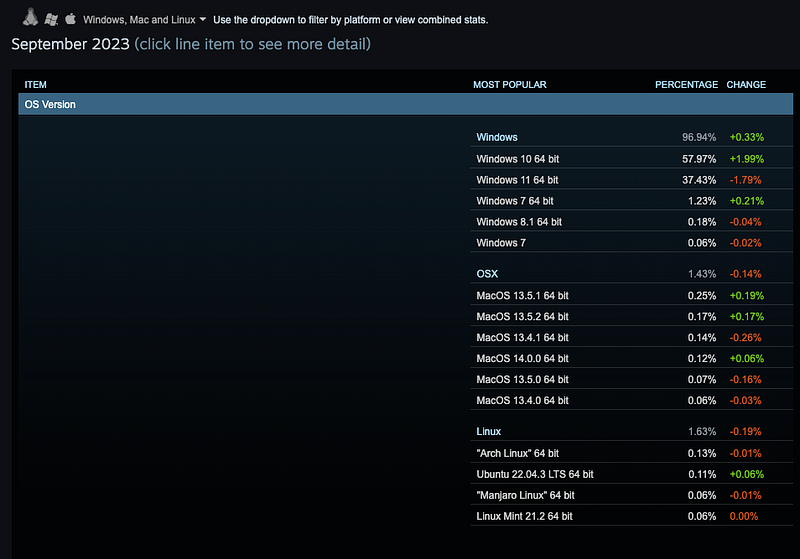
- Windows — 96.94%
- OSX — 1.43%
- Linux — 1.63%
Due to the tiny percentage of OSX gamers (which is MacOS in general) compared to Windows, it seems obvious that most game developers would not have great intention of porting their games to the Mac ecosystem.
So, this would be the main problem. Even if Apple had committed to helping game developers port their games into MacOS, the Mac gaming community is generally too small compared to the effort needed.
A Recent Example
For example, in October 2023, Valve just announced that they would be dropping MacOS support for Counter Strike 2. Note that the predecessor game (CS:GO) actually had MacOS support.
The reason that was provided by Valve is: it is just too small of a community, as MacOS users contributed less than one percent of active players.
It’s simply not worth it from a developer standpoint.
The Chicken and Egg Problem: A Never-ending Loop

Hence, we have now fallen into a chicken and egg problem, where the loop does not end and the cycle will continue. What do I mean?
Basically, we have few stakeholders in this issue, which involves the company (Apple), game developers, and gamers. Now here’s the catch:
- Game developers would not want to spend resources porting games to MacOS, as it has too little of a gaming market in terms of percentage.
- End users do not have any good incentive to buy Macs for gaming, because Macs are not the best option for gaming, in terms of accessibility and also pricing.
- Finally, Apple may find it just not worth it to commit to the gaming aspect on their platforms, as there is no great demand from users (since gamers already chose other platforms).
- This, in the end, would lead back to game developers not wanting to spend resources, and the loop continues.
Breaking the Loop
So how would this loop be broken?
The answer is quite simple. One of the stakeholders needs to do something, and it is quite obvious that Apple is doing it now. A lot of effort needs to be spent not just incentivizing game developers, but also their own hardware (the new chips introducing ray tracing).
By showing their commitment to their own hardware, only this can give developers and users more confidence in Apple’s overall stance on Mac (or Apple) gaming.
Even then, it still takes time to build up a gaming community among users in the Apple ecosystem.
So, it this strategy even logical?
One important point to note is that, since existing Mac users generally do not have a high demand for gaming (as most gamers may already be using PCs), it currently only acts as a ‘nice to have’ feature, providing additional capability for users.
To really convince the users on the other side, there are a lot of things that will need to be considered. So even if there is good support on Mac, if there is a much better alternative at a similar price point, people will just get the alternative instead.
Besides, if the performance between the same price points is similar, it is extremely likely that people will stick to what they are familiar with.
Somehow, the product value and gaming experience would need to be that much greater, so that users and gamers would want to perform the ‘leap of faith’ into the Apple ecosystem. This process would take time as well.
Conclusion
The current chicken and egg problem for Mac gaming is indeed hard to be solved.
Commitment and time are a must, and it seems good that Apple is planning to reduce the gap in both hardware (chips) and software (game development). The good news is that the gaming gap between Windows and MacOS users will be reducing.
But, whether the inflection point will occur is still unknown. Until then, the road to a world where mainstream users recognise Mac as a gaming platform, will be a long haul.