
Can Ecstasy Cure PTSD?
Understanding PTSD and an unexpected treatment
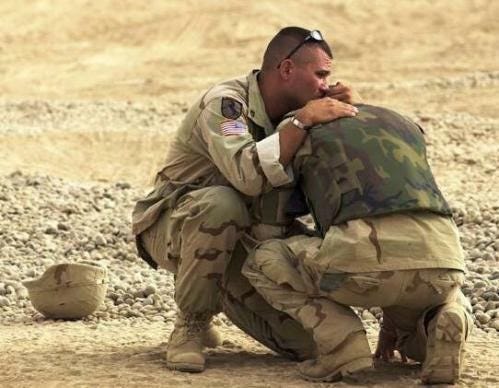
The National Book Award for fiction was awarded to Phil Klay, a returned soldier, for Redeployment, a short story compilation that draws on Klay’s experience serving as a Marine in Iraq. In an interview with Alexandra Halter in The New York Times, Klay said that writing the book helped him to overcome and process his post-traumatic stress, adding, “I can’t think of a more important conversation to be having, war is too strange to be processed alone.”
Phil Klay’s experience with war trauma is unfortunately a shared experience. An unprecedented amount of soldiers who toured in Iraq and Afghanistan returned with crippling post-traumatic stress without the proper resources to overcome and reintegrate back into society. Post-traumatic stress disorder has left a staggering one third of American soldiers who served in Iraq and Afghanistan with PTSD. Of that one third, the side effects have a great range of severity, from unwanted thoughts to terrifying flashbacks. These more severe side effects often make it challenging for some to reintegrate back into civilian society.
The most common medical treatment currently prescribed for PTSD is SSRI’s or selective serotonin re-uptake inhibitors, which is the same medication used to treat depression. The medication creates an excess amount of serotonin in the brain, which is responsible for regulating mood. But as mentioned in the Harvard Health Publication, SSRI’s are just a temporary fix masking the underlying problem and is not considered a cure. The underlying problem is the one Klay is talking about — the difficulty of processing memories of war and the need to do so with the help of others.
It is time to revisit the results of a study conducted by the Multi Disciplinary Association for Psychedelic Studies (MAPS). The study combined methylenedioxymethamphetamine (MDMA) — also known as ecstasy or molly — with a series of psychotherapy sessions to study the effects on soldiers returning from Iraq and Afghanistan with severe PTSD. But before we discus the startling results of this study it’s important to first understand PTSD and how it affects those suffering from it.

Post-Traumatic Stress Disorder, in its simplest form, is the brains inability to successfully adapt to traumatic events. This unsuccessful adaptation can take form through a wide range of adverse symptoms and complications, but the most common symptom in soldiers, as many people know, is re-experiencing past trauma through violent flashbacks.
Recent research in cognitive psychology has shown that after experiencing a traumatic event, there is an initial reaction of total shock followed by a period of information overload where memories and images of the trauma cannot be stored in the same way as ordinary memories. As a result, a multiplicity of psychological defense mechanisms takes charge in order to keep the traumatic information unconscious. This is followed by a period of denial and or detachment. The brain has a need to integrate new information with already existing information, this causes the traumatic memories to break through the psychological defensive mechanisms in place and invade into one’s consciousness in the form of flashbacks, nightmares, and unwanted thoughts. Failure to process this traumatic information means that the partially processed information will remain in one’s short-term memory without ever being fully processed leading to constant post-traumatic symptoms.
Guess what? There’s a drug free cure, but it may be the most terrifying, and uncomfortably introspective cure out there.
If those who are struggling with PTSD are able to reprocess their trauma in a way that allows their brain to successfully make sense of their memories and properly store those memories, they are no longer susceptible to unpredictable flashbacks and nightmares brought on by their trauma. Essentially, reliving one’s most terrifying memories is the only known effective cure. This is, perhaps, the most critical step in recovery as well as the most difficult step. Often, when patients get to this point, they are paralyzed by fear and understandably can’t gather the strength to mentally experience their trauma all over again.
This is where the MDMA comes in.
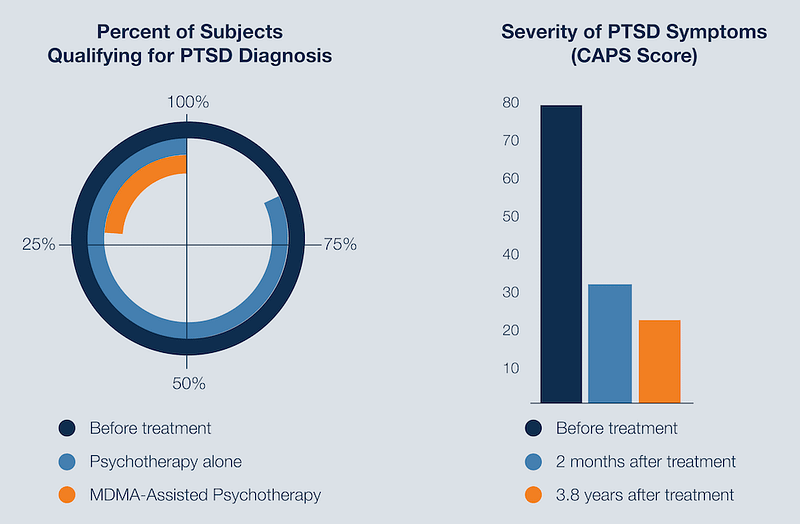
A clinical trial conducted by the Multi Disciplinary Association for Psychedelic Studies (MAPS) combined MDMA with a series of psychotherapy sessions for soldiers returning from Iraq and Afghanistan with severe PTSD. This clinical trial is one of the first studies to ever to draw conclusive evidence in potentially curing PTSD. MDMA triggers the release of endogenous chemicals in the brain, chemicals that reduce the response to fear-inducing stimuli that would subsequently allow patients to revisit traumatic experiences without becoming paralyzed by fear and panic.
The study administered MDMA on three separate occasions, all coupled with psychotherapy sessions. By the end of the trial 89% of subjects felt Increased self-awareness and understanding, and 68% experienced fewer nightmares, flashbacks or intrusive memories with 77% of subjects having lasting benefits.
Unfortunately due to the criminalization of MDMA the public may have preconceived notions about the efficacy of using a “party drug” to combat something as serious as Post Traumatic Stress Disorder. In response to the taboo nature of the study Dr. Michael Mithofer — one of the lead scientists on the study — explains,
“It’s not that people just have a blissed-out experience and feel great about the world, a lot of the time it’s revisiting the trauma, and it’s a painful, difficult experience. But the MDMA seems to make it possible for them to do it effectively.”
Let’s not judge our soldiers for using a treatment that happens to be a party drug. In fact, PTSD itself was once considered a taboo subject after its initial discovery. Shortly after PTSD was discovered, some doctors and military officials didn’t recognize it as an actual disorder, but rather a way for cowardice soldiers to be relieved from duty. One American doctor suggested that “any appearance of such symptoms as tremors, paralysis, etc. should be rigidly discouraged” (Cowardice) as if soldiers displaying said symptoms were choosing to do so. The military began to limit leaves, placed soldiers in isolation, and administered electric shock therapy in order to “suppress the self-indulgence which is so often the cause of the soldiers’ condition” (Cowardice).
It wasn’t until 63 years after Dr. Thomas W. Salmon — the chief consultant in psychiatry for American forces in Europe discovered “shell shock” that PTSD became an official diagnosis in the American Psychological Association’s third Diagnostic and Statistical Manual (DSM-III) in 1980. Upon PTSD’s induction into the DSM, the public’s understanding of the disorder has exponentially increased to such a degree, that an article in the Journal of Anxiety Disorders was written to more clearly articulate the definition of PTSD. The outcome of the clarification was the availability for PTSD to be used and studied correctly among all medical professionals.
One would think that with the promising results the MDMA study displayed that there would be a follow up study almost immediately. It took some time due to MDMA’s classification as a Schedule 1 drug, but the FDA has agreed to expand access to the program. All the while, MAPS has moved onto Phase 3 FDA trials to eventually make MDMA combined with psychotherapy an approved prescription treatment for PTSD. If all goes well we could be looking at a life changing treatment that would help thousands of soldiers that risk their lives for their country.


