
Can Cognitive Dissonance Hold You Back While Investing?

I have often heard investing is only for the rich to become richer. During the pandemic, the rich are getting richer. When you barely make ends meet, the stock market is one of the last things on your mind. However, we all want to retire comfortably, which is possible through investing. To invest, you need the money and to make more money, most of us need to invest. It’s a vicious circle. I have been there, and the first thing that I had to change was my mindset.
Locus of control as the first step In life, there are many things that happen. We all perceive events in another way because of our locus of control. Julian B. Rotter developed the concept of locus of control, which revolves around the degree of control individuals believe they have over the outcomes in their life. An individual with an internal locus of control believes that outcomes in their life primarily depend on their actions, where someone with an external locus of control believes the opposite.
External factors play a part in our lives, but how we react to them is in our hands. Making it possible to invest a certain amount regularly makes it possible to make more money. But how do you get there? It starts with challenging the mindset that investing is only beneficial for people who are rich. It’s possible to compound your money over time while starting with a small budget. At this moment, the reality reveals that this belief isn’t true, which can lead to cognitive dissonance. Leon Festinger researched this phenomenon and there are three ways to reduce the dissonance.
1: Change one or more of the beliefs, attitudes, values to make the relationship between the two elements consonant.
The individual could learn more about the benefits of investing and abandon their belief that investing is only meant for the rich to become richer. Or they could change their belief by adding that bad moments such as (virtually) losing money are also part and parcel of investing for everyone and learning how to deal with it. Acting in this way allows you as a regular investor to keep the belief that you can compound your money over time.
2: Use new information that outweighs the dissonance
You could tell yourself that people with a similar background made a lot of money through conducting their research and disciplined investing. However, even experts in the field despite conducting their research will also lose money (virtually) because of external factors that are likely to not be permanent, a company that shows unexpected negative results, a trade war, or an epidemic virus that affects the whole stock market. However, over a longer period, they increase their wealth by dividing their investment(s).
3: Reduce the importance of the cognition(s)
The investor could convince him/herself that investing would not matter much to them in the grand scheme of things. This would help them reduce the dissonance between the belief that investing is only beneficial for the rich to become richer and the reality that anyone who invests regularly can compound their money. At that moment doing your research, expecting good long-term returns on their investment and the reality of (virtually) losing money is less important.
What the expert of investing recommends Warren Buffett recommends investors to invest in an index fund. The S&P 500 returns 10% annually on average. Below, there is a graph of the S&P 500 in the last 50 years.
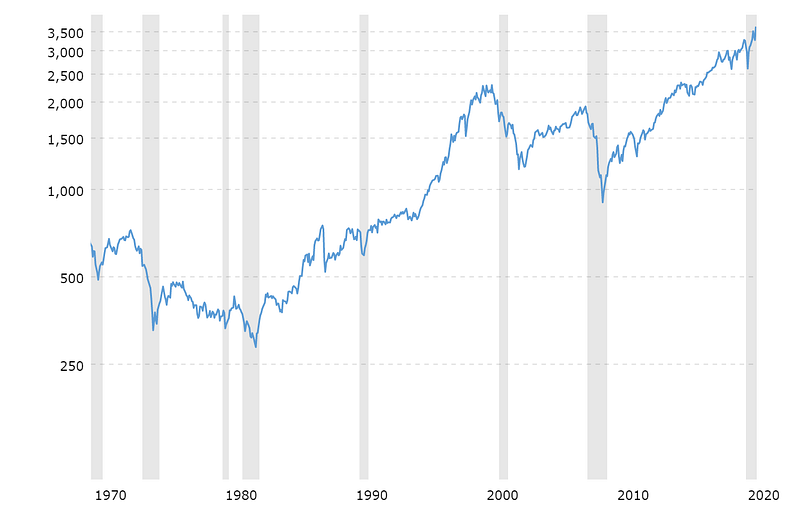
I will show what this can mean for you as a regular investor.
1000 dollars/euros and adding the same amount each year with an average annual return of 10% becomes 181.943 dollars/euros after 30 years.
After 40 years, the same strategy leads to 487.852 dollars/euros.
After 48 years, the million-dollar/euro threshold is reached because your initial investment becomes 1.057.190 dollars/euros.
Cognitive dissonance can hold you back from seeing that it’s possible to make a substantial amount of money through investing. Having money in the first place helps and believing that with patience investing can be beneficial for all of us.
Thank you for reading and I wish you a nice day.
This article is for informational purposes only. It should not be considered Financial or Legal Advice. Not all information will be accurate. Consult a financial professional before making any major financial decisions.