
Can Co-Living Alleviate the Rental Crisis?
Rental prices have been skyrocketing in many countries, particularly in big cities, after the pandemic. This has resulted in a “rental crisis” in major cities like London (Barnes, 2022), Melbourne (Yu, 2023), and Sydney (Harris, 2023), etc. Unfortunately, it may take several years for the housing supply to adjust to the disruptions caused by the movements of people in the post-pandemic period, and governments have no immediate solutions to the global rental crisis. Co-living has been studied as a potential quick fix solution to the problem.

What is Co-living?
Co-living is a form of shared living space. There are several different models of sharing living space, such as co-housing, co-living, and sub-divided units:
Co-housing is like a dormitory where tenants share both private and communal living spaces.
Co-living is defined as a housing arrangement in which individual tenants have a private self-contained housing space (a house, a flat, or a bedroom) but share a range of communal facilities with other tenants, such as shared living areas, dining spaces, gardens, etc.
Sub-divided units, on the other hand, are more common in high-density cities such as Hong Kong, and they are independent housing sub-units without sharing any space except the main entrance and the corridor leading to the units.
Why has Co-living become more popular?
Co-living has become increasingly popular due to the sharing economy’s chic and the sophistication of online peer-to-peer accommodation platforms. Co-living is viewed as a solution to the housing affordability crisis in cities with high housing rents (Corfe, 2019). Additionally, co-living provides spaces and opportunities for better social interactions and engagements with other tenants, making it a new way of living in cities that emphasize community and convenience (Coricelli, 2022).
In various cities worldwide, including New York, London, Seoul, Hong Kong, and Auckland, startups specializing in co-living are increasingly emerging. These cities are known for their high housing rents and attract many visitors, expatriates, as well as local and international students. As a result, the demand for rental housing in these cities is highly volatile, especially during peak seasons. The popularity of co-living in these cities can be attributed to the need to provide affordable and flexible housing solutions.
Hurdles in Co-living
Despite the increasing demand for co-living in large cities, the scale of co-living space is still in its infancy compared to traditional renting of whole houses or flats. There are hurdles in the market demand and supply. Sharing living space can have disutility, such as inconvenience and lack of privacy, and conflicts between tenants. As a result, it requires a rental discount to justify the disutility. On the supply side, landlords require sufficient economies of scale to make the scheme financially viable, especially when the conversion cost is high.
Although there have been very few studies on the rents of co-living, our recent study of residential rental listings data from New Zealand showed that even though co-living tenants may receive rental discounts, sharing communal space with more flatmates in co-living houses can increase the overall total sum of rental incomes, indicating economies of scale (Yiu, Cheung & Xiong, 2023).
Economies of Scale of Co-living Space
We gathered a comprehensive data set of housing rental listings by collecting 99,146 entries from TradeMe (2022), a leading online real estate agency in New Zealand. The data includes all residential rental listings from major cities in New Zealand from November 2021 to January 2023. To estimate the total rent per week for each house, we multiplied the listed rent by the number of flatmates plus one. This represents the maximum rental income generated from renting either a single-family occupied house or a co-living home.
Our study uses a traditional semi-log hedonic price model to analyze individual housing data and test the disutility and economies of scale effect of co-living. Our results indicate a 17.3% switching discount for co-living, showing an initial marginal disutility. However, as the number of flatmates increases, there is a gradual increase in the economies of scale effect. This suggests that while individual co-living tenants may receive some rental discounts, the total rental income can be increased by sharing communal space with more flatmates in co-living homes (Figure 1).
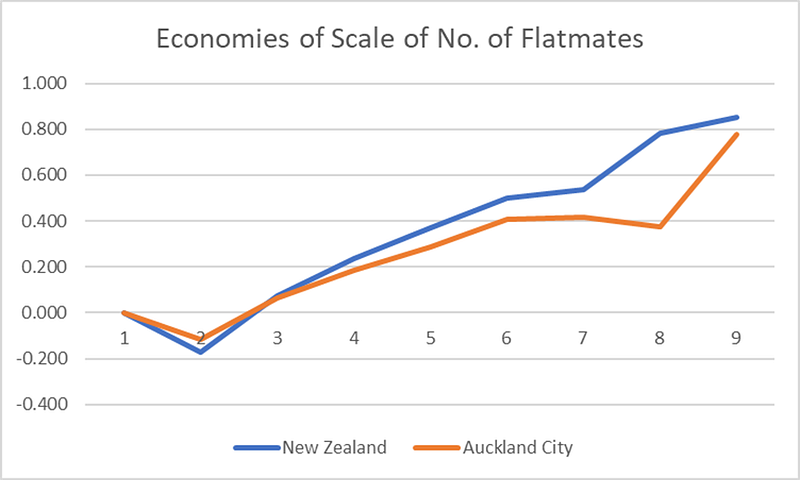
Consumer Substitution Theory explains why co-living space in expensive cities
In a closed system, the affordability of house rents should theoretically be limited to a certain level. For example, the maximum affordable rent for a single-family occupied housing unit may be set at 30% of a household’s disposable income, regardless of the unit’s size or quality. However, tenants tend to consume less floor area or poorer housing quality in exchange for living closer to the city centers when rents are higher, as predicted by the consumer substitution theory (Leung & Yiu, 2022). Therefore, housing units in city centers are often smaller in size and have a higher density. Space sharing is more common in expensive city centers.
To share living space, there are three approaches: co-housing, co-living, and sub-divided units. These approaches can increase the overall total rental income, especially when the number of co-tenants is sufficient to achieve economies of scale, even with a significant discount for individual tenant rents.
Conversion costs for sub-divided units and co-living space
In addition to rental discounts and economies of scale, there are various capital costs associated with leasing shared spaces, including conversion costs. Among the three approaches to sharing living space, sub-divided units have the highest conversion cost, which includes building independent pantries and toilets for each tenant and may require approval from authorities. As a result, sub-divided units are typically found in informal housing markets. Although the unit rent of sub-divided units can be higher than co-living spaces, the risks and upfront intensive capital investment involved can be insurmountable.
On the other hand, co-living spaces have much lower conversion costs since most facilities, such as kitchens and toilets, are shared communal spaces. This cost is even lower in cities where large-sized single-family houses are common, providing enough bedrooms and communal facilities for sharing. When privacy is not a major concern for tenants, co-living with more flatmates can enhance networking and engagement, provided that there are sufficient shared communal facilities to meet basic needs.
- **This article is written for the World FM Day 2023***

References
Barnes, O. (2022) Inside London’s rental crisis, the mass return to cities post-lockdown swamped the rental market with demand, Financial Times, Dec. 28. https://www.ft.com/content/4a7a19b7-0f17-4702-9949-e0ff6f4f605e
Corfe, S. (2019). Co-living: A Solution to the Housing Crisis? Social Market Foundation, February. https://thinkhouse.org.uk/site/assets/files/1885/smf0219.pdf
Coricelli, F. (2022). The Co-’s of Co-Living: How the Advertisement of Living is Taking Over Housing Realities, Urban Planning, 7(1), 296–304. https://doi.org/10.17645/up.v7i1.4805
Harris, C. (2023) Rental crisis fears for international students as they return to Sydney, The Sydney Morning Herald, Jan. 30. https://www.smh.com.au/national/nsw/rental-crisis-fears-for-international-students-as-they-return-to-sydney-20230130-p5cgj0.html
Leung, K.M. & Yiu, C.Y. (2022). How do the poor survive in an unaffordable city? — An empirical study of informal housing households living in Hong Kong, International Journal of Urban Sciences, 26, 398–419. https://doi.org/10.1080/12265934.2022.2036627
Yiu, C.Y., Cheung, K.S. & Xiong, C. (2023) Economies of Scale of Co-living — an empirical study of the New Zealand Rental Housing Markets, Pacific Rim Property Research Journal, 28(1), 1–19. https://ssrn.com/abstract=4345418
Yu, A. (2023) Melbourne renters struggle to secure a suitable place to live as a rental market crisis continues, ABC News, Mar. 12. https://www.abc.net.au/news/2023-03-12/victorian-rental-market-crisis-housing-shortage-tenants-victoria/102084206