
Can ChatGPT Replace Google
Google search faces many threats, but ChatGPT isn’t one of them

On Nov 30th, OpenAI released ChatGPT Beta. Within a week, it has taken the world of content creation by a mini-storm.
When it will be released publicly, it is only a matter of time before apps powered with ChatGPT will be all over the world. The non-tech world will quickly catch up with it, too.
Meanwhile, Microsoft competitors might start actively pushing their engineering managers to come up with their AI weaponry. If not, they will build a strategy to cope with the new world dominated by AI-generated content.
For now, I am relishing a deja-vu moment.
Google and Microsoft’s Deja-vu moment:
The end of the 90s witnessed Microsoft losing the Anti-trust case against the US Department of Justice. It was held responsible for the death of the Netscape browser (the father of Mozilla Firefox and Javascript), and illegally monopolizing the Windows users market by forcing Internet Explorer down their throats.
Microsoft’s careful steps in the web area, coupled with its ongoing litigation liabilities ensured that the web space was open from domination by a single company.
Google took advantage of the market gap. Having built a gigantic web presence based on its highly relevant search engine, it also built Chrome (2008). Unlike the browsers of the 90s, it got unobstructed access to all platforms (including Windows) and became the de-facto browser of the world in no time.
In doing so, Chrome served an ulterior motive that many users weren’t aware of: When used to browse GMail (which was made in 2004) and other Google applications, it became much more streamlined and performant to pile up Google’s inventory:
That of the personalized user data.
Today, with Microsoft-backed OpenAI’s GPT release, the internet is asking a question Google isn’t comfortable answering:
Can Chat GPT replace Google?
Google Search is falling off the relevance chart:
Google’s most dominant revenue source is Search.
With or without ChatGPT, the news isn’t good for Google. Its search results are faltering. And people are finding out about it.
Here is a 5-point summary of my personal experience:
#1: Google search results are ads-only, with little or no organic search results:
It’s true that Google’s search platform is ad-driven. For a long time, ads occupied only the top spot.
This got worse, and ads began to occupy the greater area. Often, they occupied the whole page with no organic entries.
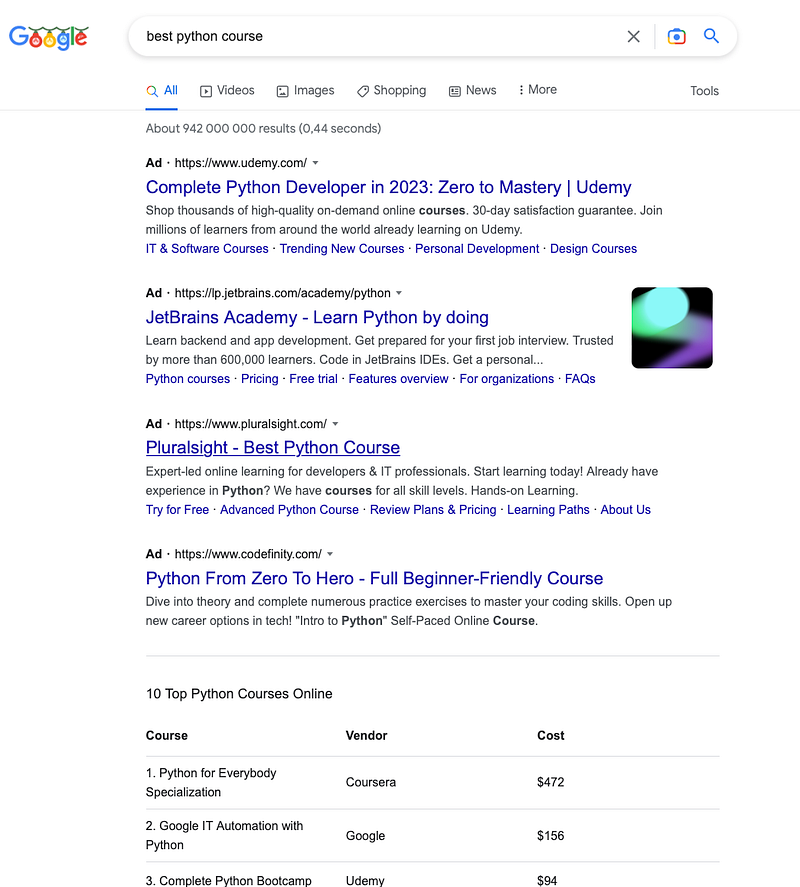
Google’s webmaster manifesto once said that to be in the top search results, a website needs to have its relevant content under the fold. The fold is approximately the first visible page area before the user has scrolled.
Google violated the fold
Websites that do not follow this rule (i.e. having their top keywords below the fold, and not within it) are downranked in the Google search ranking.
Google violates its own rule, by giving way more/complete space to advertiser’s links when the user is looking for an organic source.
#3: Gaming by SEO junkies:
When I was building my first WordPress blog, I was on a mission to be in the top search result, without paying a dime to Google. (In those days, I trusted its bias for organic results)
Turned out, I wasn’t good enough. But what I noticed was the fact that there were tons of WordPress plugins that promised the top spot, and some webmasters seemed to rake in millions using those tools + affiliate marketing.
Their secret sauce? Google-friendly SEO.
The simple technique they used was keyword-stuffing the web pages at relevant points (In the first paragraph, in all the headers and subheaders, and so on). It didn’t matter if the content satisfied the user’s search query.
For example, in its early days, a lot of content on WikiHow used to be meaningless, yet it topped the search rankings.
#4: YouTube:
Today, those to-do websites have been replaced/downranked. And guess who replaced them? YouTube.
Now, I get that YouTube is Google’s long-due cash cow. Google bought it for under $1 Billion. And it’s finally delivering its true worth. The 2019 financial report revealed YouTube made Google $15 Billion just in that year.
But what Google doesn’t (want to) understand is that navigating to YouTube involves friction. Recently, a lot of it, due to Google’s greedy advertising algorithm. Users would happily watch an ad if going to YouTube is still worth it.
It would be worth the search terms such as: “how to fix a car tire”.
It’s less relevant, for the likes of: “How to create an excel formula.”
And then it’s pointless. When the user intends to copy-paste (e.g. “Linux file sync command”), going to YouTube to watch a 20 seconds ad is like going to your local cop every day, only to verify that your passport expiry is still in the future.
#5: DuckDuckGo:
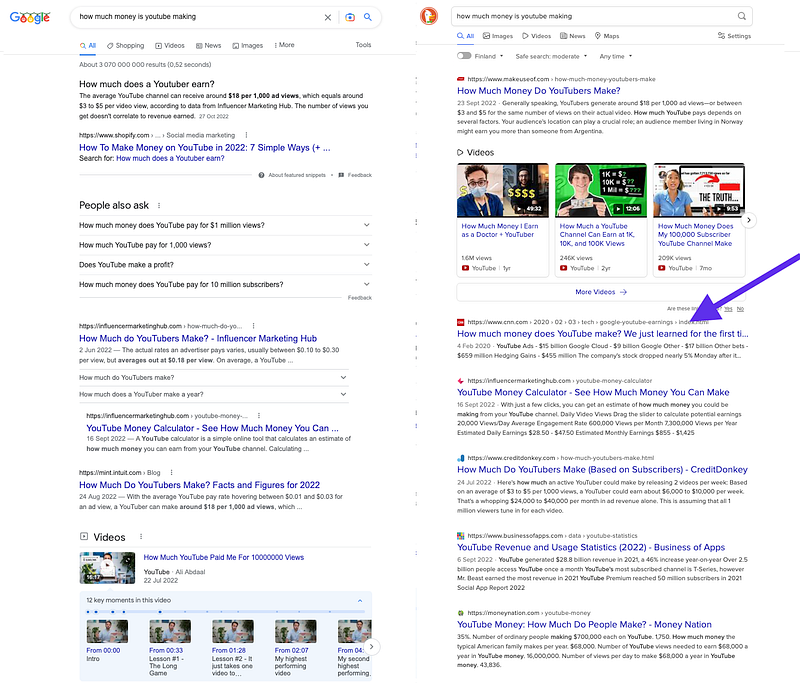
When it comes to relevance, DuckDuckGo is winning. I tried asking “How much money does YouTube make”. The irony: Google didn’t know.
#6: Miscellaneous:
Sometimes, Google search results simply falter to meet users’ expectations. For example, it fails to give any results for quoted (those enclosed by “”) queries.
At other times, proponents of the dead internet theory claim that the entire SEO game is rigged, and that most of the internet is fake:
Large proportions of the supposedly human-produced content on the internet are
actually generated by AI networks in conjunction with paid secret media
influencers in order to manufacture consumers for an increasing range of
newly-normalized cultural products.
Can ChatGPT replace Google Search?
OpenAI’s latest invention has got the world talking. The query in the title is trending in the entire social media, so I am sparing the source.
ChatGPT isn’t going to replace Google search anytime soon. This is not because ChatGPT can’t access the internet, and it lacks recent information.
The reason it won’t replace Google is that it's different from Google. The architectural viewpoint that goes into serving Google-like services requires a different set of choices than the one used in ChatGPT.
The intent of ChatGPT (and its ancestor GPT) is to have:
- Meaning out of textual information — both in terms of data and sentiment
- Generate a response based on the intent (what the user has asked) and context (what has already been discussed)
The intent of Google search is to provide information based on keyword inputs.
- It doesn’t generate any information on its own.
- Deliver results based on ever-growing web content, in an almost real-time fashion
To understand the difference, though, we must delve into how Google search works vs how ChatGPT works.
Let us take a deep dive.
How Google search works:
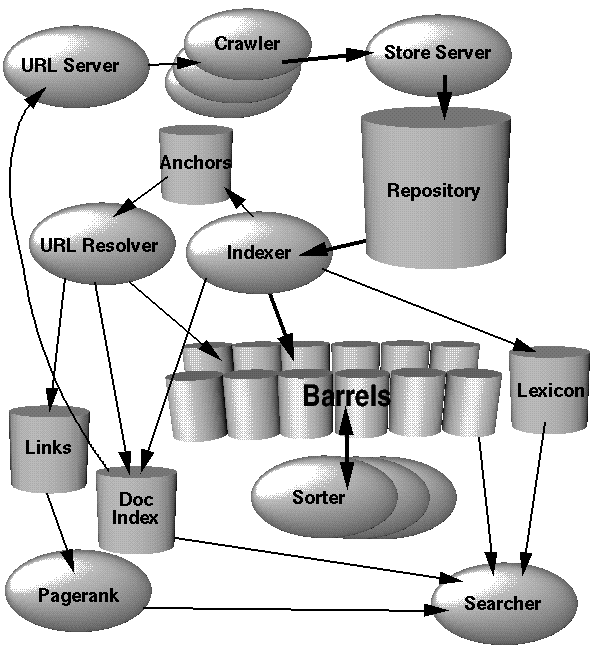
- On a very high level, Google search is simply a web crawler coupled with a huge database index. And that index is ever-growing.
- Crawler keeps scouring the world wide web periodically and adds newer URLs to its database.
- Most important: It stores all entire web documents on those pages, keyed by the keywords supplied by webmasters. This is done via HTML anchor text and meta tags. Every time user searches for “cruiser skateboards”, Google almost picks up all the pages (e.g. abc.com and pqr.com) having “cruiser skateboards” as their keywords.
- Even more important: Along with the web page content, Google also stores something which has historically been the closest credibility benchmark: The backlinks score. If abc.com/about has 50 links pointing to it (called backlinks), that number is stored as part of the abc.com/about.html database record. If pqr.com/about has 29 links pointing to it, that number is stored in the pqr.com/about database record as well. This is then converted into an intricate graph, the details of which are too tricky to cover in this article.
We aren’t done yet. The most important part is sorting those candidate pages, which makes it possible to show only the most relevant results for the user in question. This job is performed by Google’s famous core algorithm called Pagerank, authored by its founders Larry and Sergey.
The detailed explanation of this algorithm uses advanced mathematical concepts and is beyond the scope of this article. The below summary is enough only to understand its objective.
- Among millions of webpages that got almost picked up by Google, only a lucky few survive. Those are the ones having the right keyword density (but not overstuffing, which used to be the case in the early 2000s), harmless content (according to Google’s guidelines), no duplicity (i.e. plagiarism), and several other criteria for credibility.
- Pagerank then processes the pages using various scores, backlinks are one of them.
- On top of the above, in the last decade, as part of its AMP framework, Google has made several compliances mandatory (e.g. DOM standardization, page loading time, where not to place too heavy javascript, etc.) for searchability.
- The one having the highest score past all the filters is placed at the top.
- All of the above only applies only to organic search results. When the webmaster has paid Google for certain keywords, the website gets a top spot as long the user matches the campaign demographic and the webmaster’s budget hasn’t run out. If it also happens to be the top organic result, it enjoys double placement (this used to be true most of the time, but I haven’t been able to verify it lately)
Based on our primitive example, a search for “cruiser skateboards” will result in abc.com coming as the top search result, beating pqr.com.
Once again, the above explanation is overly simplistic for the scope of this article. Over time, Google’s original algorithm has not only changed, but it has got some AI-based natural language understanding + generation nuances, too.
For example, Google Search, with its MUM AI model, can detect if the searching user is trying to find ways to commit suicide, and can offer mental help instead of fulfilling his/her query.
How ChatGPT works:
I haven’t gone through the intricacies of how ChatGPT derives meaning from user queries and provides insightful answers. However, I will try to dissect its making from a layman’s viewpoint.
Any AI model is built with known inputs -> known outputs. This is how it derives its rules.
For example:
x = 3, y = 9.  => y = 3*x, right?
x = 4, y = 16. => wrong, y = 4*x.
x = 5, y = 25. => wrong again, y = 5*x
Eventually, it won’t take long for the AI model to learn that:
y = square(x)This is not very different from training a dog to go bring the ball (by rewarding it with food) but not the stick (by punishing it with the same stick).
An AI-based chatbot, at a very high level, contains the following:
Parser: This is done via tokenization (Separating sentences into verbs, nouns, objects, and subjects)
Sentiment analyzer: Based on the order of words, the presence of symbols such as “!” and “?”, and other tonal indicators, emotion can be taught. A sentiment analyzer usually emits a score: Positive or negative emotion score. More nuanced? Anger score: 0.8, Frustration score: 0.2, Sarcasm score: 0.4.
Feedback loop: While training the chatbot model, makers of the signal feed it with known text input, and mark the outcome that is intended as correct/incorrect.
For example, let’s say a data model has 3 inputs:
“Peter ate the banana angrily” (subject = Peter, Verb = eat, object = banana)
“Joanna ran the sprint hastily” (subject = Joanna, Verb = run, object = sprint)
“The elephant saved the child carefully.” (subject = Elephant, Verb = save, object = child)
After signaling enough sentences with those pairs, the model will know enough about the sentence structure and terms. When invoked, it will spit the desired output based on the requirement. (e.g. Joanna saved the banana — funny, but not wrong according to sentence formation it learned.)
That was simplistic enough. But the real use of AI comes when it is trained to infer various language phenomena from the likes of the following sentence tuples:
The pavement was wet and slippery. (**cause**)
A sign board told visitors to walk carefully (**possible outcome**),
or they would slip and hurt themselves. (**effect of wetness + falling**)

It rained heavily last night. (**cause**)
The river was overflowing. (**effect of water flow**)
The collector issued the flood warning (**consequence**)
In the above example, wetness can harm people, but it has various other outcomes such as the growth of grasslands. All such phenomena are just raw data inputs (<key><value> pairs of causes, effects, consequences, and so on) to a language model which intends to use them to become powerful.
Bigger and more extensive models are more powerful. However, they are computationally expensive.
The more such bits are fed to the model, the thicker the model becomes. At the same time, it also becomes computationally expensive to work with it. As per a Twitter estimate, the free ChatGPT beta is costing OpenAI $3M per month, which will quickly turn into billions.
At some point, it would be upon Microsoft to meaningfully extract the cost from its AI-hungry customer base.
The natural language generation(NLG) phase:
This is relatively simpler, as it consists of the same language rules fed before. This time, it generates the response content. All it needs is a proper dictionary. Optionally, it could source from any lexicon or language repository based on usage e.g. research journals, magazines, and so on.
An important part of the NLG phase is to do proper sentiment management. For example, AI should not spit angry output in response to angry user input, and so on. It should also be free from biases of discrimination.
ChatGPT is trained on 175 billion+ parameters, which means that it has extensive capabilities to handle a wide range of linguistic inputs. As a result, it knows the content of the research papers and vast literature, is able to infer their meanings, and can write stories and good poetry, too.
Why everyone is asking about ChatGPT replacing Google?
Google’s replaceability question has arisen due to its own actions.
To exploit its dominant position (and prevent users from going away from it), Google began to inline content from forums (Quora), news outlets, tutorial websites, Wikipedia, and its favorite child YouTube. The practice also resulted in its legal battle with publishing houses.
The world began to subconsciously use Google as a chatbot.
As a result, most users began to use it as an impromptu Q & A tool, instead of navigating through the complex labyrinth of links called the world wide web.
Google can answer any question.
-Average web searcher
This was reinforced by its deep penetration into people’s lives via Android, defaults (Google being the default in both iOS and Android), and Gmail apps.
It is in this sense that many users feel Google’s existence is being threatened by ChatGPT.
Conclusion:
I already explored whether ChatGPT can write a novel. ChatGPT’s power lies in its understanding of human language and generating a response based on millions of pages of textual content.
Searching (sourcing, filtering, ranking, and presenting) isn’t the same as interpretation — a task that ChatGPT is good at, with all its imperfections.
With its market share, Google search isn’t facing any immediate threat. Part of this is also due to its enormous inventory of user behavior + research data. With its robust technology base, it can pivot with utmost agility.
However, ChatGPT, being the baby of Microsoft, will eventually find its way into Bing. Since Microsoft’s web defeat in the 2000s, Google search has been winning on all platforms — thanks partly to its hegemony with Apple (Apple allows it to be the default search engine on iOS with sizable payment every year — a deal under the scanner of the US anti-trust).
Due to the looming litigation threat of biased AI (a concern also with ChatGPT), Google has decided against any novel AI initiative in search as of now.
Having concluded that, if:
- Bing+ / other MS enterprise product delivers more bang for the buck thanks to ChatGPT, and
- DuckDuckGo manages to make serious inroads (optionally resulting in Microsoft acquiring it)
…roads would quickly turn uphill for Google search.
With the arrival of human-usable AI, tides are about to turn during the current decade.
Want to write for Medium? Or read every story on Medium?
Become a member using this link. A part of your membership fee will support Pen Magnet’s writings.
Want to get an email every time Pen Magnet publishes? Click here to join his subscriber list.
Pen Magnet is the author of the popular senior developer interview eBook:
Comprehensive Approach to Senior Developer Interview (40+ example questions)