

Can ChatGPT Perform Variance and Profitability Analysis?
Financial Planning and Analysis (FP&A) professionals play a critical role in helping organizations achieve their financial goals by providing insights and analysis to drive informed decision-making.
Traditionally, FP&A professionals rely on financial software for performing variance and profitability analysis, maybe even some are still just using Excel.
However, with the advancements in artificial intelligence (AI) and natural language processing (NLP), tools like ChatGPT, a language model developed by OpenAI, can now be utilized for financial analysis tasks.
In this article, we will explore how ChatGPT can be a powerful tool for FP&A professionals in performing variance and profitability analysis, and how it can enhance their decision-making process.
Variance Analysis
Variance analysis is a vital part of financial analysis that involves comparing actual financial results with budgeted or expected results to identify and explain the reasons for any deviations. ChatGPT can assist FP&A professionals in performing variance analysis by automating the process of data extraction, calculation, and interpretation.
With ChatGPT, FP&A professionals can easily input financial data, such as budgeted and actual revenues, expenses, and other relevant financial metrics, and the model can quickly calculate variances for each line item. ChatGPT can also generate intuitive visualizations, such as charts and graphs, to help visualize the variances and trends over time.
Furthermore, ChatGPT can provide valuable insights into the underlying reasons for variances by analyzing the data and identifying potential drivers, such as changes in pricing, volume, or cost structure.
FP&A professionals can leverage ChatGPT’s NLP capabilities to extract meaningful insights from large amounts of financial data, helping them uncover hidden patterns and make data-driven decisions.
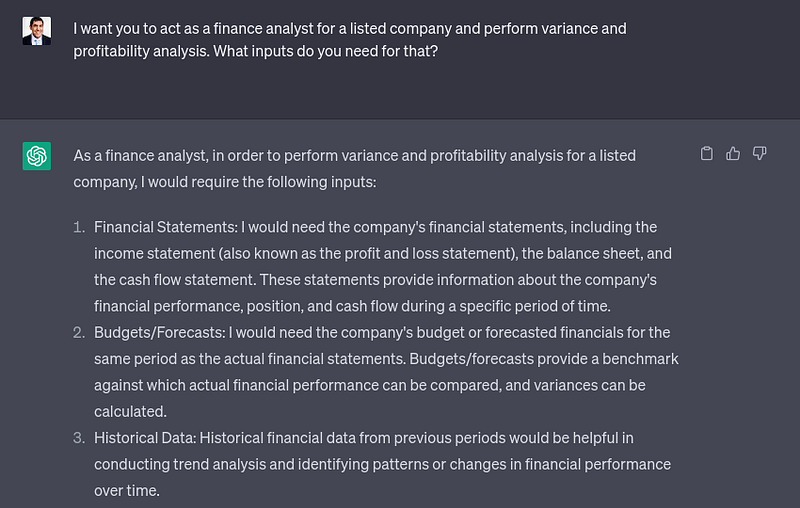
Profitability Analysis
Profitability analysis is another critical aspect of financial analysis that involves evaluating a company’s profitability and identifying areas for improvement. ChatGPT can be a valuable tool for FP&A professionals in performing profitability analysis by automating complex calculations and providing insights into profitability metrics.
Using ChatGPT, FP&A professionals can input financial data, such as revenue, costs, and expenses, and the model can calculate key profitability metrics, such as gross profit margin, operating profit margin, and net profit margin. ChatGPT can also analyze historical data and trends to assess the company’s profitability performance over time and identify areas where profitability has improved or declined.
Additionally, ChatGPT can help FP&A professionals perform sensitivity analysis by changing various assumptions and inputs to assess the impact on profitability.
This can be particularly useful in scenario planning and decision-making processes, allowing FP&A professionals to evaluate the potential outcomes of different strategic options.
Enhancing Decision-Making with ChatGPT
ChatGPT can be a powerful tool for FP&A professionals in enhancing their decision-making process.
Here are some ways in which ChatGPT can provide value in financial analysis tasks:
- Time and Resource Efficiency: ChatGPT can automate repetitive and time-consuming tasks, such as data extraction, calculation, and interpretation, allowing FP&A professionals to focus on more strategic and value-added activities.
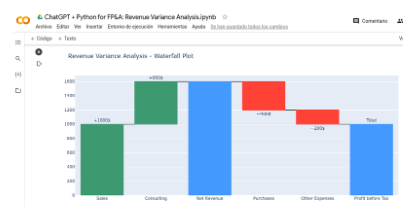
- Data Insights and Visualization: ChatGPT can generate intuitive visualizations, such as charts and graphs, to help FP&A professionals visualize data and trends, making it easier to identify patterns and outliers.
- Data-driven Decision-making: ChatGPT’s NLP capabilities enable FP&A professionals to extract meaningful insights from large amounts of financial data, helping them make informed and data-driven decisions.
- Scenario Planning and Sensitivity Analysis: ChatGPT can assist FP&A professionals in performing scenario planning and sensitivity analysis, allowing them to evaluate the potential impact of different scenarios on financial performance.
- Enhanced Accuracy and Consistency: ChatGPT can perform calculations and analysis with high accuracy and consistency , minimizing human errors and ensuring reliable results in financial analysis tasks.
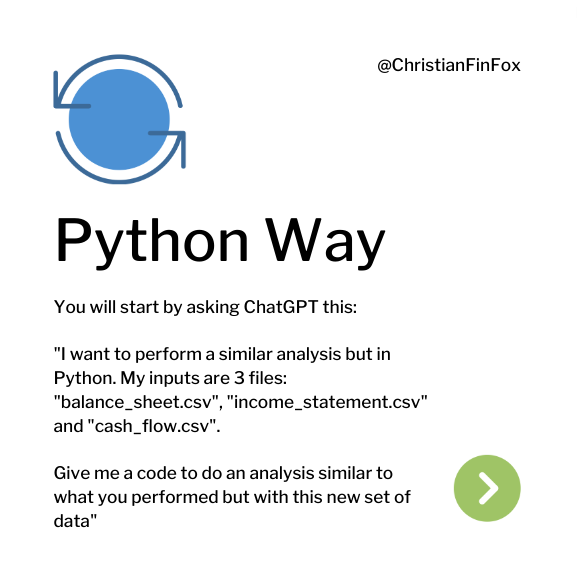
For this, there are just 3 simple steps:
- You will start by asking ChatGPT this: “I want to perform a similar analysis but in Python. My inputs are 3 files: “balance_sheet.csv”, “income_statement.csv” and “cash_flow.csv”. Give me a code to do an analysis similar to what you performed but with this new set of data”
- Then, And ChatGPT will provide the code and you will go to Google Colab to paste it.
- Finally, you hit “run”.
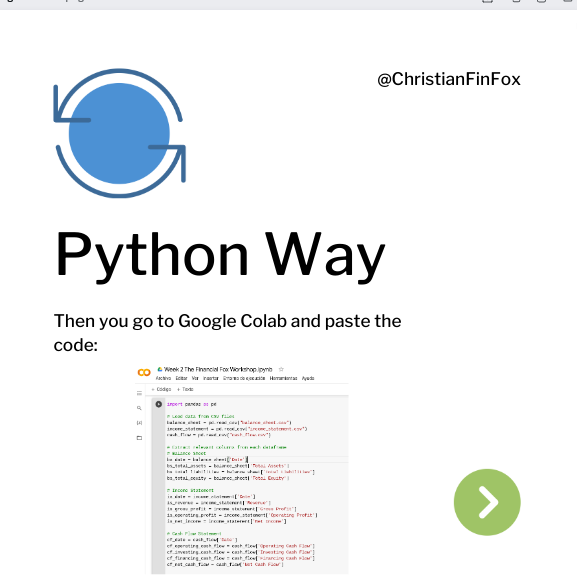
You can even build graphs there too!
Conclusion
ChatGPT, with its advanced AI and NLP capabilities, can be a valuable tool for FP&A professionals in performing variance and profitability analysis. It can automate tasks, provide data insights, generate visualizations, and assist in decision-making processes, enhancing the efficiency and accuracy of financial analysis tasks.
FP&A professionals can leverage ChatGPT to uncover hidden patterns, identify drivers of variances, assess profitability performance, and perform sensitivity analysis, enabling them to make informed decisions and provide valuable insights to their organizations.
As technology continues to evolve, ChatGPT and other similar tools have the potential to revolutionize how FP&A professionals perform financial analysis and drive strategic decision-making in the future.