
Can Breakthrough Starshot make us interstellar explorers?
What would it take to reach other stars?
In 1584 when Giordano Bruno proposed that other stars were distant suns similar to ours and have planets of their own, he was of course right. But he was only guessing. He didn’t have observational data or mathematical formulas to support his theory.
First real evidence of other galaxies came in 1924 when Edwin Hubble realized our neighbor Andromeda wasn’t just a cloud of gas, but an entire galaxy on its own. And it wasn’t until the 1990s that first exoplanets — planets orbiting stars other than our Sun — were discovered.
Today we think an average galaxy contains around 200 billion stars. And there are an estimated 2 trillion galaxies in the universe. Those are unimaginable numbers.
But what is equally unimaginable are the distances separating us from these distant bodies. One light-year — distance light travels in a year — is 9,5 trillion kilometers. That’s 9 and twelve zeros. We often talk in thousands, even millions of light-years when describing the cosmic scale.
So if we want to venture outside our solar system, where should we start? Well, the logical first step would be to visit the star system closest to us — Alpha Centauri.
Our triple neighbor
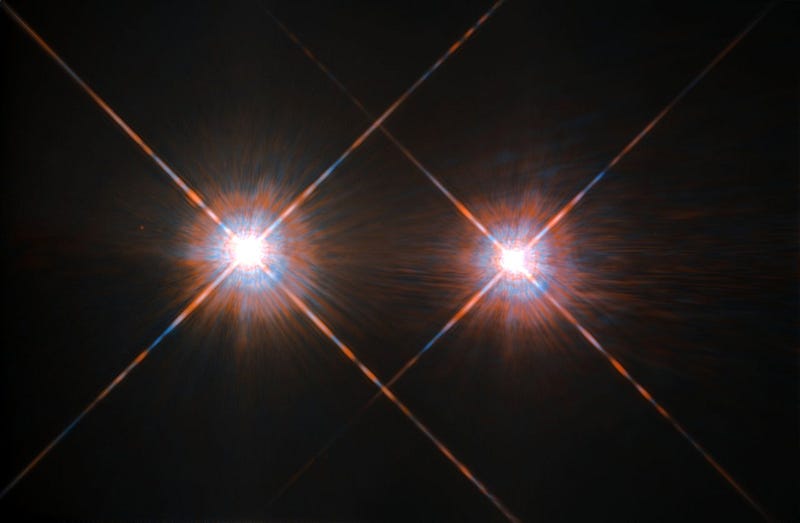
Alpha Centauri is a very interesting system that consists of three stars. Alpha Centauri A and B are Sun-like stars and form a binary pair. To the naked eye, they look like one star — the third brightest in the night sky — although invisible from most of the Northern hemisphere.
The two stars orbit a common center of mass and are 40 Astronomical Units apart — about the distance between the Sun and Pluto.
The third star, Alpha Centauri C — or Proxima Centauri — is a red dwarf, a very cool star much smaller than our Sun. Although it lies 13,000 Astronomical Units from its binary neighbor, it’s almost certainly gravitationally bound to it. Its proximity makes it the closest star to our solar system.
But its relative closeness isn’t the only reason we want to explore this dim dwarf. In 2016, an Earth-sized planet, Proxima Centauri b, was discovered orbiting it. Although it spins very close to its star, it lies in its habitable zone. This means it could contain liquid water — one of the first things we look for when we search for life.
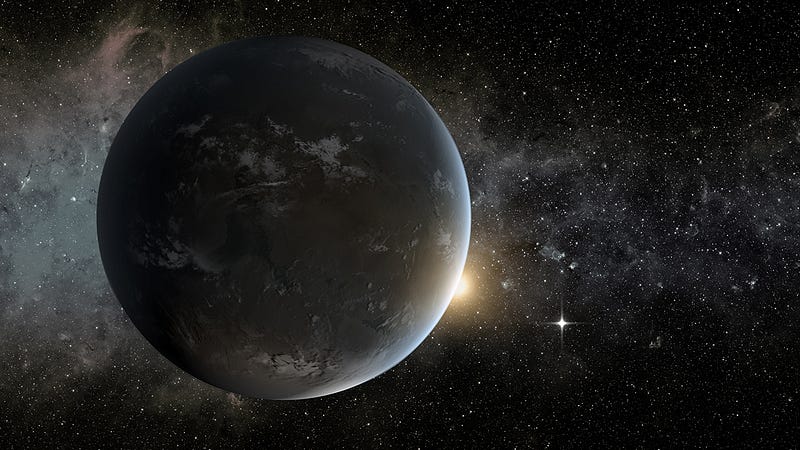
The Alpha Centauri system lies 4.3 light-years — or 41 trillion kilometers — from Earth. The fastest man-made object, Parker Solar Probe, can travel up to 700,000 km per hour. At this speed, it would still take more than 6,000 years to reach Proxima Centauri b.
To stand any chance of completing this voyage within a human lifetime, we need radically different technologies.
An ambitious dream
Although very fast, even at its maximum, the Parker Solar Probe travels at less than one percent the speed of light. But what if we could set something in motion at let’s say 20% the speed of light? How long would then take to get to Proxima Centauri?
About 20 to 30 years.
This might seem like science fiction, but it’s a real project started in 2016. Its name? Breakthrough Starshot.
The idea was first presented a year earlier by a cosmologist Philip Lubin at the 100-Year Starship Symposium in Santa Clara, California. During his speech, he laid out a plan to accelerate tiny robotic probes to incredible speeds using an array of Earth-based lasers, and send them in the direction of Alpha Centauri.
Six months later he received $100 million in funding from Breakthrough Initiatives, a nonprofit program funded by Russian billionaire Yuri Milner, Stephen Hawking, and Mark Zuckerberg.
The probes imagined by Lubin will be extremely small, weighing just 1 gram with a body roughly the size of a postage stamp. This will allow the craft to be superfast — more mass would require more powerful lasers to attain the same speed. But how do you squeeze the necessary electronics on such a small surface?
The probes will have several miniaturized instruments, including a power supply, cameras, and a communications system.
To communicate, they will need to send a signal back to Earth. But since they won’t have a lot of power due to their small size, this signal will be very weak. We would need a very large detector which remains a problem.
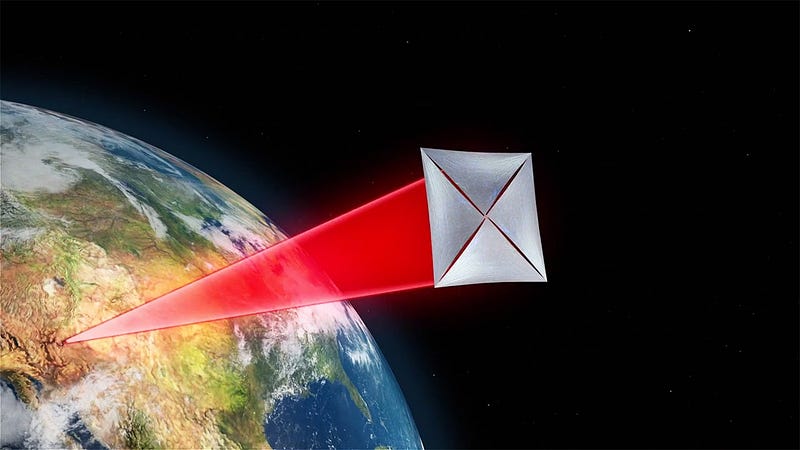
Each tiny probe will be attached to the middle of a sort of a sheet called the sail. It will stretch 4 meters in diameter and it will be only a few atoms thick. But how to choose the right material?
The material used to construct the sail has to fulfill several conditions: it needs to be very resistant to survive huge acceleration; it has to be extremely light, weighing less than one gram; it should also be highly reflective not to absorb too much laser light which would destroy the sale.
The problem? Light materials like graphene are not reflective and reflective materials like metals are too heavy. We still haven’t invented the perfect material for the job.
Let’s say we managed to overcome these obstacles and now have a fleet of about a thousand probes connected to their sails. How do we get them to travel at 20% the speed of light?
By using giant lasers.
This is known as laser propulsion. We use a laser beam to propel a spacecraft very rapidly through space. If you shine a torch on a ball, that ball won’t move. But if the light beam is strong enough and the ball is very light, you can accelerate it to incredible speeds. At least in theory.
We would need a huge array of laser amplifiers down here on Earth. Once the spacecraft are positioned in orbit, we turn the lasers on. Their individual beams would be combined into one giant beam — with up to 100 gigawatts of power — and send into the direction of the spacecraft’s sail.
We also have to keep in mind that space might seem empty, but it’s actually filled with interstellar dust. Even a very small particle could cause a lot of damage if it hit the vehicle. The founders plan to send several probes — around a 1000 — to compensate for those destroyed by collisions.
Another non-negligible aspect to consider is money. So far, the founders have invested 100 million dollars into the project to research its feasibility. But the development of the necessary technology will be on the same scale as CERN or the Apollo project — reaching billions of dollars.
And finally, there are the ethical and geopolitical implications of building such a powerful energy source as the lasers we would need. After all, they could also be used as a weapon.
Bottom line
Would it be cool to live to see a spacecraft visit Alpha Centauri? Absolutely. At least for me. Is it probable? Well, that depends on your age.
It could still take 20–30 years for the technology to be developed, another 20–30 years for the spacecraft to get there, and 4 more years for their signal to reach Earth. You do the math.
If I live to see it, I’ll be pretty darn old and I’m not sure I’ll still care. But right now, I think it’s one of the most exciting projects in the space exploration domain. And I sure hope it finds its way to the stars.

Thank you for reading my story!