
Can Bananas Make You Float in Mid Air?
The answer is probably not but some scientists are actually looking into this right now. Before we dive into floating bananas, let's first talk about anti-matter and the mysteries of the universe
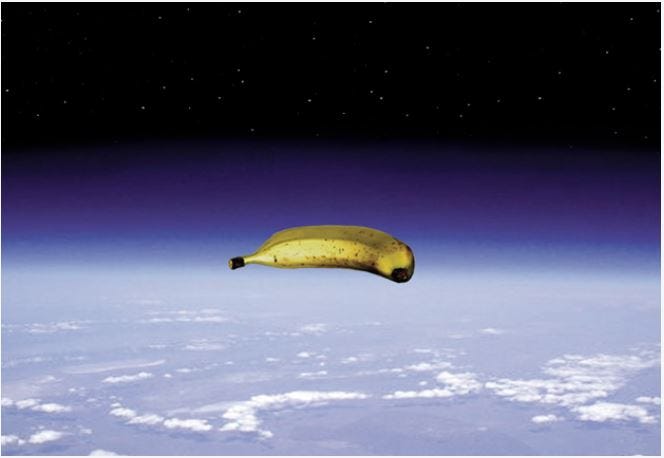
Growing up in the ’80 one of my favourite TV shows was Star Trek, both original and next-generation since you asked. If you ever watched the show, movies or played the games, you might remember that antimatter powers the ships' warp engines. It is fascinating, as Spock will say, that what many of us knew as a sci-fi explanation to justify the ability to wrap or fly at incredibly high speeds is something very real, it is so real that scientists knew about this since the early ’30s.
Some necessary background.
Nature, or the laws of nature, likes things to be balanced. For years people have tried to create the perfect machine, a perpetual motion (Perpetuum mobile) device, that will generate enough energy to power up a city or a country with a small investment of energy. But like the mass conservation law, where the overall mass in a closed system must stay the same, energy also needs to be balanced. You cannot generate more energy than you invest and things must be balanced out. One of the first things chemists learn, is how to balance the charges and mass in their equations, but what about inside the atoms? We know that atoms contain positive particles, called protons, and negative particles, called electrons, but the reality is that protons are much heavier (in mass) than electrons. Physicists have been trying to deal with this for years, and in 1928 Paul Dirac, a great contributor to the quantum theory described a new particle as an anti-electron. He looked at the topic from a basic mathematical perspective; if you take the square root of 4 there are 2 answers +2 and -2, for years people dismissed one of the solutions since it didn’t make sense but with the development of quantum physics things started to make more sense. 4 years later Carl D. Anderson was able to measure them experimentally and introduce the term positive-electrons or positrons, a discovery that won him the Noble Prize in 1936.
Let's get to the Banana?
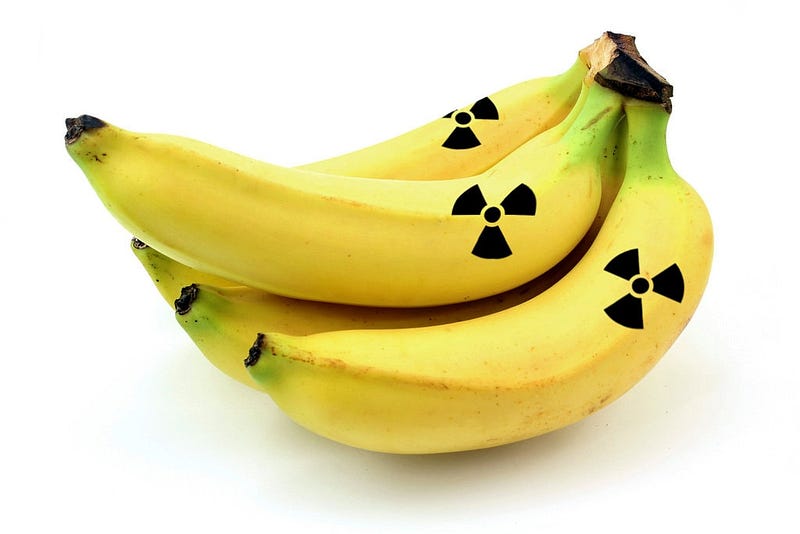
As kids, we are told to eat Bananas since they are rich in potassium which is true, however, not many people know that a small portion, about 0.001%, of the potassium in Bananas is actually Potassium-40 which is a radioactive form of potassium. In fact, you can measure ionizing radiation, like X-rays, exposure in Banana Equivalent Dose (BED). Radioactive atoms tend to decay, which means they will release energy and matter from the nucleus. This energy can be released in several ways, in the case of the Banana Potassium-40 will release an electron or a positron (or anti-electron) every 75 min. If you have a Banana laying around you probably had some positrons floating in your home. Bananas are not unique; other potassium-rich foods like baked potatoes, table salt and even roasted chicken can also release positrons.
What happens when a Positron meets an electron?
Now that we know of one natural positron or anti-electron source we can ask “The Question”: What happens when a positron collides with an electron? If we go back to Start-Trek there is a scene where Captain Kirk (William Shatner) asks Spock (Leonard Nimoy) what will happen when two identical particles of matter and antimatter meet and Spock replays “Annihilation, Jim — total, complete, absolute annihilation”. Star Trek got it almost right or not completely wrong. Yes, the particles will cancel each other but in our case, it won't lead to total annihilation. If you recall I started by talking about the mass conservation law, one of the main concepts in quantum physics is the partial duality explained by Einstein's famous equation E=mc2 where c is the speed of light, E is energy and m is mass. According to this equation, energy and matter(mass) are interchangeable without breaking any physics laws. In fact, evidence has shown that if you take a proton and a neutron (natural charge element similar in mass to a proton) and get them close enough they’ll stay together, prevented from drifting apart by a small amount of energy shared between them. But energy can not come from anywhere so where does this energy come from? Experimental evidence shows that the weight of the proton and neutron, when stuck together, is slightly less than the sum of the weights of the proton and neutron separately. It is incredible to learn that some of the mass of the proton and neutron has changed into energy, the same energy that holds the two particles together.
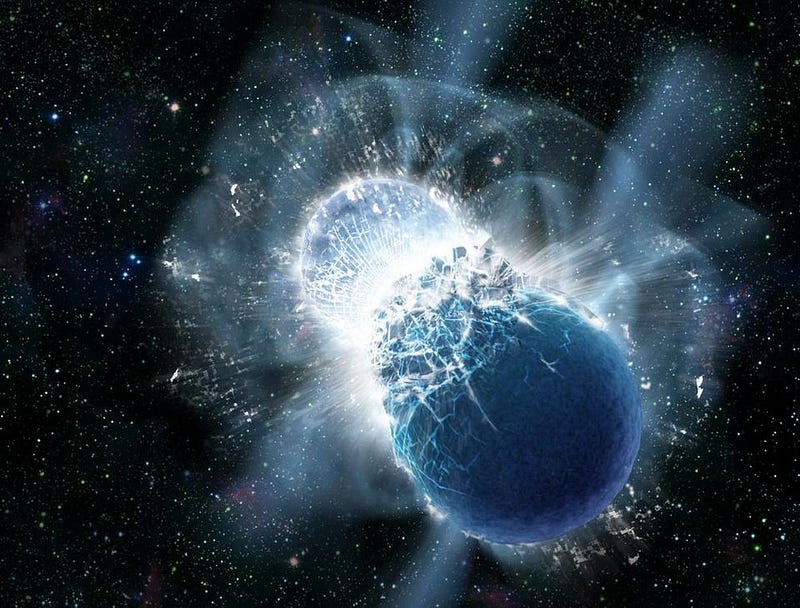
So back to our question, what will actually happen if matter and antimatter collide? If an electron collides with a positron, they will cancel each other but also will release energy. So Star Trek wasn’t that wrong, if we have a huge amount of positrons and electrons in theory we will release a lot of energy. How much energy? Prof. Phil Kesten's claims that one particle will only release a small amount of energy, not enough even to charge a cellphone. However, if we create antimatter copper atoms the size of a quarter coin we will have enough energy to cover the needs of all the households in the City of Santa Clara, CA (over 130,000 people) for an entire year
Wait a second did you say Copper anti-atoms?
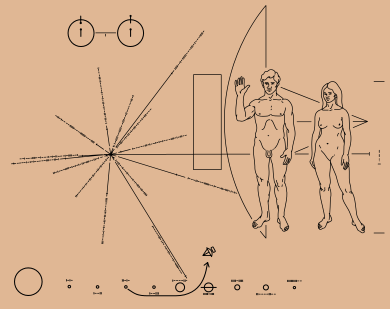
You are right if you read the previous paragraph full of doubt, a copper atom has 29 protons and 29 electrons (in its elemental state). Making an antimatter copper is very hard, however making antimatter hydrogen or antihydrogen is a much more doable task. Hydrogen contains one positive proton and one negative electron orbiting him. It is not only the lightest element but one of the most fundamental and was included on the 1972 and 1973 golden plaque that contains valuable information regarding Earth which was placed aboard the Pioneer space probe. Antihydrogen is made out of a negatively charged proton and a positive charge electron (positron). Although scientists succeeded in producing it in 1995, only in 2011 they were able to keep it alive for 16 min in order to further study its properties
Are we missing something, where is all the ani matter?
I started by writing about how nature likes things to be balanced, and that led to the discovery of antimatter. Well, the universe is filled with matter and we know antimatter exists so where is it all? This is not a simple question to answer, we also know that antimatter doesn't survive long enough and once it meets its counterparts (matter) it will cancel itself and release energy. Scientists are creating antihydrogen and positrons in order to get a better understanding of the laws of physics and to try to answer the elusive question where is it all hiding?
Don’t end it now, didn’t you say something about floating?

Well I need to admit that was a bit of a teaser but there are a few scientists that do believe just like gravity exists, “antigravity” particles must also exist, I will leave you with this question that I first heard from NPR’s Geoff Brumfiel, we all know that matter falls down, but will anti-matter float?


