
An AI tried to beat the stock market index. It failed.
The Nordics’ first AI-powered fund versus a basic index fund.
Every investor dreams of beating the index. Experts handpick stocks to add to their portfolio and create expensive hedge funds that attempt to beat the market. However, the truth is that only a fraction of investors manages to beat the index over an extended period of time.
In 2008, Warren Buffet confronted the hedge fund industry. Buffet argued that an index fund could outperform a handpicked portfolio over a period of ten years. Sure enough, Buffet proved to be right. A simple index fund defeated all of the experts’ handpicked funds.
Tony Robbins has written a 660-page book called Money: Master The Game, in which Robbins explained the ins and outs of financial investments while interviewing some of the greatest minds in economics. In it, Robbins mentions that “[t]here are 7,707 different mutual funds in the United States […]. But the statistic is worth repeating: 96% will fail to match or beat the market over any extended period.” (Tony Robbins, Money: Master The Game, 2016, p. 96, ISBN: 978–1–4711–4861–3).
That’s right: 96% of mutual funds in the US fail to beat the index over an extended period.
Humans clearly struggle with beating the index. So what about artificial intelligence (AI)?
A Finnish asset management company called FIM launched the Nordics’ first AI-powered fund in November of 2017. It’s called FIM Artificiell Intelligens A. The fund uses artificial intelligence to select investments based on the object’s economic data.
Though the fund is Nordic, more than half of the companies that the AI-powered fund invests in are seated in the United States of America. The five biggest investments in the fund’s portfolio are ChemoCentryx Inc, West Pharmaceutical Services Inc, Energix-Renewable Energies Ltd, IDEXX Laboratories Inc, and GN Store Nord.
So, let’s see how well the AI has performed. The fund itself has actually been around since 2001 (previously named FIM Nordic Placeringsfond), though it was renamed and started using AI in 2019–11–20. Thus, let us compare the fund’s performance since its first day of using AI up until the last closing day at the time of writing, which was 2020–06–19.
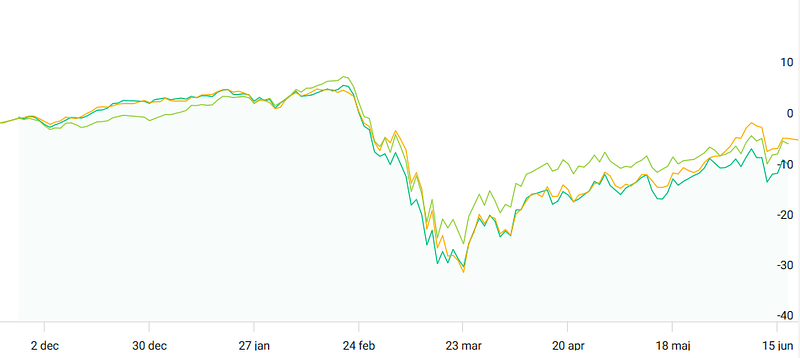
Since the fund is Nordic, I am comparing it on a Nordic website.
The blue line represents the main character: FIM Artificiell Intelligens A. If you would have invested in 2019–11–20, you would have lost 8.91% by 2020–06–19. Between February and March of 2020, the market crashed due to the Coronavirus.
Did it beat the index? The yellow line indicates the Dow Jones World Index. Look how closely the two intertwine up until the market crash in February. After that, the DJ World Index has recovered faster than the fund.
What about the green line? The green line represents Avanza Global, a Swedish index fund that contains over 1,500 assets. It closely follows the Amundi Index MSCI World. The reason why I am comparing the fund with Avanza Global is to compare it to a local index fund that is available on the same trading platform. If you would have invested in 2019–11–20, you would have lost 4.85% by 2020–06–19.
For this period of time, the index fund clearly outperformed the AI-powered fund. The former dropped by only 4.85%, while the latter by 8.91%. And here’s the kicker: this is before accounting for fees. Excluding costs for purchasing and selling, the fees for FIM Artificiell Intelligens A comes down to 1.64%. For the index fund Avanza Global? 0.10%.
A premium price for an inferior product, one could argue.
One could also argue that the AI didn’t know how to react during a pandemic. After all, since the inception of the stock market, we have never experienced a pandemic on this scale, so how could the AI have known how to handle it? But if the AI is unable to handle volatile, unexpected markets, then what’s the point? Even before the pandemic, the AI’s performance was closely following the index, albeit at a higher price. If the AI is unable to outperform the index during neither ordinary nor extraordinary circumstances, then why bother having it?
Perhaps I am harsh. AI-powered funds are a recent invention. Over time, the algorithms will be fine-tuned. It’s very plausible that we will one day have fully autonomous investment funds that outperform all human funds.
But that is certainly not the case today.
It appears as though neither humans nor machines can consistently beat the index. At the end of the day, the experts are right: invest in index funds.
Thanks for reading! If you‘re interested in AI, you will probably enjoy my book on the topic: