
Can AI Ever Truly Write Like Us?
In a time when everything seems effortless, everything feels worthless
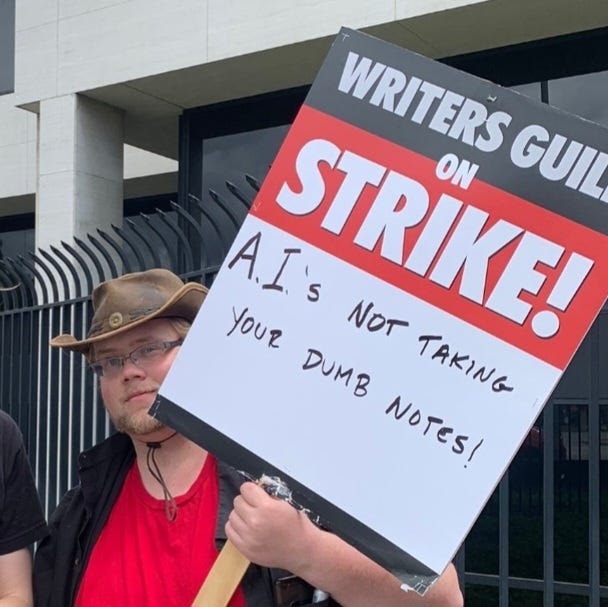

Picture this: you’re all set to pen a heartfelt letter to a loved one, only to find that an AI algorithm can craft it for you in seconds, complete with simulated handwritten fonts.
While the convenience is undeniable, there’s a lingering sense that something profoundly human is missing from the experience.
It feels like patching together different voices to say ‘I love you’, or write a script, or whip up a fancy ad. Even when AI gets the hang of your style, it’s not you. It can’t be.
The craft of writing, once a pure slice of human spirit, now feels hollow, commodified by lines of code.
Is it possible that our art, the most human of all expressions, is at risk of being dehumanized by the very tools designed to assist us?
What really gives art its human touch?
One key element has to be the creative process. AI doesn’t paint a painting, it renders it. It doesn’t take a picture, it makes one up. It doesn’t really write; it just shuffles words in a smart pattern. This absence of a true creative journey dehumanizes the ‘art’ already.
Picture it. AI-written novels fill our bookshelves. AI-written screenplay winning an Oscar.
After yet another competition won by an AI generated photo, I felt sad. It made me wonder if we’re really prepared for this.
In a time when everything seems effortless, everything feels worthless.
But the good news is that quality work created by human minds and hands will stand out now more than ever.
Imagine a time when most content is created by AI. There’s this 10 year old girl, let’s call her Ellie.
Ellie grows up with bedtime stories spun by AI, each one perfectly tailored to her preferences by a clever algorithm. She never tires of these stories because as soon as she does, they’re reshaped and updated to align with her changing interests.
That’s until she discovers a dusty, handwritten diary among her mom’s belongings— the story of her grandmother’s youth, along with a few poems. For some reason she couldn’t quite understand, those words felt different. Ellie’s fascination with these imperfect, heartfelt words propels her on a quest for authentic writing.
Imagine how valuable genuine human creations would be then…
Can AI truly create meaningful writing?
I say, it’s like using a calculator for a math test; it helps, but you need to know your numbers first. You need to understand how to get there or why. You can’t just lean on AI; it’s a tool, not the craftsman.
To make something really good with AI, you’ve got to be a writer yourself. You need to do most of the work. You put in more than you get out, and that’s the only thing that still saves art, in all its forms, from complete dehumanization.
It’s not just about the art itself; it’s about what creating art means. The struggle, the chaos, the bliss of making something out of nothing. Can a bunch of code lines ever truly understand that?
A future is approaching where AI might mimic our writing so closely that it blurs the line between human and non-human, whatever that category might encompass.
AI will likely sound and read ‘almost’ like us, for the most part. This isn’t because it has become one of us, but because it has studied us like a diligent student. That’s what it’s programmed to do.
However, if we enjoy reading human words, we might always be able to tell them apart. We’ll just sense it.
Consider those moments when literature has left you utterly spellbound. If you’ve ever delved into the profound depths of Anne Sexton’s poetry, imagined yourself wandering the distant planets with The Little Prince, or felt the weariness of an old man battling the sea, you know what I mean.
What AI is missing
You know that, to truly match human writing, AI would need more than algorithms and data.
It would need to experience life as we do, with all its ups and downs. It would need to feel — the warmth of the sun, the sting of a heartbreak. And most importantly, it would need to understand what it means to be human, without being human.
To sum it up, for AI to write just like us, it would need:
- Self-awareness
- Real-life experiences
- Sensory capabilities
- Emotions
As for seeing this happen in the foreseeable future, I’m skeptical. The exception could be sensory capabilities, perhaps. What does ‘foreseeable’ really mean today, anyway?
I can see the day when AI gets so good at catching our writing quirks that it can almost pass off as one of us. But that’s about it. The parrot might learn to talk; it sounds human enough, but you know it’s still a bird.
As for writing the way we do, I highly doubt AI could ever pull it off. Writing’s got soul, the writer’s soul. That’s not something you can code. It’s born from the chaos and beauty of being wonderfully, messily human. It’s born from our flaws, from our deepest undergrounds.
AI might get good at assembling words in a way that sometimes resembles human writing. But it can’t write like us. It can’t write. Not yet. Instead of viewing it as a threat, it’s wiser to learn how to work alongside it. It’s just another tool.
Just don’t forget we’re the ones doing the thinking.
Thanks for reading!