
Can a volcano launch a rock into orbit?
Recently, someone asked me on my Ukrainian channel:
Does an erupting volcano have enough power to launch “pieces of Earth” into space, which would fly as meteorites to other planets?
The question is quite interesting, especially since fragments of Mars, presumably ejected into space during a volcanic eruption, have already been found on Earth. This suggests that something similar could happen on Earth.
There are several viewpoints regarding the possibility of a volcano ejecting debris into orbit and further into space. Such ejection is impossible in the case of ordinary volcanoes, which we are accustomed to from movies, books, and personal experience. During their eruptions, debris can reach supersonic speeds. Still, according to all models and observations, their speed does not exceed 1000 m/s, which is less than 10% of the second cosmic velocity required to escape Earth’s gravity.
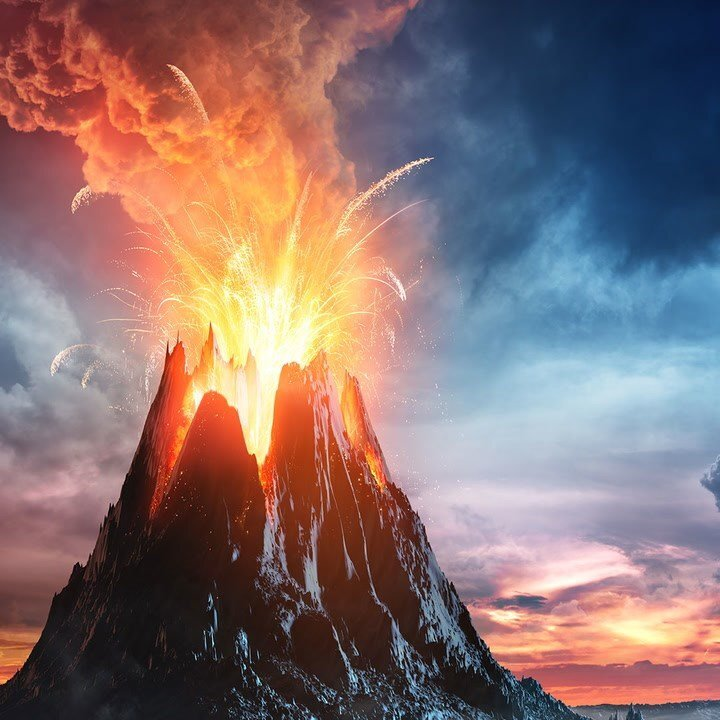
Moreover, any debris would rub against the atmosphere and slow down, requiring an even greater initial speed to escape into open space. Friction would also cause small debris to burn up in the atmosphere. Debris would need to be quite large for it to escape into space. No ordinary volcano can provide debris with either sufficient speed or size to reach orbit.
However, there are supervolcanoes on Earth, like the Yellowstone Caldera, whose eruptions are sporadic. Still, according to some scientists’ calculations, they can launch relatively small amounts of material into orbit.
There is also a theory about eruptions of colossal force called Verneshots, named after the French writer Jules Verne, who wrote “From the Earth to the Moon.”
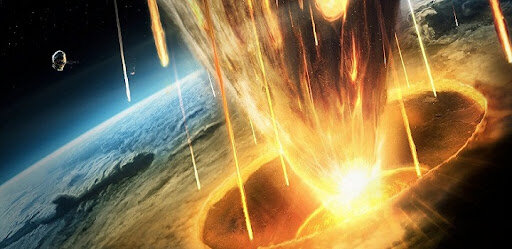
This theory posits that numerous streams of mantle material, called plumes, sometimes rush to a specific area of the crust beneath the Earth’s surface. If they find a passage through the crust, then at a depth of about 10 km, the magma begins to expand rapidly and explosively, resulting in a supervolcano. However, if a monolithic lithospheric plate is present at the plume accumulation site and these flows have no exit to the surface, then a Verneshot could occur.
If, along with the plume accumulation under the crust, a large volume of carbon dioxide also accumulates in the same place and has no way out, the pressure in that area rapidly increases, and eventually, the plate fractures, leading to a massive explosion. This explosion can launch lithospheric debris and mantle material into orbit and potentially even beyond Earth into interplanetary space.
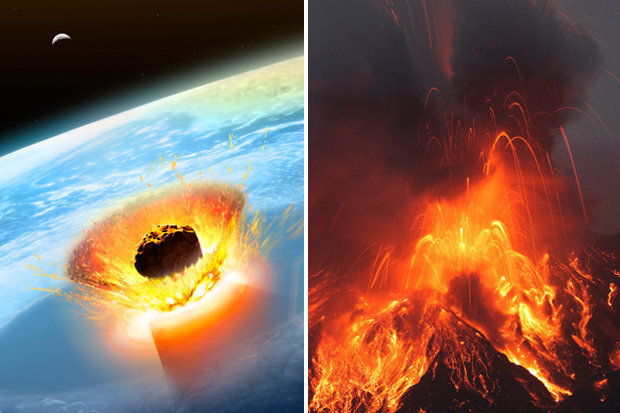
Verneshots are linked to several mass extinctions that have occurred on Earth, including the extinction of dinosaurs. The commonly accepted theory is that dinosaurs died out due to an asteroid impact in what is now Mexico (the Chicxulub crater). However, around the same time, a massive eruption occurred in what is now India, forming the Deccan Traps.
Some scientists supporting the Verneshot theory suggest that this was indeed a Verneshot and that what actually fell in Mexico was not a meteorite but a piece of lithospheric plate launched into orbit by an explosion. Other proponents of this theory see a feedback mechanism: the asteroid’s impact on Mexico catalyzed the eruption in India. Unfortunately, with the current level of scientific development, it is impossible to determine who is right.
Clape if you want to see more articles about space in your feed!
Subscribe to our channel and ask your questions, which I will answer in the following articles.