
Campaign Slogans and 10-Word Answers are the Tip of the Sword
MODERATOR: Governor Ritchie, many economists have stated that the tax cut, which is centerpiece of your economic agenda, could actually harm the economy. Is now really the time to cut taxes?
RITCHIE: You bet it is. We need to cut taxes for one reason– the American people know how to spend their money better than the federal government does.
BARTLET: There it is… That’s the ten-word answer my staff’s been looking for for two weeks. There it is. Ten-word answers can kill you in political campaigns. They’re the tip of the sword. Here’s my question: What are the next ten words of your answer? Your taxes are too high? So are mine. Give me the next ten words. How are we going to do it? Give me ten after that, I’ll drop out of the race right now. Every once in a while… every once in a while, there’s a day with an absolute right and an absolute wrong, but those days almost always include body counts. Other than that, there aren’t very many unnuanced moments in leading a country that’s way too big for ten words. I’m the President of the United States, not the President of the people who agree with me. And by the way, if the left has a problem with that, they should vote for somebody else.
This is a well-known scene from The West Wing, where President Bartlett pauses for a moment of introspection in the middle of a debate and then masterfully responds to his opponent’s powerful assertion. In Aaron Sorkin’s idealistic world, President Jed Bartlett is a Nobel Prize winning economist with a once-in-a-generation mind. President Bartlett is eloquent, confident, and clever in virtually every encounter. Remind you of anyone?
Ten-word answers can be just as powerful in the real world as they are in Sorkin’s dramas. We humans, while capable of understanding very complex concepts, enjoy when a single sentence captures our thoughts and feelings at least for a moment in time. It is also much easier to quote candidates’ one liners than it is to unpack their policy agenda. This is also why Presidential campaign slogans are so powerful. They can capture the thoughts and feelings of a group of people, and those people can build their identities around the slogan. These one-liners and campaign slogans are what Presidential campaigns tout for the months leading up to Election Day. So, it makes sense that candidates are intentional about creating memorable one-liners for debates and slogans for their very long campaigns.
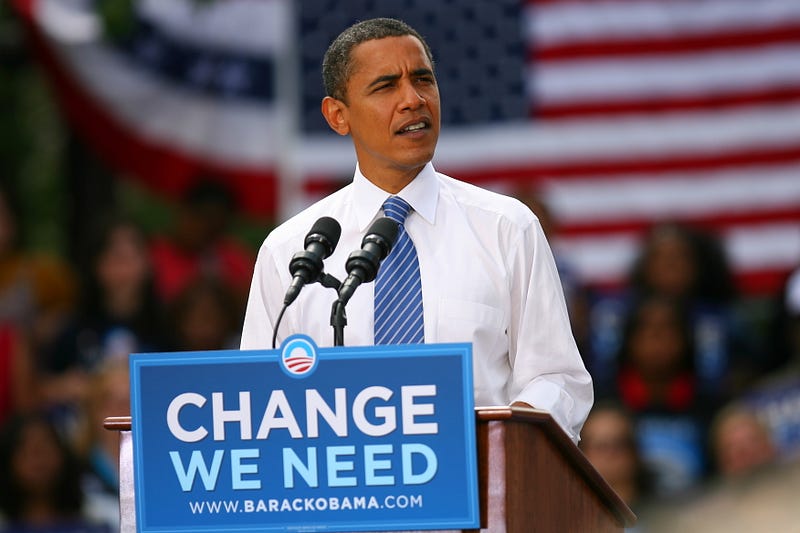
President Obama’s Presidential campaign in 2008 built its brand around the word “Change”. A Presidential campaign branded with the word “Change” was not novel in 2008. President Bill Clinton’s 1992 campaign slogans were “It’s Time to Change America” and “For People, for a Change”. And, one of President Jimmy Carter’s campaign slogans in 1976 was “A Leader, for a Change”. The slogan that really resonated with people in 2008 wasn’t “Change”. It was “Yes We Can”.
Why was “Yes We Can” so powerful? It probably had something to do with the deep idealism that exists within Americans. In 2008, we were in the middle of Operation Enduring Freedom in Afghanistan and the financial crisis had just hit, and yet Barack Obama pronounced an abiding faith in the possibilities of America. In the face of adversity, the notion of HOPE resonated more than just “Change”. Those words, “Yes We Can”, still provide hope today to Americans across the political spectrum.
Slogans in the current field of 2020 Presidential candidates range from short assertions about the strengths of a candidate to attempts at distilling the high-minded ideals of America. Senator Bernie Sanders slogan, “Not me. Us.”, seems to assert that his campaign is not about him, but rather it is about all of us. We’re all glad he clarified. Vice President Biden’s campaign website headline is “Our best days still lie ahead.” This sounds like something Captain America would say, and it is a nice platitude, but far from motivating. Senator Klobuchar’s, “Let’s get to work” slogan may be timely when the recession hits in 2020. Mayor Pete Buttigieg’s campaign slogan, “It’s time for a new generation of American leadership” appears to assert that a younger candidate would do a better job than an older candidate, which while presumably inspiring to younger generations likely alienates older generations. Senator Warren’s “Persist” and “Dream Big. Fight Hard.” slogans might seem out of place in any other election, but could resonate with voters that are singularly focused on ousting the current administration.
Andrew Yang’s slogans are perhaps the most similar to President Obama’s. The slogan, “Humanity First” speaks to the hopeful and high-minded ideals of America. And, “Not Left. Not Right. Forward” is what President Obama aspired to create — a post-partisanship era. In fact, President Obama’s 2012 slogan was “Forward.” And, remember in President Obama’s 2004 speech at the Democratic National Convention he said, “There is not a liberal America and a conservative America. There is the United States of America!” He went on to pose the question, “Do we participate in a politics of cynicism, or do we participate in a politics of hope?”
Right now, it feels like we’ve adopted a politics of cynicism. Perhaps we can begin to dream again in 2020. As Presidential candidates wade into primary season, hopefully an authentic, inspiring, and consensus-building message emerges again. Hopefully.