
Callout for Coders And Puzzlers Or Anyone Up For A Challenge
Tribute puzzle for Alan Turing is as tough as the enigma code
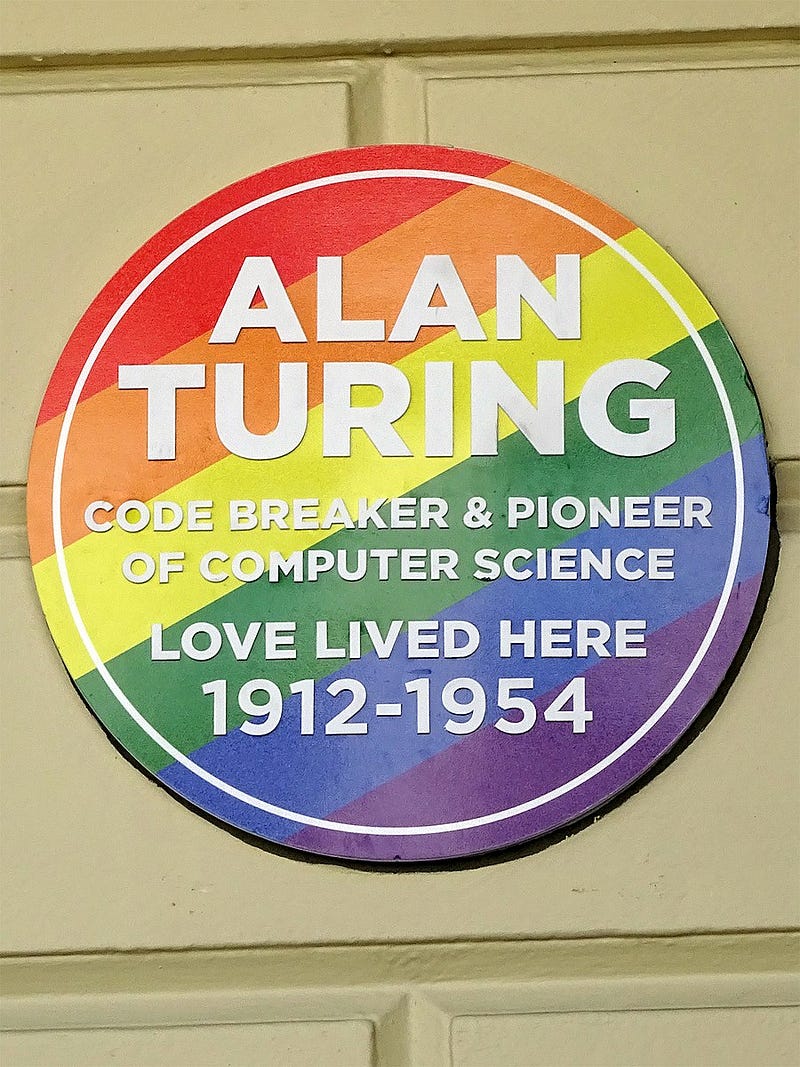
Alan Turing (1912-1954) is regarded as the father of modern computing and a pioneer in artificial intelligence. His research and experiments contributed to the foundation of modern computer science.
He was an exceptional mathematician whose ideas played a pivotal part in breaking the famous Enigma code used by the Germans during World War Two (WW2). The allies recognised that this achievement shortened the war and saved countless lives.
Turing’s image will now appear on the new Bank of England £50, the first openly LGBT+ person to appear on a banknote in England. The new banknote will enter circulation on Turing’s birthday, 23rd June, in his memory.
An apt quotation from an interview he gave in 1949 will accompany his image.
“This is only a foretaste of what is to come, and only the shadow of what is going to be”.
GCHQ sets a fiendishly hard puzzle as tribute
As part of this process, the modern equivalent of the wartime code breaking organisation where Turing worked, now known as GCHQ, has produced a 12 part puzzle in his name.
They are calling this the “Turing Challenge” and claim it will stretch the ability of the most talented puzzle solver.
I agree!
The challenge requires you to solve a string of 12 puzzles, that gets increasingly difficult. You can try your luck with the challenge here.
GCHQ estimate that to complete all 12 puzzles would take an experienced puzzler seven hours.
So don’t feel too bad if it takes a while to get through the first few puzzles.
To spur you on, they have set up a unique Enigma system for each participant in the last part of the puzzle. This is where you input your answers from the previous 11 puzzles.
If you get really stuck, Twitter and YouTube are already providing help.
There is no judgement here!
The more participants the better, as it helps to show appreciation for Turing’s contribution as a visionary scientist and original thinker, way ahead of his time.
What was the Enigma code, and why was it so important?
Germany used a complex encryption device during WW2 to transmit top secret messages. This device was the Enigma machine. It had billions of combinations to encode messages. Germany knew the importance of the Enigma code and also understood its weaknesses. They made frequent adjustments to the code to protect it and keep their communications secure.
At the time Turing and his team were working on the code, the Germans believed it to be their strongest version yet. The Enigma code was also used to communicate with German U-boats on patrols in the Atlantic Ocean.
Convoys of American ships were delivering vital supplies of food and weapons to England during some of the toughest periods of the war. There was a critical need for these ships to make it safely across the Atlantic.
Fleets of German U-boats, known as wolf packs, tried to hunt them down in a deadly game of hide and seek. When the allies could read the Enigma code, they could route the ships clear of the U-boats and therefore land the supplies safely. We can see the significance of breaking the code from an examination of naval records from the period.
Between the months February to October 1942, the code breakers couldn’t break the code because the Germans had made changes. The German U-boats sank hundreds of thousands of tons of allied shipping supplies every month.
Winston Churchill’s analysts predicted Britain would soon starve if they didn’t find a solution. Churchill was later quoted as saying, “The only thing that ever frightened me during the war was the U-boat peril”.
Top team crack the code
Turing was part of a team based at a secret location for Britain’s top code breakers, Bletchley Park. The Germans changed the code every day, making it almost impossible to break. Although Turing and his team had the benefit of earlier research by a team of Polish experts, they still faced an enormous task.
They received a significant boost from the retrieval of an Enigma machine, along with code books, from sunken German U boats. They were still working under extreme time pressure, however, as the code had to be broken quickly to be of any use.
Turing was among the first to recognise that it needed a machine to beat a machine. His invention, a machine known as the Bombe, was an advance on earlier work by Polish mathematicians.
The Bombe allowed the Bletchley Park team to decipher messages in time for the allies to act. The team worked together to break the Enigma code. It was Turing, however, who broke the form of the code used to control the German U-boats.
German messages were sometimes being read by British intelligence within an hour of transmission. This task would have been impossible without the use of automation.
Turing’s work post ww2 and his legacy
After the war, Turing continued to show his extraordinary talents. He designed an Automatic Computing Engine (ACE) that broke new ground in computer science.
He also explored the concept of Artificial Intelligence, devising the Turing Test, which had at its heart a simple theory for an incredibly complex proposition. In 1950, Turing had produced a paper exploring whether machines could think. He proposed a test to determine the answer.
The test was that if a machine could engage in a conversation with a human, without being detected as a machine, then the machine has shown human intelligence. Turing likened Artificial Intelligence in a machine to the mind of a child in that the machine would grow and expand by learning and experience.
Much of Turing’s work during the war fell under the Official Secrets Act. This meant that it wasn’t known to the public for a long time.
His premature death meant that his gigantic contribution to the field of computer science was really only know to the few experts working on similar concepts.
It was only years later that we discovered his full contribution to WW2 and to computer science and gave his work the recognition it deserves.
Turing’s personal life
Turing was gay when it was a criminal offence in England. Homosexuality was illegal in England until 1967. There was a ban on members of the LGBT+ community being involved in British intelligence services that lasted until 1991.
The inherent injustice of that position affected many talented individuals and undoubtedly weakened the various agencies. Organisations know now that they gain by promoting a policy of diversity and inclusiveness.
Turing has received awards for his brilliance in 2021, but in post-war England the authorities prosecuted him for his sexual orientation. He reacted to his prosecution with defiance rather than any sense of shame that the cultural norms of the time might have expected.
Turing’s criminal conviction in 1952 meant the loss of his security clearance for certain research projects. Alan Turing dies in 1954.
In 1954 an inquest ruled his death as suicide by poisoning, but, some historians have questioned whether his death was accidental. His death was two years after his prosecution and, as highlighted earlier, Turing had reacted to this with defiance rather than any sense of shame.
Rather fittingly, following an internet campaign, Turing received a posthumous apology from the British Government in 2009 and received a royal pardon in 2013. The Queen officially quashed his criminal conviction from 1952.
The early loss of such a genius, who had already contributed so much to humankind, and was likely to have played a key role in further scientific advances, was a tragedy for the world and a high price paid for the policy of intolerance.
I can’t see Turing having any difficulty with the GCHQ challenge, but I don’t mind admitting I am struggling!
References
https://www.bbc.com/news/technology-17662585
https://www.iwm.org.uk/history/how-alan-turing-cracked-the-enigma-code
https://www.rte.ie/news/newslens/2021/0325/1206008-turing-challenge/