
Calling Somebody ‘Simple’ Can Be Offensive
What’s plain-as-day to you might be complex to someone else

It’s a cliché that almost everybody has heard. “Men are simple creatures.” According to these armchair gender experts, the male species only needs a handful of basic entities to be happy and fulfilled. Sex. Food. Sleep. Adventure. Shelter. Beer. Sports. More sex.
To this day, I’m haunted by my memory of the first time this idiom truly triggered me. The 1999 pilot episode of a short-lived ABC sitcom called Odd Man Out (starring Erik Von Detten, my “heterosexual boyfriend” during my adolescence) featured a male teen protagonist forced to live in a household of overbearing women after his father’s sudden death. During the episode’s cold open, Andrew Whitney (Von Detten’s character) and his best friend Keith are watching football, but they’re interrupted by five of the women in Andrew’s family who demand to watch ice skating. Andrew’s mom insists they take a democratic vote…and Andrew and Keith are outnumbered by a margin of two to four.
The fifth female member of the family, Val (played by Vicki Davis), refuses to participate in the vote. As a sloppy caricature of a teen feminist, the Val Whitney character proceeds to rail against the skimpy wardrobes of the female ice skaters. Andrew and Keith immediately cave, switching the channel to ice skating. Val, who was orchestrating a mini-ruse the entire time, covertly high-fives her mother and quips, “They’re such simple creatures.”
It was at this point when a simmering truth boiled over for me, after twelve years of watching ridiculous male stereotypes flouted on television sitcoms: Hollywood views men as nothing more than imbeciles and boobs. This is ironic when you consider how Hollywood has traditionally been dominated by male writers and male showrunners. Well, maybe not so ironic…they’re clearly pandering to the pedestrian misandry of certain female consumers who are only a small part of the viewing audience.
Over the years, pop culture has gradually inched its way toward becoming more reflective of social truths. At the turn of the century, it was still in its primordial stage. Sadly, these stereotypes linger within our zeitgeist.
Put on your critical thinking hats, folks, because it’s time for a Clarity Cleanse. Human behavior is far more complex than Hollywood writers would have us believe. Just like there are many layers and grey areas to the “emotional” behavior for which women are so often disparaged — a parallel truth applies to the seemingly “dimwitted” and “juvenile” behavior for which men are condescendingly patted on our heads.
Approximately four years ago, I was at a golf tournament hosted by my old college fraternity for alumni and undergraduates. A group of us were having a discussion about gun control, over at the bar. Jason, the President of our Alumni Corporation Board, was expressing his staunchly conservative beliefs that there should be minimal gun control in the United States (with the exception of some narrowly-written “red-flag” laws). I was saying how I had a slightly more tolerant view of limited gun regulation, but I also reflected upon my past disagreements with leftist friends who want to see most guns banned for civilian use. I was telling my fraternity brothers how I would try to emphasize to my leftist peers/acquaintances that taking such an extreme position compromises their credibility.
The undergraduate Chapter President at the time, a politically-conservative guy named Jake, reacted to my centrist position by affably saying:
“You seem like a moderate, to me. In my opinion.”
To which I responded, wryly with a smile:
“And your opinion is correct.”
Jason proceeded to roll his eyes at my comment. I sort of suspected why Jason reacted with such nonverbal belittlement, even though I was only attempting to validate Jake’s perception of me. After all, I *do* identify as a political moderate. But I also knew that (unlike Jake), prior to this interaction, Jason had already pegged me as “a liberal” based on the topical areas where we’d disagreed — given how Jason is hard-core libertarian/conservative in his own policy views.
So, then I proceeded to say, with a little smirk:
“I’m a complex creature.” (while conceptually holding up my middle finger at Val Whitney)
To which Jason retorted:
“Well, you’re half-right.”
Obviously, I could read between the lines. But I wanted to explore this further. So I pressed him:
“What do you mean?”
Jason assessed me, using a bit of a backhanded compliment:
“You’re straightforward. You know what you want out of life.”
I neutrally replied:
“That’s an interesting perspective…” I was censoring myself here. Because I had a duty to our fraternity chapter, as our Chapter Advisor (an appointed position, from which Jason could hypothetically remove me) at that juncture in time, I didn’t want to rock the boat. Had I not been so intimidated in that moment, I would have told Jason to go to hell (or some witty variation of it) while intellectually finding a way to remind him of what a judgmental blowhard he is.
If we read between the lines of Jason’s subtext, he was essentially telling me: You’re not “complex,” Eichy. You’re a simple creature. Simple is good. It means you’re transparent and noncomplicated in your motivations. If you choose to call yourself “complex,” you’re mischaracterizing yourself as a drama-filled emotional vampire. Don’t sell yourself short. Embrace being simple.
What’s so ironic about this is that both wielders of this fallacy were from diametrically-opposed ends of the political spectrum. Jason and Val would each be prone to fetishizing divisive figures (Donald Trump and Ted Cruz, in Jason’s case; Hillary Clinton and Janice Raymond, in Val’s case). Although Val was a fictitious character, she was given a small-screen voice by real people (most likely, self-loathing men) who are all-too-eager to attach value-judgments to the psychology of others based on our genitalia per se.

I realize it’s tempting for lazy pontificators to place everyone else into neat little categories of how women and men each think and act. But these common misconceptions allow both men and women to shirk personal responsibility, while doing the long-term damage of closing off communication with one another.
Much of this is rooted in heterosexual romantic courtships. A blogger who goes by the name of “Kim” at relationship blog The Art of Charm believes there’s often a fundamental misunderstanding of how members from the opposite sex process things or exert their desires. Women, she says, are more likely than men to overanalyze or complicate things. While this makes it convenient for men to receive the label of “simple” by default, both sexes tend to make excuses for their hesitancy to approach each other.
Australian sex coach Cam Fraser states, when marketing his relationship advisory services, how men are indeed complex — and not everything in a man’s life is about craving sex. Faith-based marriage counselor Ryan Frederick similarly rejects the widespread portrayal of male simplicity from TV sitcoms. He contends that men desire more collaboration (accompanying leadership) than society gives us credit for, and there are many coed traits necessary in order to make romance work. Those traits include trust, love, confidence, and sexual desire.
Approaching it from a different angle, attorney Carolyn A. Edgar argues that the simplicity trope enables men to use the smokescreen of “being simple” in order to absolve themselves from personal responsibility. She says that a portrayal of women as “complex creatures” gives men an excuse to avoid putting in the work that will make a heterosexual relationship succeed. Edgar also believes that many men will make the claim of “being simple” in order to cover up their own insecurities, or even to blame one’s female significant other (or female relatives) for one’s failures.
Digital marketing writer Dale Harris observes the existence of gender-based communication styles. He contrasts women using more apologetic language with men using more authoritative language. However, Harris identifies a trend where men can be less talkative than women — and more introverted when it comes to exploring our innermost thoughts. Meanwhile, pastor and theologian Christopher Poirier ties together all of these conflicting dynamics by expressing:
Real men aren’t simple men of childish bravado, but that of faith, courage, and responsibility.
So if all of these people from different walks of life — and with different ideological backgrounds — are saying the same thing…could it be that these supposedly fixed characteristics we attribute to women and men aren’t actually as “fixed” as we’d assume?
This is where, much of the time, diversity in gender identity can be a superpower. Homosexual, bisexual, and transgender people will often become the informal “ambassadors” who foster better communication and psychological translation between heterosexual women and heterosexual men. When your identity exists outside of a heteronormative binary, you learn to identify genderism and oppressive social cues in order to navigate them. That makes intuitive LGBT+ people especially well-equipped to bridge the male/female divides that have become so stubbornly engrained within our society.
In positive and responsible contexts, “male culture” can be speckled with activities such as extreme sports, horseplay, pranks, and alcoholic gluttony. And, when practiced in moderation and with common sense, these jovialities can thrive outside of (and independent from) rape culture.
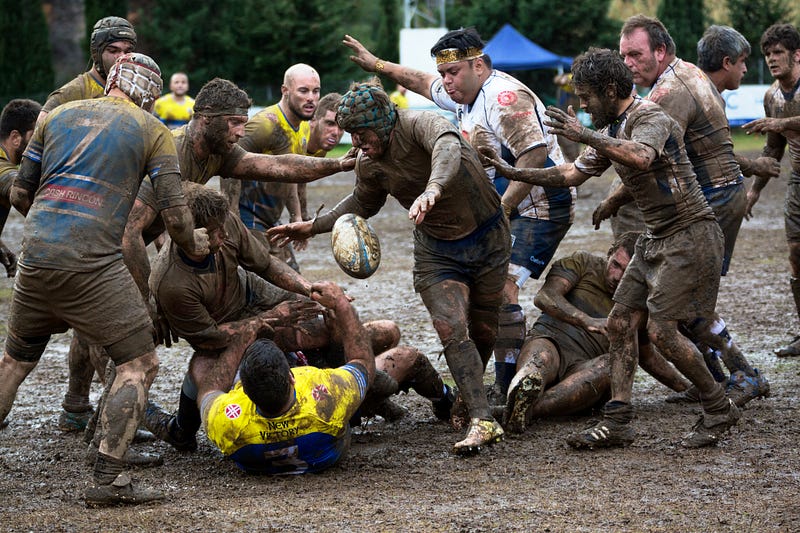
Do you ever wonder why some guys love getting messy (muddy excursions, food fights, paintball, waterparks, goop forfeits, foam parties, etc.)…and seem to love getting their buddies messy, as well? Or why certain guys enjoy casual nudity…and seem to relish the chance to goad their bros into getting naked, too? Why beers, marijuana, craftsmanship, grilling, martial arts, or athletic interactions (and all the chest-bumping that tends to accompany it) provide such a thrill to men?
It’s the camaraderie. It’s our desire for bonding, for friendship, for a spiritual connection with those who can relate to the confines of our physical bodies. Many alternative ways of expressing or seeking out such intimacy have been stunted by patriarchy and homophobia. Thus, the socially-acceptable versions of male interaction may understandably be viewed by woman (from the outside looking in) as childish or superficial.
You know…”simple.”
This goes back to the questionable ways in which we condition kids to blindly accept gender roles. We, as a society, can overcome these barriers by asking questions to the individual. Don’t assume anything about a person’s boundaries or comfort level solely based on their sex or gender per se. Ultimately, so many women and men out there want the same things when it comes to sex, friendship, recognition, and public policy. We just can have very different ways of expressing it, based on the societal restraints that have been set up for us…or those which we continue to impose upon each other.
Unlike what Jason and Val would have us believe, the idea of “simplicity” isn’t necessarily a virtue or a scientific fact. Yes, the presence of testosterone will produce common trends in male competition, social awkwardness, and aggression. But it isn’t some metaphorical affliction of blood poisoning that somehow needs to be purged from one’s body.
Male voices, such as Tom Cotton and Steve Harvey, often romanticize “simple men” as a charming fact of life. Even prominent female public figures, such as Judge Judy or Kiley Dean, normalize the disdain for complexity by conveying utilitarian preference toward being “a simple girl.” But these privileged personalities cannot speak for the human population as a whole. They stigmatize those of us who want our emotions and identities to be taken seriously by the rest of the world.
So, in this respect, if you’re quick to peg somebody as “simple” — bear in mind that you might, in effect, be writing them off as milquetoast or doltish.
If someone tries to insist “It ain’t that deep” by generalizing most male behavior…be wary of their motives. Their veracity and awareness level might be suspect.
It’s the equivalent of when women tell men “I’m fine” — but they aren’t actually “fine,” and they really want to talk about it…but they don’t want to come off as too needy, so they’re trying to drop a hint about how they desire conversation.
Men (and boys) want to *live* it…with “it” being a synergetic, exhilarating, satisfying life. But we can’t admit that out loud…because male vulnerability is frowned upon, from all directions.


