
Who Is (Would Be) Your Perfect LGBTQ Ally?
Calling all LGBTQ Allies/Friends: Please Wear a Pin For Us? It’s Time!
Time for the silent majority to speak up in daily public solidarity
A conservative backlash against bisexual, transgender, and gay people is growing so strong that random street violence is surging in the U.S., the U.K., and elsewhere. Kids are learning hatred from parents and churches then bullying and beating up LGBTQ classmates. Queer adults are fleeing conservative states out of fear, and things seem to be getting worse rather than better — particularly for transgender people.
I’ve been writing about that disturbing trend for months, and people often ask me what they can do to help. Well, I have some experiences to share. If I could ask one simple thing of friends and allies of LGBTQ people, it would be daily public solidarity.
How?
Let me tell you a story first, so you understand why I’m about to ask you to do something that might feel very uncomfortable.
“Screw the red ribbon!” I grumbled to a buddy as we leaned against the back wall at a New York City Act Up meeting in 1995. “You see the damn things everywhere but they’re worthless.” I blinked back tears. “People think they’re cool just by wearing them. They’re just easing their consciences without actually helping us!”
I was wrong, badly wrong, which I would recognize only in hindsight.
I was in a lot of pain that day. I’d just learned my best friend was about to die of AIDS. I had gone to see him in hospice that morning, but he was unconscious so I couldn’t even say goodbye. His nurse told me he would linger only a few more days at most.
When my buddy and I left Cooper Union after the meeting, we pushed through crowds of busy people, most of whom (way over half!) wore little red ribbons on their coats. Hell, I was wearing one! I got home and flipped on the TV to see newscasters, weather reporters, and guests on The Tonight Show sporting the little red icons.
I grumbled about them under my breath, but I should not have.
Maybe you’re too young to remember those days. There’s a lot to remember.
Republican leaders like Ronald Reagan and Jesse Helms had either ignored the HIV/AIDS epidemic or blamed it on gay men, calling the virus God’s punishment. The Right opposed spending significant national resources on treatment and prevention, out of either apathy or unapologetic homophobia.
Lots of people remember that.
In the 1980s, fear of HIV-positive people was very strong. Men and women living with HIV/AIDS found themselves shunned and unloved, even on their deathbeds.
Lots of people remember that too.
But by the early 1990s, a remarkable attitude shift had taken place. Education campaigns lessened fear of infection. Public sympathy and support grew. Prevention-education campaigns became popular. Right-wing figures still spouted a lot of a hate, but significant majorities of Americans were no longer cool with that.
Fewer people remember how progress became more more politically possible. I was there, and I almost didn’t notice it. When I did, I sometimes grumbled.
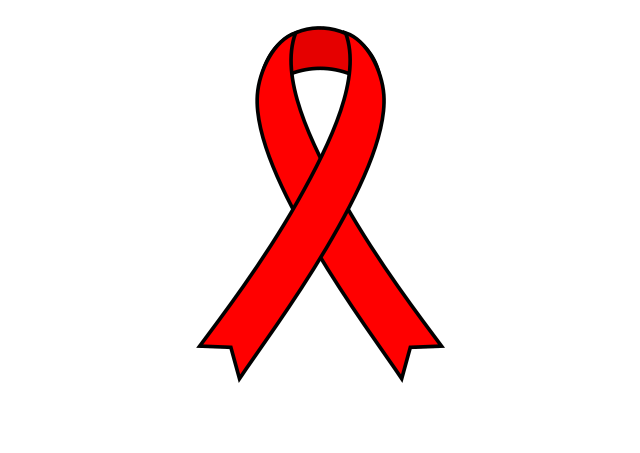
The red ribbon awareness campaign started in the spring of 1991 when costume designer Marc Happel attended a Manhattan meeting of the Visual AIDS artist caucus. He had an idea for an awareness symbol they’d been searching for. He proposed the red-ribbon design you see above.
He said he took inspiration from yellow ribbons he’d seen tied around trees to honor servicemen.
The artist caucus loved Happel’s idea and ran with it. Local businesses donated supplies. Cutting, folding, and pinning soon went into overdrive at “ribbon bees” — like quilting bees, only designed to raise awareness of HIV/AIDS. Within a few weeks, the ribbons were often spotted on NYC streets, though few people knew what they meant.
Then somebody thought of the Tony Awards coming up in May. What if most award winners wore the ribbons on national television? The artists, some of whom did gigs as Broadway designers and dressers, got busy with address books and rolodexes. Response was reportedly mixed, so right up until the show started, nobody knew if the plan would work.

Then Daisy Eagan, the 11-year-old star of The Secret Garden, accepted the show’s first award, best featured actress. And she was wearing a red ribbon! Kevin Spacey also wore a ribbon. So did Penn and Teller. By the end of the show, almost every celebrity who walked onstage had worn a prominent red ribbon, though no one told viewers why — possibly because the network threatened to cut audio if anyone talked about AIDS.
That mystery-marketing tactic was probably unintentional, but it couldn’t have been more powerful if professionals had planned it. By the end of the next day, the whole nation was buzzing. Why had all those famous actors worn identical ribbons? Why didn’t they talk about them? What’s going on?
Answers came fast as celebrities and AIDS activists gave interviews to local and national media. To paraphrase: “HIV/AIDS is a humanitarian crisis killing our friends and neighbors. We as a nation are not doing nearly enough. We wear the red ribbon to call for greater love and more action. We ask you, all of you watching, to wear the ribbon too.”
The nation responded, and not just in New York, San Francisco, and Los Angeles.
Yes, from the Oscars and People’s Choice Awards to beauty pageants and town halls, red ribbons became de rigueur fashion, but the ribbons weren’t just for celebrities. I flew home to visit family in a conservative state in 1994, surprised to see flight attendants, baggage handlers, bartenders, grocery-store cashiers, and even one cab driver wearing little red ribbons on their chests.
I didn’t yet grasp why they were important. Grief had traumatized me. Important activism had focused me. I didn’t look up to see the bigger picture: Americans everywhere were wearing their consciences over their hearts.
People who had been members of silent majorities were speaking up in daily public solidarity. Maybe they didn’t know much about HIV/AIDS. Maybe they would never do more than say, “We wear the red ribbon to call for greater love and more action.” But by making that silent daily statement, they normalized support, caring, and hope. They said no to hate and fear.
They encouraged their neighbors to love. They changed public attitudes.
Greater love is needed today more than ever. We queer people cannot stand up against waves of hate without help.
Are you a friend or ally? Are you tired of book bans? Are you astonished that states are criminalizing drag shows and and forbidding mention of trans and gay people in schools? Are you sick of the war against transgender people? Sick of the demonization and conspiracy-theory hate campaigns?
Do you understand LGBTQ people are just ordinary, that we just want to live in peace while enjoying the same dignity and equality as everyone else?
If so, you represent a silent majority of Americans and Brits, and according to most polls, a very large majority. Sometimes it feels the other way around. The haters are loud and seemingly everywhere.
So how about we start changing perception? How about we work on daily public solidarity again? How about we wear our consciences on our chests again?
I was planning to include video clips here of people burning, smashing, or stomping on Pride flags. I saw more of that than I cared to in my news feeds before breakfast this morning. I don’t want to see it again, and I don’t want to inflict it on you.
I want to ask you to do something instead.
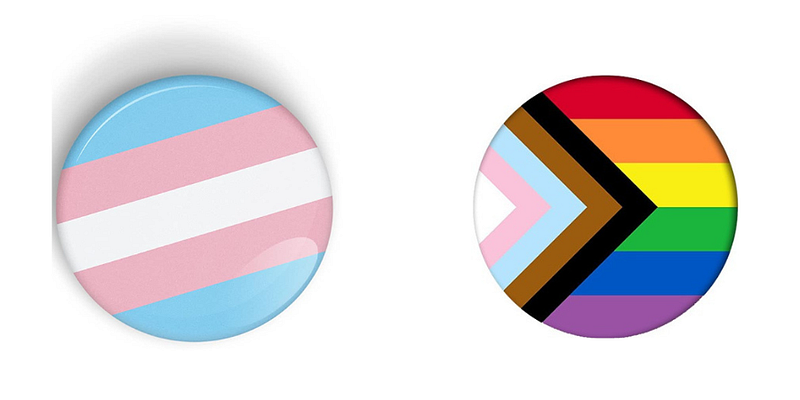
If you’re part of that silent majority who love and support queer folks, will you seek out rainbow or transgender pride pins? Will you start right now?
The pins are inexpensive and available everywhere. You can find them at major stores or buy them online. The designs above are common, but others exist that might suit your personal taste better. Just Google “Pride pin” or “trans pin.”
They say love conquers hate, and I believe that.
I know red ribbons did not conquer AIDS. I know that in some ways those ribbons were merely “performative,” a word not yet coined when I grumbled out grief at that Act Up meeting.
But the ribbons broadcast love and normalized love. They did so much more good than I understood that day.
Can we do that again? Can we wear little pins in daily public solidarity? It’s time. It’s past time, in my opinion.

This story is a response to the Prism & Pen writing prompt, I Need a Friend! Who Is (Would Be) Your Perfect LGBTQ Ally?


