
The least expensive and most interesting major metropolis in the world
Cairo: you’ll want to keep going back
Pyramids, Mummies, Nile River Dinner Cruises, and more…
My first time in Cairo was in October 2008. I had enrolled in a graduate program in the Middle East, and the department planned a trip to Cairo for the students to get to know one-another. Tensions had flared in another part of the region in September, leading to most of the students backing out at the last minute. But, the tensions weren’t in Egypt, so I wasn’t going to miss the opportunity for an all-inclusive five day trip to Cairo! About a dozen of us showed up, including the two tour guides. That was the perfect number of people to be able to really get to know everyone and share an intimate adventure in one of the most interesting cities in the world.
Cairo is really five cities, not one. As empires expanded, enveloping Cairo, each one built a new city next to the last. As a result, the history of different parts of Cairo are vastly different as they come from periods separated by hundreds if not thousands of years. In just five days, no one could possibly see everything Cairo has to offer. I went back again in 2017, and would happily spend months there exploring a new site of cultural or historical importance every day without being able to see everything.
Tour guides
First thing first: Hire a tour guide. They’re very inexpensive, extremely well-trained and licensed, speak whatever language you need, and can navigate the enormous city much more efficiently than you’ll be able to. In 2008 my group of about ten people had two, and in 2017, I hired one for myself and my wife. Each time they were friendly, professional, and knowledgeable. We were picked up at our hotel every morning, guided around the sites we wanted to see, given lunch, taken to more sites in the afternoon, and then dropped off at our hotel in the evening. In 2017, the total cost for eight hours per day for two days for two people was $145, including transportation, guided tours of sites, and meals. You’re much better off doing this than trying to navigate the city on your own by hailing cabs, finding restaurants, and trying to figure out what you’re looking at.
What to see and do
Pyramids and the Sphinx
The pyramids are in Giza on the outskirts of Cairo, right on the edge of the Sahara desert. My first time at the pyramids was in 2008. Back then, there were plenty of tourists. When I returned nearly a decade later, in 2017, there were none. Unfortunately, the tourism industry really took a hit after the events of the Arab Spring in 2011, and then the political crises between the Muslim Brotherhood and the military regime in 2012 and 2013.
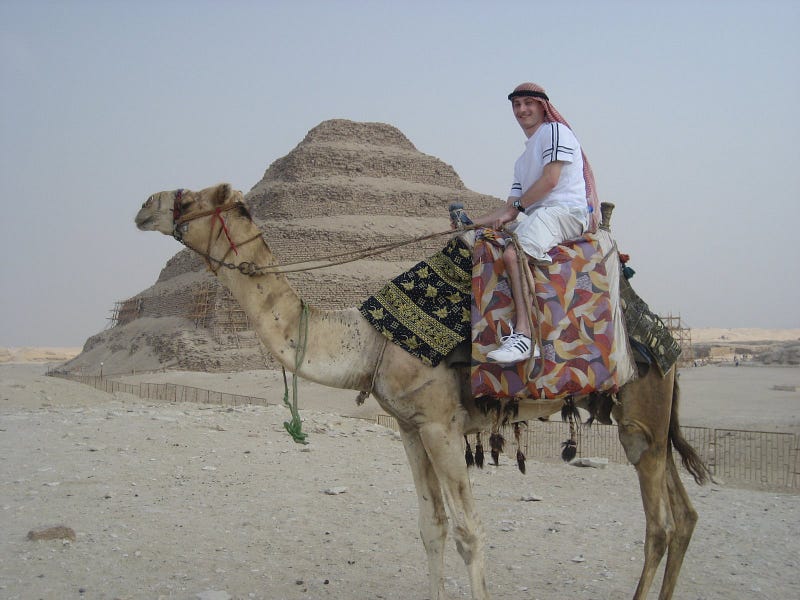
Anyway, the pyramids are connected by paths and plazas that were filled with vendors selling souvenirs, as well as men with camels in tow offering to take your picture on a camel with the pyramids in the background. Obviously, I hopped right on a camel and was walked 15 minutes out into the Sahara desert! When we finally stopped, the guy leading the beast asked for my camera to take a picture. He took a great picture, but then said it would cost 35 Egyptian pounds to get my camera back! At the time, that was $7 US, so I gave it to him, but I didn’t appreciate the shakedown… By the time he walked me back to the pyramids, and helped me off the camel, my tour group was gone! Fortunately, he spent the next 20 minutes walking around looking for them with me until we found them. I appreciated that, and forgave him for the rude way he had made me give him 7 dollars. Aside from the cost of the trip, which included food, lodgings, and transportation, I only spent 20 dollars in those 5 days. I can’t stress enough how inexpensive Cairo is. The exchange rate back in 2008 was 5:1 Egyptian pound:US dollar. When I returned in 2017, it was 12:1.
There are 3 “Great Pyramids” in Giza, but the complex around it has several more, including the “Old Pyramid at Sakkara,” and many walkable tunnels in, under, and around the pyramids. There is a tunnel you can enter on the side of the center pyramid that goes up to a chamber toward the top. The walkway inside is very steep and has a low ceiling, so you’ll be doing a bit of crawling. Once you get to the top, the chamber is bare and dark, which is rather anticlimactic. It’s still worth the experience, but the tunnels underneath the pyramids and in the areas around them are much nicer. You can walk through them normally, they’re well lit, and they’re beautifully painted with hieroglyphics that are thousands of years old but still brightly colored and readable, as long as you can read ancient Egyptian hieroglyphics.
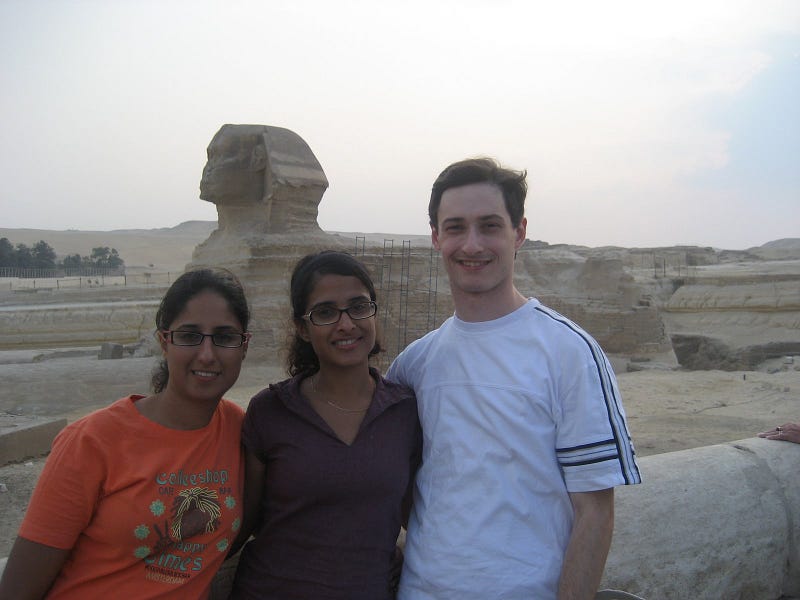
The sphinx is also nearby in the same complex, and well worth seeing. You can walk around it and take pictures with the pyramids or the city in the background behind it. There are some nice restaurants around the sphinx, too, where you can sit along a wall of windows with nothing but the sphinx and the pyramids on the other side. The view is surreal.
The area around the sphinx also has perfume stores where they’ll teach you about how perfume was invented in ancient Egypt and then try to sell you dozens of scents. Many of them are quite nice and they’re all inexpensive, so it’s a great place to buy gifts to bring back home.
The Nile
To get to the pyramids, we hopped in our minibus and drove south along the Nile River. The drive was not long, maybe half an hour from downtown Cairo to the pyramids, with a lot to see on the way. The scenery driving along the river was beautiful but tragic. The land in that area is quite dense with reeds, grass, and tall brush. Many poor people were living in cutouts of this brush along the river. The reeds grow quite tall, up to 10 feet high, and some people were so impoverished that they simply chopped down enough reeds to clear an area big enough to fit a bed, a chair, and a cookpot, built three walls out of scraps of wood or plastic, and lived in it. The reeds and grass around them were higher than the walls of their hut, so they provided plenty of shade. Since it doesn’t rain in Cairo, they didn’t bother with a roof. I’d never seen such squalor.
The Nile is very wide as it goes through Cairo, but the tributaries along the delta get quite narrow, only a couple meters wide in some places. There were also dead cattle floating in the tributaries. In narrow points, they got stuck between the banks and rotted. Those were not sights I was expecting to see only minutes outside of a city with a population of more than 20 million people.
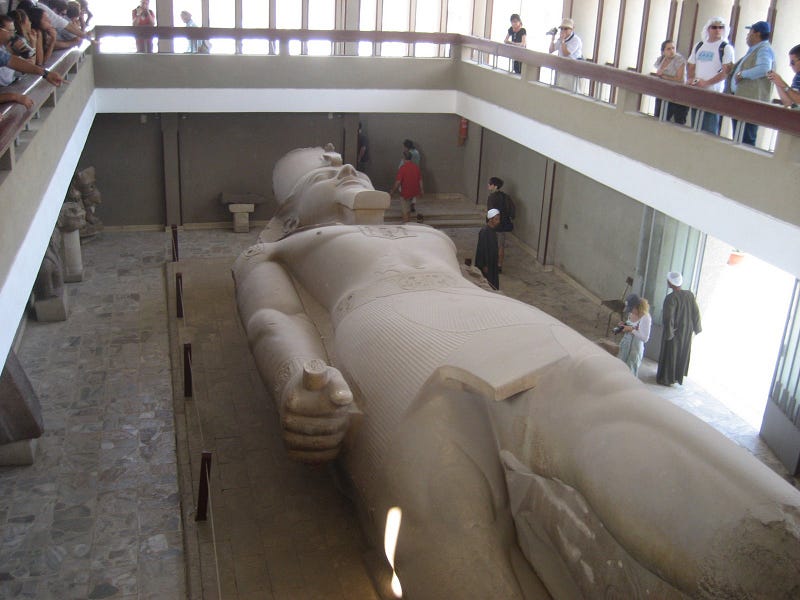
Along the way, we stopped to see several road-side museums centered around significant individual ancient artifacts. One had huge statues of Ramses II, another had a wooden boat, and still others had pottery, jewelry, etc. Also on the road were schools and workshops where they produce oriental rugs, and others where they produce papyrus.
In the 1930s, then the Crown Prince of Iran Mohammad Reza Pahlavi, married the daughter of Egypt’s King Farouk, Princess Fawzia. As an act of political goodwill intended to strengthen Egypt’s economy, the Pahlavi throne established oriental carpet weaving schools in Egypt. Some of these schools are still in operation and offer tours in which visitors can see how the carpets are woven by hand. You can also buy them for prices much more reasonable than you’re likely to find back home. I didn’t buy any there, but I should have. When I got interested in oriental rugs later on, the memory of seeing those people weaving the rugs helped convince me to try to figure out how to do it myself; now I do it as a hobby.
The papyrus schools also offer exhibitions showing tourists the process through which papyrus is grown, treated, and then painted. I took a video of an exhibition for my brother, who is an art teacher, to show his students. I also purchased a few as souvenirs that I then had framed for myself and my friends.
Nile Cruise
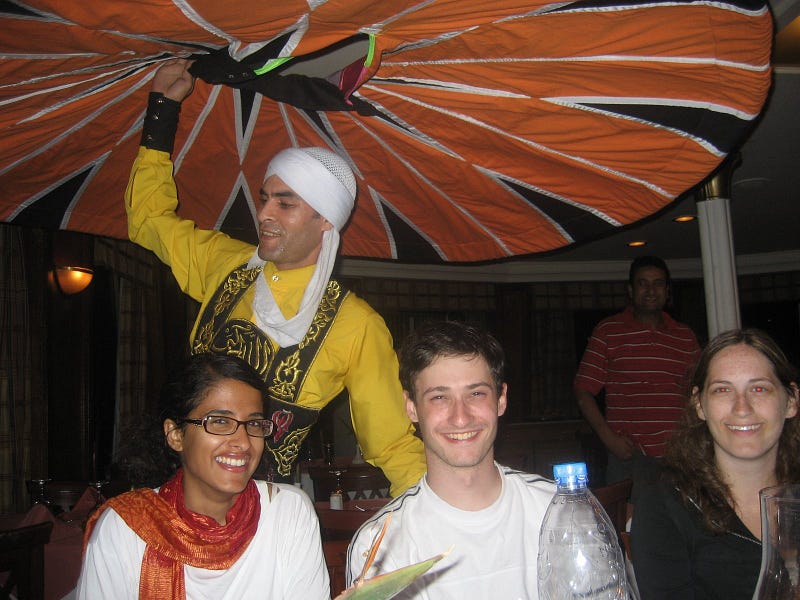
When I go to Cairo I make sure to sign up for a dinner cruise on the Nile. The food is nothing to write home about, but the live entertainment is great. There are variations of entertainment, so try to sign up for the cruise with the belly dancer and the whirling dervish. The live band is fine, but you can get that anywhere on the planet. My favorite act is the whirling dervish. His dance brings him into a trance-like state, takes years of practice, and is intended for spiritual meditation. But, for anyone not familiar with ancient metaphysical art forms, this guy has spun in circles for years and can do it for hours without getting dizzy. You’ll be surprised by his act as you probably don’t even know what I’m talking about when you’re reading this.
Tahrir Square and the Egyptian Museum
Tahrir Square is large plaza in downtown Cairo that has held political and social significance for over a century. Today, it is most well known as the geographic focal point of revolutionary protest movements. In 2011, it was the site of the largest Arab Spring protests that brought down the military government that had been led Hosbi Mubarak for thirty years. Then, in 2013, it was the site of the largest protests that brought down the Muslim Brotherhood government of Mohamed Morsi. The site is also directly adjascent to the Egyptian Museum, and near the Ramses Hilton, and the Four Seasons.
The Egyptian Museum is a must-see. After the pyramids and the sphinx, it’s at the top of the list of sites to see in Cairo. It’s filled with ancient artifacts from Egypt’s history, including statues, thrones, gold, jewelry, mosaics, papyrus, scarabs, steles, glass, miniature figures, masks, amulettes, and more. The highlights are colossal statues of Pharaohs, King Tut’s Tomb, and the museum’s crown jewel: the mummy room. In the mummy room you can stand face-to-face (through glass) with the remains of biblical Pharaohs like Ramses II and his son, who perished in the flooding of the Red Sea in pursuit of Moses and the Hebrews as they escaped from slavery. Tickets to the mummy room cost a bit extra on top of the museum’s entry cost, but are well worth it. There are signs forbidding taking photos in the mummy room, but you’ll regret it if you listen to them, as no one else will. Also, it’s pretty cool to have your picture taken with someone who was actually in the bible. Ramses II knew Moses personally, and looks much better than you’d expect after three thousand years; he still has his hair!
The October War Museum
The weirdest place in Cairo is the October War Museum. The October War, also known as the Yom Kippur War, was fought in October 1973 between Egypt and Syria on one side, and Israel on the other. Egypt celebrates the war as a victory over Israel because its political implications led to Israel exchanging the Sinai Peninsula for peace and statehood recognition several years later. The museum is a peculiar tribute to the war for a number of reasons. For example, it was built by North Korea, who was not involved. Also, its main exhibit is a panorama in which visitors sit in what seems like a movie theater, while the wall rotates slowly around them, showing painted scenes of battles between Egyptian and Israeli forces in the Sinai.
Khan al-Khalili market
This is the storied open air market/suk/bazaar that is a major marketplace in Cairo. There are two parts to it. One part is where locals buy goods they actually need, like food stuffs and clothing. The other part is where tourists buy tchotchkes. You’ll have more fun in the tourist part. Feel free to haggle with the vendors. They’re expecting it, so they set the price high expecting you to negotiate. The more time you spend negotiating, the lower the price will go because they’ll want to make some money after spending time talking to you.
Al-Azhar Mosque and University
This was one of the centers of education in the world for centuries. Think of it like Oxford but hundreds of years older and much more influential. The mosque was the center of Islamic thought and the Fatimid caliphate, not unlike the Vatican is for Catholicism. However, the sciences, arts, and humanities have not always been considered separate from religion, as they may sometimes appear these days, and very much part of the university’s history. If you enter the mosque, you’ll need to remove your shoes and women will need to cover their hair. There’s not much to do there besides pray, and making noise will disturb those trying to do so. So feel free to take a peak, reflect for a moment on where you’re standing and its historical and spiritual significance, and then make room for the locals because the place is still active and gets very busy at times.
Ancient Churches, Mosques, and Synagogues
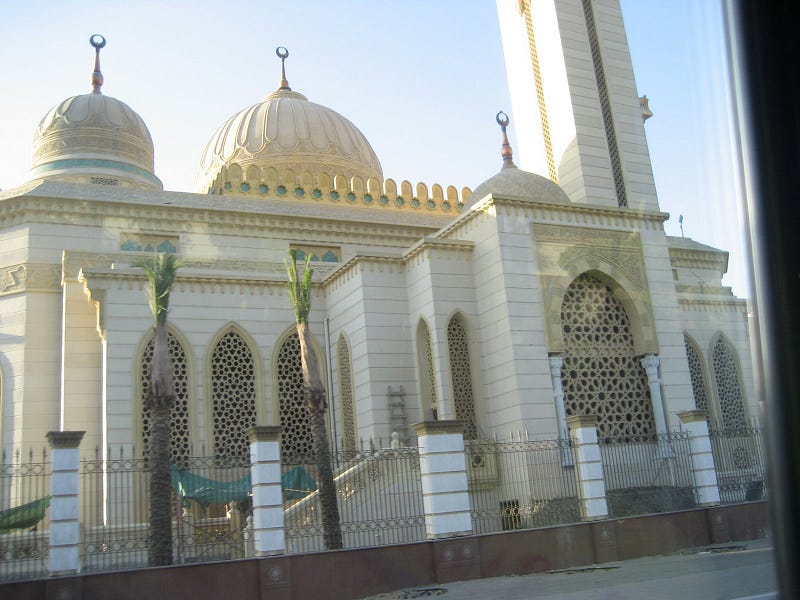
Although Islam has been the predominant religion practiced in Cairo for over a thousand years, Christianity and Judaism have been there for a couple millennia. They both still have many historic sites that are preserved and operated by the government’s antiquities authority, and are well worth the visit if you’re interested in history or religion. Coptic Christianity is still widely practiced in Cairo, so make sure to visit the churches during periods of inactivity. The synagogues are not in use much, and undergo renovation from time-to-time. It’s important to travel to historical sites in Egypt with licensed tour guides because they’ve been trained to teach you about the sites you’re seeing, and know when is a good time to go, how to get there, and what else is nearby. This is particularly important when visiting religious sites because, as living museums, they lack the plaques and explanations that you’d find in a more traditional museum.
Getting around
Visa, cabs and transportation
When you get to Cairo, you’ll need to purchase an entry visa in the customs hall at the airport. The last time I was there it was between ten and twenty dollars.
The cab drivers will definitely try to overcharge you. However, the attendant at the taxi line at the airport has a list of the fares depending on what part of town you’re going to, so as long as you get a taxi from that line, you won’t get ripped off. That being said, Egypt is extremely inexpensive. The taxi driver who rips you off will charge you something like 10 dollars rather than 5 dollars for a 45 minute ride. So, feel free to give him a tip on top of it when you get out of the car. He’ll probably give you his business card and offer to be your driver for your entire stay. It’s not necessary, as you’ll always have easy access to taxis, but it never hurts to build a rapport with a taxi driver because he’ll be able to give you helpful recommendations for sites and restaurants, and come when you call.
There is a subway system in Cairo as well, but I haven’t tried it. Cabs are cheap enough and don’t require any navigation from the traveler, so I stick with that. Traffic is shockingly busy. I’ve witnessed and been in some fender benders in downtown Cairo. The speeds at which people come into contact with one another are quite slow, so at most they get out of the car to yell at one other before resuming their journeys. No insurance information is exchanged, it’s just routine to bump into someone once in a while.
Crossing the street
Have you ever played frogger? This one takes some getting used to. If you wait on the sidewalk for traffic to clear, you’ll stand there for years until a local grabs you by the hand and leads you into traffic. Then you’ll realize that the only way to cross the street in Cairo is by taking a faithful step off the curb and trusting that the cars will avoid you. They will, but you’ll have to experience it before you can believe it. So, when you inevitably get grabbed by a stranger and pulled into oncoming traffic, don’t worry, he knows the drill.
Food and Accommodations
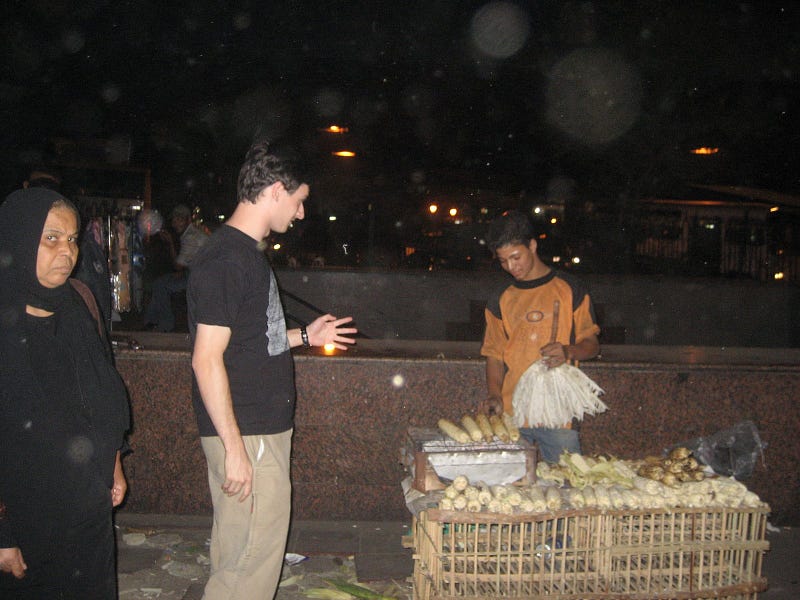
I have not been impressed with the food in Cairo. The international hotels have continental breakfasts, which are the closest to what you’ll be used to eating. But the local fare is really hit or miss. Ful is the bean paste comparable to humus that is eaten in Egypt. Ful is made with fava beans whereas humus is from chickpeas. Otherwise, they’re the same dish and are eaten the same way with bread, salads, pickles, etc. The shawarma is pretty standard regional food, so if you’re into that, you won’t go hungry. There are also kids selling corn on the cob as they grill it on an open flame on the sidewalk. I haven’t tried it, but it’s ubiquitous.
Ramses Hilton vs. Four Seasons
The Ramses Hilton and the Four Seasons at the Nile Plaza hotels are both behind the Egyptian Museum in Tahrir Square in downtown Cairo. Both are five-star hotels, but that just means they have a certain set of amenities. They are much more affordable than you’d find a five-star hotel in other countries. However, the Ramses Hilton smells like people have been smoking in it for 50 years and never once cleaned the smoke out of the carpets or the walls. The hotel staff are great, but try the Four Seasons. Both Hilton and Four Seasons have multiple other hotels in Cairo.
The weather, atmosphere, and people on the street
Cairo is hot. It sits on the edge of the Sahara desert and never rains. It’s also extremely dusty, if not dirty, as the desert blows dirt and sand into the city non-stop. That being said, there are plenty of trees and grass in the area along the Nile, so you’ll enjoy the scenery and be able to find plenty of shade. Wearing light clothing is highly recommended, and shorts and short sleeves are fine. Some of the population will be more modestly dressed, but Cairo is a major metropolis with all kinds of people. They’re used to just about anything and won’t get offended by seeing your knees and elbows. In fact, they will be very glad to see tourists because their economy needs it. Don’t be afraid if the younger people try to engage you in conversation. They’re just excited to be able to practice their English, and might want to sell you something.
Shopping
Only go to government souvenir stores because they are regulated. That means the prices are set and the goods are authentic. If you’re traveling with a tour guide, they’ll take you to these without you asking. If you’re on your own, ask any hotel clerk, cab driver, or local on the street.
Conclusion
There’s so much to see in Cairo, it’s absurdly affordable, and the people are happy to see you. You can get a room in a five star hotel overlooking the Nile River and be shuttled around for several days by a private tour guide with perfect English for only a few hundred dollars total… Send me a message and I’ll put you in touch with people who can help you set it up.