
Cade Metz Pulls a ‘Deep Capture’ on Slate Star Codex
It’s no surprise to me that a New York Times reporter named Cade Metz is responsible for the destruction of a superb blog called Slate Star Codex.
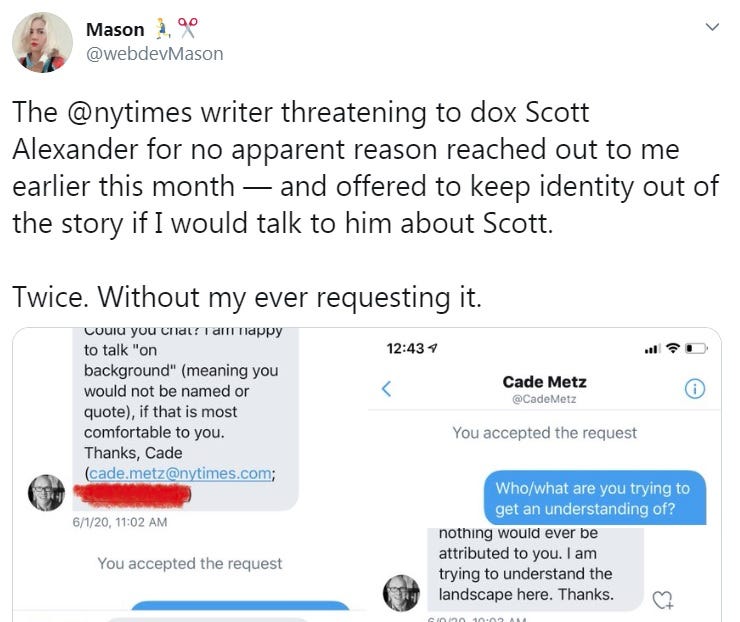
According to the anonymous author of the blog, a Times reporter, revealed by National Review to be Metz, contacted him recently to say that he was writing an article on the blog. He “told me it would be a mostly positive piece about how we were an interesting gathering place for people in tech.”
But there was a catch. “Unfortunately,” the blogger wrote, “he told me he had discovered my real name and would reveal it in the article, ie doxx me.”
Since the blog’s author was a practicing psychiatrist, who writes under the pseudonym “Scott Alexander,” there were plenty of reasons not to reveal his real name. But Metz would have none of it.
The blogger went on:
When I expressed these fears to the reporter, he said that it was New York Times policy to include real names, and he couldn’t change that. After considering my options, I decided on the one you see now. If there’s no blog, there’s no story. Or at least the story will have to include some discussion of NYT’s strategy of doxxing random bloggers for clicks.
So he shut the blog. A storm of criticism followed, during which it was revealed that Metz was talking out of both sides of his mouth. He had readily offered anonymity to people who wanted to talk with him about the blog — a blatant violation of Times policy on granting anonymity to sources quoted in articles.
I believe that Metz embarked on this story with the intent of doxing “Scott Alexander.” I think his assurances that the article would be favorable can also be discarded as so much campaign rhetoric. I hold that belief because I have dealt with Metz, and I found him to be a totally unscrupulous, unethical reporter — a first-class skunk, to put it bluntly.
That brings me to Deep Capture. That was a blog run by Overstock.com’s CEO Patrick Byrne. The hatchet man he employed as its “editor” was the company’s public relations chief Judd Bagley. Background on Byrne and Bagley can be found throughout the Internet, but here’s a good piece on Byrne from 2005 in Fortune. If you were critical of the company when Byrne was CEO — he fled to Indonesia last year and dumped all his stock — he sicced Bagley on you. Bagley ran Deep Capture.
A principal purpose of Deep Capture was doxing. One of Bagley’s tasks for Byrne was to expose anonymous Internet identities and pretend that people were ganging up on Byrne. He usually failed. No problem. He just made stuff up. Once Bagley used Facebook to snoop on Byrne’s critics. Creepy stuff like that. The “results” of these “investigations,” suitably embellished and fictionalized, were published in Deep Capture.
Smears and lies were an effective strategy. Journalist Susan Antilla observed in her website a few months ago:
Over the years, Byrne and his social media sidekick Judd Bagley staged vicious attacks on the reporters who didn’t buy their conspiracy theories. They were effective enough that a star of financial journalism once told me it wasn’t worth writing about Byrne because of all the grief he put reporters through.
Cade Metz wasn’t one of those journalists. He was a pal of Byrne and Bagley, promoting their craziness in print.
Based solely on Bagley’s “research,” Metz ran pieces in The Register and then Wired swallowing whole all of Byrne’s insane conspiracy theories — he blamed all the stock market’s ills on “stock counterfeiting” — and included all of his real and imagined enemies in the mix. Byrne/Bagley/Metz claimed that I edited Wikipedia in furtherance of the conspiracy, working out of an an office at the Depository Trust Company, a Wall Street clearing operation. All of it was complete garbage, lies from beginning to end. But Bagley and Byrne didn’t care.
And neither did Cade Metz, who published that junk.
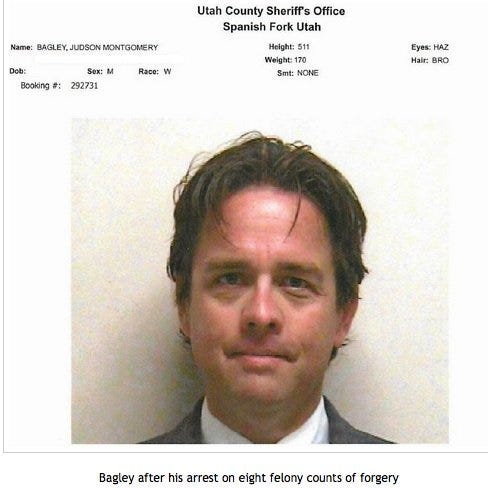
Eventually Byrne and Bagley were discredited. Bagley, a drug addict, was arrested on eight felony counts of forging drug prescriptions, using his young daughter for cover as he went from pharmacist to pharmacist. He copped a plea to keep out of prison.
Byrne and his subordinates at Deep Capture were the subject of a libel suit in Canada by one of the victims of his lies. A Canadian businessmen had been targeted with the usual fictitious accusations, such as that he was a financier for Al Qaeda. Byrne’s mistake was to subject a Canadian resident to that treatment. Canada is probably the worst place on the planet to be sued for libel.
The businessman, Altaf Nazerali, sued and won a record judgment in 2016. Nazerali was awarded punitive damages and legal fees, and Byrne was excoriated in a lengthy, scathing judgment. The court found that Byrne and his subordinates displayed a “reckless indifference for the truth,” that their motive was to “inflict damage” on Nazerali, and cited “the overt animosity, even hatred of the plaintiff, expressed by Mr. Byrne.”
The court concluded that “it is clear on the evidence that their intention was to conduct a vendetta in which the truth about Mr. Nazerali himself was of no consequence.”

Despite the libel judgment, Metz continued to write puff pieces lionizing Byrne and peddling his lies and screwball Wall Street conspiracy theories — which encompassed every member of the press who ever was critical of him. Metz never mentioned the libel suit or Bagley’s forgery conviction.
When Byrne fled to Indonesia in August 2019 and sold his immense stake in Overstock, Metz co-wrote an article that didn’t mention his smear campaign against critics, and, as usual, failed to mention the libel verdict, which had already been upheld on appeal. It’s not every day that a CEO is smacked with that kind of libel verdict, but it wasn’t fit to print in Metz’s view. Byrne’s 15% stake in the company is noted with approval — and his dumping of that stake a few days later did not warrant a follow-up.
Metz also said not a word about Byrne’s campaign to harass and attack reporters, which the Times itself had chronicled. But he did give a cheerful little plug at the end to Deep Capture.
No surprise there — just as it is no surprise he would try to “pull a Deep Capture” on Scott Alexander.
In one of the few conversations that I made the mistake of having with Metz when he was beginning his p.r. campaign for Byrne, he made it clear to me that he swallowed Byrne’s conspiracy theories hook, line and sinker, and approved of Bagley’s doxing, smears and attacks on Byrne’s enemies.
In my very first conversation with him, Metz misrepresented the slant of the article he was preparing on Byrne, indicating that it would be a tough and skeptical piece and not the puff piece he produced. So I would caution Scott Alexander and his allies to be skeptical of Metz’s statements that he was planning to do a “positive story” or that “Times policy” was the reason he wanted to dox Alexander. Journalist Tom Chivers, says Metz told him “that his editors wouldn’t let him write a piece about Alexander without naming him.”
That’s possible. But my theory is that he wanted to dox Alexander to get a notch on his gun stock at the Times, not because he was handcuffed by a terrible policy he couldn’t duck.
I expect that the Times will circle the wagons around Metz, as it tends to do when reporters are caught with their pants down. Thanks to the Internet, Metz’s shabby treatment of Scott Alexander is now on display for all to see. Whatever happens to Cade Metz, whether he’s kept in the bosom of the Times or sent packing, anyone who talks to him for a story is taking a grave risk. I wouldn’t believe a thing Metz ever says, including “hello” and “I think it’s raining outside.”