
Using SoulCollage® to Reveal the Various Faces of Myself and My Characters
The One and Many aspects of our Soul come in and out to play
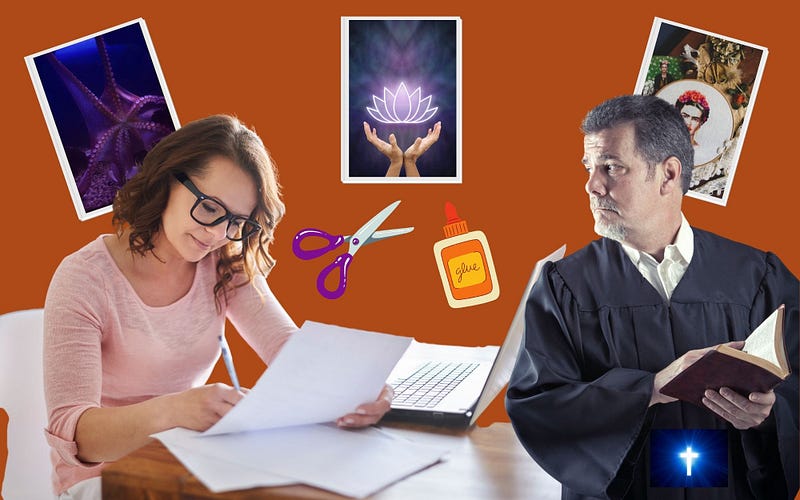
I do SoulCollage® because it speaks to my writer’s soul.
As I mentioned in post published last week, discovering how to collage a deck of tarot-like cards that tell the story of me was a eureka moment. I’m hooked.
My first question was, why is it called SoulCollage®? It has a nice ring to it, but its name also speaks to the heart of the practice.
A practice created by a Jungian art and psychotherapist with a master’s in divinity from Yale is bound to go deep. Intrigued, I ordered SoulCollage®’s creator, Seena B. Frost’s book, Soul Collage Evolving, and read up on the principles informing the practice.
Starting with Soul
We writers throw this word around a lot. We may refer to the soul of our story. The soul of my novel in progress is a redemption story. As in its deepest essence. It’s also humorous, but that’s along its surface.
We refer to the soul of our characters as well. My main character Pastor Silver’s soul (and halo) gets very tarnished before its act III polish.
But how is soul used in SoulCollage®?
Seena puts it this way:
The word Soul in SoulCollage® work is inclusive. It includes all the Netters (aspects or facets) of the personal self: the personality parts, including the ego, the energies of the physical body, and the archetypes that come from the cosmic realms to influence us, and even other sentient beings….This Soul might also be called the Whole Self. and it is actually holy simply because it is a form manifested originally from Source.
No matter how shadowed the Soul becomes through a lifetime, at its core, there is a spark of the holy. I call that spark of Source which lies at the center of every Soul SoulEssence.
We each have a SoulEssence. And so do our characters.
How does this translate to making collages?
In SoulCollage®, we assemble images that speak to us in a compelling way. We play with them, combining them in a variety of possible arrangements, seeing what want images want to go with what others. There are no rules for this, other than what feels right.
Once we’re satisfied with the arrangement, we glue them to a card or board. I call these soul cards.
Seena calls what’s revealed to us on our cards a Neter. She says, Neter is my favorite substitute word for energy, presence, guide, ally, or challenger. The word itself comes from ancient Egypt.
Its mysterious and paradoxical meaning appealed to Seena:
It seems that the word Neter pointed to God beyond God, or what in SoulCollage® work we call Source. Neter meant the One from which all that exists arises. But–and herein lies the paradox of this word–Neter meant, at the same time, the Many.
What or who constitutes the many?
According to Seena, it’s our inner personality parts, physical energies, members of our community, and archetypes that are part of our souls.
Neters also reveal significant facets of our character’s souls.
When we know our own foibles and failings, as well as our talents and strengths, we create more well-rounded, human, and hence, believable characters.
We have many, many Neters but they all come from one Source. As do our characters. In fact, my characters often have my Neters.
Sometimes that happens consciously. Other times, accidentally.
My main character, Pastor Sterling, has my quirky sense of humor and my struggles with honesty and integrity.
He’s hiding an affair from his wife, and his life is unraveling before his eyes. That’s why he’s so fun to write. I complicate his life with familiar struggles and then pile on even more.
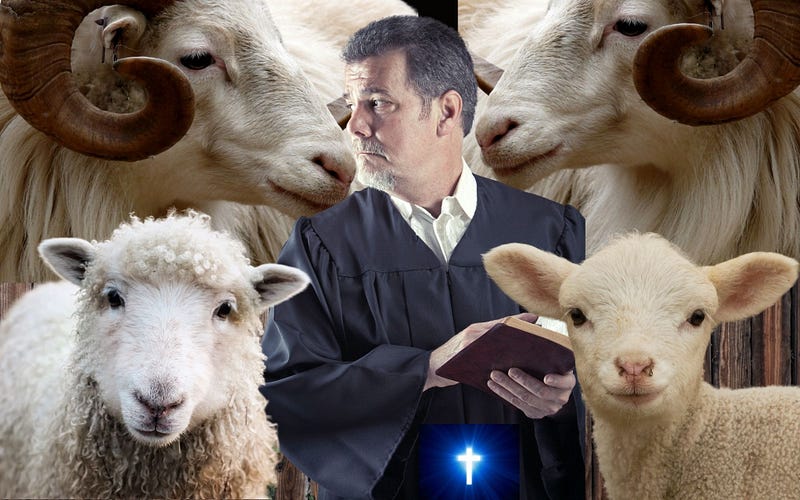
In making a card with Pastor Sterling in mind, I’m drawn to images of sheep since his church is called Jesus the Lamb. If I saw a ram charging head down I’d grab it. Silver’s look good gets knocked over, and knocked hard in the process of getting knocked up. After all, the book’s called Man Pregnant! and he’s a pro-life minister.
While he’s a horrible husband, he’s a devoted dad. That’s a different Neter that comes out in my story. And a redeeming feature. So I’ll make a card for that side of him as well.
Using Soul Cards while Writing
As I make my soul cards, I put them where I can look at them as I write.
Yes, I have a character profile. But I love having visuals encapsulating his complexities at a glance. It makes it easier to keep more of him in mind as I write. These images also inspire scenes I might not have thought of without them.
I can put that charging ram into my story in the form of the men’s fellowship. They gang up on Sterling, demanding he do their bidding. Which is the opposite of his wife’s and their pro-life group, B.A.A. I’ll even name the men’s group the Righteous Rams.
Beware the Shadow
In her book, Seena refers to Shadow quite a bit. Not surprising for a Jungian scholar. Rather than labeling things good or bad/evil, she looks at the shadows cast by the Neter’s energy as balanced or unbalanced.
When its energy is perfectly balanced, a Neter casts no shadow. It just is.
But often Neters cast a shadow.
She writes: Shadow is either an exaggeration of its best energy–too much of it– or it may be the absence of its best energy — -too little of it.
One of Sterling’s Neters is a healthy libido. But aphrodisiacally enhanced, his libido falls into the too much category, casting a long shadow over not just his life, but those all around him.
That shadow includes his unwanted pregnancy. In addition to messing up his life, it messes with his virility, an example of the not enough category.
Nice to know Neter’s aren’t static. There’s a range on a rich continuum full of juicy choices to inflict on our characters and spice up our stories.
Whether or not you use SoulCollage@, these possibilities are worth exploring.
So I leave you with these questions:
What’s the SoulEssece of your story? Of your main character?
What Neters or aspects of yourself are reflected in your character(s)?
What Neters do your characters express that are not reflected in you?
How do the shadows of these Neters come out in your story?
Would any of this be fun and/or revealing to explore via collage?
Let us know how it goes!
Here are additional resources for SoulCollage® and writing.
Marilyn Flower’s the author of Creative Blogging: Ninja Writers Guide to Character Development and Bucket Listers, Get Your Brave On. Clowning and improvisation strengthen her resolve during these crazy times. Follow her Sacred Foolishness and Stay in touch!


