
What is a Bitcoin Halving? — Explained
Why does it matter?

A bitcoin halving typically occurs every four years, the most recent Bitcoin halving happened on 11 May 2020. To understand what bitcoin halving is, it is necessary to first understand a bit about how the bitcoin network works.
The bitcoin system consists of a network of computers (also known as “nodes” or “miners”) that run bitcoin’s code and store its blockchain. A blockchain can be thought of as a series of blocks metaphorically. Each block contains a set of transactions. Since all computers running the blockchain have the same list of blocks and transactions, they can see these new blocks and transactions in real-time.
The blockchain becomes more stable and secure as more machines, or nodes, are connected to it.
It is estimated that over 10,000 nodes are currently running Bitcoin’s code.
Can I become a node in the bitcoin network?
Yes, you can become a node in the bitcoin network if you have enough storage to download the whole transaction history and entire blockchain, but not a bitcoin miner.
Bitcoin Mining
Bitcoin mining is the process where people can use their computers to participate in. In general, mining entails solving computationally complex puzzles in order to find a new block to add to the blockchain. Bitcoin uses a system called Proof of Work (PoW).
Faster computers with a variety of hardware can be used to generate bitcoin. Some companies use certain computer chips or advanced processing units likE GPUs to get more block rewards.
The smallest unit of bitcoin is called a Satoshi, and it is divisible to eight decimal places (100 millionths of a bitcoin). Bitcoin could eventually be made divisible to even more decimal places if required and if the participating miners support the shift.
What Is Bitcoin Halving?
On the Bitcoin blockchain, a “block” is a file containing 1 MB of Bitcoin transaction data. So miners add the next block by using hardware to solve complex mathematical puzzles, generating a random 64 character output code called “hash,” finishing the task, and locking the blow so it can’t be altered or hacked. Miners earn bitcoins by completing these blocks.
Bitcoin halving is when the rate of new bitcoin creation is halved, which occurs every 210,000 blocks mined, or about every 4 years until all 21 million bitcoins are completely mined.
The halving is notable since it represents a further reduction in Bitcoin’s limited supply. Bitcoin has a maximum supply of 21 million coins. There are currently 18,361,438 Bitcoins in circulation, with just 2,638,562 remaining to be released via mining reward.
In 2009, the reward of each block was 50 bitcoins. After the first halving in 2012, reduced to 25 and then from 25 to 12.5 in 2016, and since 11 may 2020 it become 6.25 bitcoin per block.
To explain this in plain English, Let’s suppose gold. If the price of gold mined out of the earth was halved every 4 years. If the worth of gold is based on its scarcity, then a halving of gold every 4 years would boost its price higher.
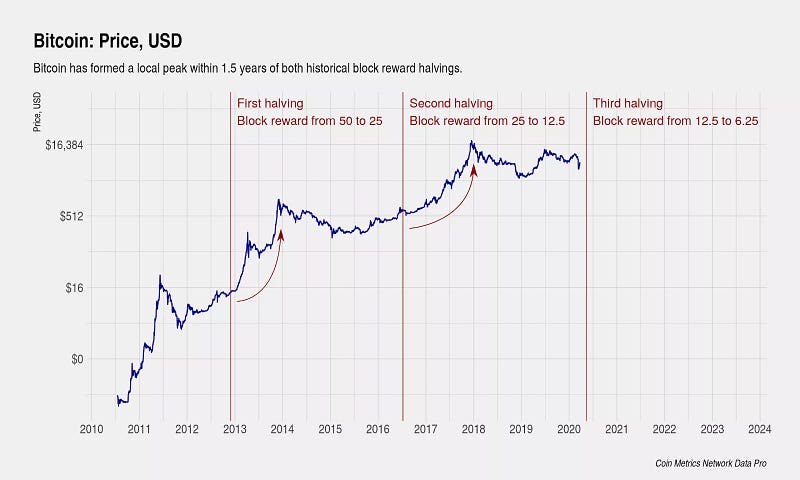
Miners definitely should “prepare for the Bitcoin halving because it represents a near-instantaneous drop in revenue,” says Caleb Chen, digital currency and privacy advocate at Private Internet Access.
It’s a built-in function of the Bitcoin network that has a major impact on the cryptocurrency’s entire ecosystem.
Why Does It Matter?
Bitcoin investors or traders should keep this systematic feature in their minds, halving often comes with a sizeable amount of instability and turmoil for cryptocurrency.
It’s easy to see why — as Bitcoin halving occurs, the supply of usable Bitcoins becomes smaller, the value of the Bitcoins yet to be mined rises. And with those variations comes the opportunity to profit.
In the past bitcoin’s history, these bitcoin halvings have a great association with bitcoin price surges. For example, The first bitcoin halving, which happened on 28th Nov 2012, when the price of bitcoin was $12 and saw a boost from $12 to nearly $1,150 in a year. The second Bitcoin halving occurred on 9th July of 2016. The bitcoin price went down $650 per coin at that halving, and by December 17th, 2017, Bitcoin’s price had ramped up at the all-time high of nearly $20,000.
The most recent halving, last May, Bitcoin was resting at $8,787 — and in the months considering, its price has blown up. Over the last few months alone the cryptocurrency has ramped up past all-time high records again and again and currently sits at around $63,380.
Certainly, there were various elements to think about when considering bitcoin upsurge after halving like increasing news coverage of cryptocurrencies and Bitcoin itself.
The third bitcoin halving in bitcoin’s history is almost assured to influence the bitcoin ecosystem in various other ways. Mostly the number of bitcoin miners is extensively expected to go down as the financial reward for the mining ends up being less engaging and for less efficient miners, unlucrative.
The halving is typically surrounded by immense speculation, hype, and volatility, and it is unpredictable as to how the market will react to these events in the future.
Final Thought
The halving is usually accompanied by a lot of excitement, speculation, and uncertainty, and it’s hard to predict how the market will react in the future
Disclaimer
This article is for informational and educational purposes only. It is not intended to be any investment advice or suggestion.
Follow us, and keep updated!
If you enjoyed reading this, you might enjoy these:


:max_bytes(150000):strip_icc():format(webp)/coinmetricsbtchalving-1aa1b4c4ddea47cfbe0439daf6e3626e.jpg)