
Pandemic Economic Restart
How do we balance health safety the economy as we reopen? This plan is an outline with key questions and metrics.

Intro
The Corona-virus pandemic has infected millions, overwhelmed healthcare systems, and killed hundreds of thousands. Yet we must restart the economy soon or suffer a steep recession. This is a discussion on how to restart while balancing safety with economics. Without any effective treatment we’ve sheltered in place waiting for the spread to get under control and attempted to “pause” a vast swath of our economy. If we wait too long there can be devastating unemployment, business closures, stress related illness, and social instability — possibly a second Great Depression.
How serious is the economic impact? Consider this — even during the Great Depression businesses were open — people could actually buy things or go to a restaurant if they could afford it. Here we have an event where entire industries are suddenly unable to conduct their business — sports leagues (and all the associated vendors, bars, hotels, restaurants), music concerts, travel. We also have entire industries which are shutted but even if reopened won’t be the same — gyms, cosmetic salons, restaurants, retail stores. There is no quick bounce back for these businesses — the devastation is real — and this kind of stress can lead to social unrest, failed businesses, and even deaths from other causes ranging from suicides to untreated illnesses from the newly unemployed.
This leads to these natural questions:
- Virus Next Wave — Can we restart without unleashing a devastating second wave?
- When can we emerge? How long do we remain shuttered before the economic effects are just as dangerous as the virus itself?
- Back to Normal — When will normalcy be restored?
I’d rather not frame this as an idea about saving lives versus saving the economy. We need both.
As fast as possible, our scientific communities are making better treatments and tests so that we can isolate those afflicted. Many new tracing technologies are being created to help identify those infected, inform those who might have been in contact, and quarantine them. However this takes time and even if extensive testing and contact tracing improves quickly it’s not enough to reopen the economy.
Here are just a few of the challenges:
- Test Lag- There is a lag from the time someone gets tested to the time we know the result. Even with rapid testing (antibodies or other quick tests) a person can only be tested so frequently leading limits of testing speed vs positive test vs quarantine.
- Virus is widespread already— 600,000+ cases in the USA and over 2 million in the world at the time of this writing. Some new results cast suggest and some of those who have recovered may still be infectious. If only a fraction of them are still infectious, but otherwise healthy, then the test-and-isolate strategy may need to be re-thought.
- Compliance Challenges— Some will comply with directives such as stay-at-home or wear a mask, some are more vulnerable to the disease, some have different political views. It can be very challenging to have a unified behavior until we get citizens on the same page.
Clearly aggressive testing and tracing can only get us so far now that the virus has infected so many people. Testing and contact tracing are important, but they are not the only element of moving forward before we have a full treatment. We must move forward anyway — just not recklessly.
Restarting Soon
Perhaps by running with a different set of assumptions we can plan to reopen the economy sooner. These are:
- The virus is here — Rather than attempt to test and isolate everyone we just assume the virus is present in most gatherings — we just don’t know which people.
- Economy must restart anyway — Rather than paint this as once the virus is under control we can restart the economy, we reverse this. We know we must restart the economy, how do we do this in the safest, smartest way
With these two assumptions (virus is here, we must restart anyway), we move to a milestone based planning phase.
Since the virus is here we must rewire our daily interactions with that in mind. That means each person must use personal protective equipment (PPE). However the amount of precautions they must take are proportional the activity they are performing. For example if someone is working in an open field (such as a farmer or landscaper) the need for protective gear is minimal. Whereas a person with close contact — such as a doctor — needs full protective gear.
We can sum this up as table:
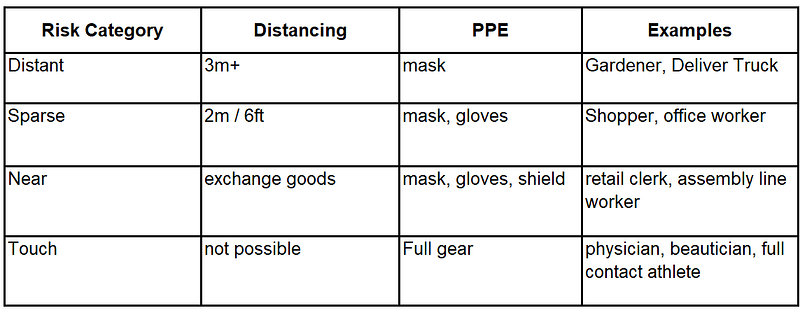
The above table is just an example. Note that we need vetted procedures for both workers and customers. The next step is to combine experts from medical science with experts who have deep knowledge of each industry to draft industry specific safety and health procedures. As those get quickly drafted we will need ample supplies of PPE for everyone — not just the medical profession. This also means a national priority is designing new PPE for some industries that might not have had PPE requirements in the past. Some PPE will be custom to a specific industry. Also some members of the population are more vulnerable to the virus — we’ll need to support them with extra caution.
A key to achieving this is to have a straightforward process which has consistency across all regions.
- Create Industry Specific Covid Restart Group s— Make sure we have correct expertise. This will be different across different sectors and locations. For small businesses (e.g. mom and pop shops) business groups/trade and labor associations and the government can help find the right expertise.
- Draft Covid Operating Procedures — Using virtual meetings the groups aggressively create procedures and walk through precautions necessary for each class of worker and customers
- Approval (Government & Industry) — Have a sign off process. As new information becomes available the Covid Operating procedures can be updated.
- Reopen plan — Acquire necessary supplies and reopen
This four step process can be started immediately. Key figures from each industry can meet virtually and work with state and local authorities to draft limited and then full reopening procedures with the idea the COVID19 is here and we just must accommodate it.
However even with this we will need to identify which industries must restart since we don’t have enough PPE gear even if we did have the right procedures.
Importance & Prioritizing
The other key element is identifying which industries are most essential. For example food processing plants are essential but some operate with confined spaces. In this case, even though we may want to wait as long as possible, at some point we just need those industries to run at full capacity. In other words we must get them restarted anyway or the secondary effects of not having their products and services will be devastating.
Other large industries will become important simply because of the number of people they employ (such as hotels, restaurants, and factories). So while we might get by for a small time with limited hotel usage, at some point, economically speaking, we must get those industries restarted.
This creates a second table: Importance.
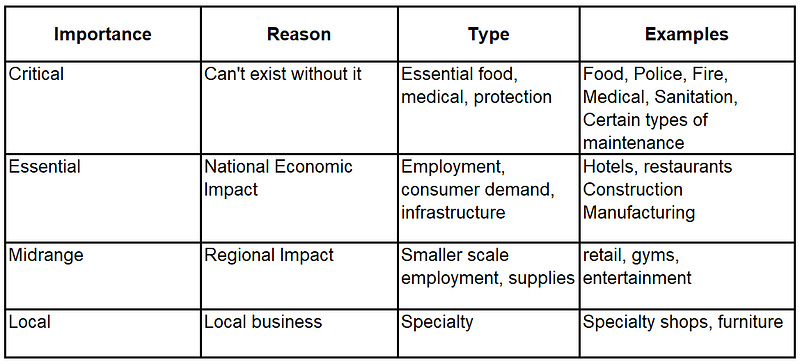
The regional and national governments can work on which industries to prioritize in conjunction with the risks shown earlier.
Putting it Together
Clearly we need to combine the following elements to restart the majority of our economy:
- Formalize safe restart procedures for each industry
- Prioritize those industries we need by core infrastructure and economic need/impact
- Collaborate with the scientific and Personal Protective Equipment makers so we ramp up the supplies we need for restart.
To help visualize this we can put the two dimensions (Risk Category vs Importance) in a simple graphic as shown here. Some professions such as those that are already isolated can restart very soon, others are important but need restart plans and PPE support.
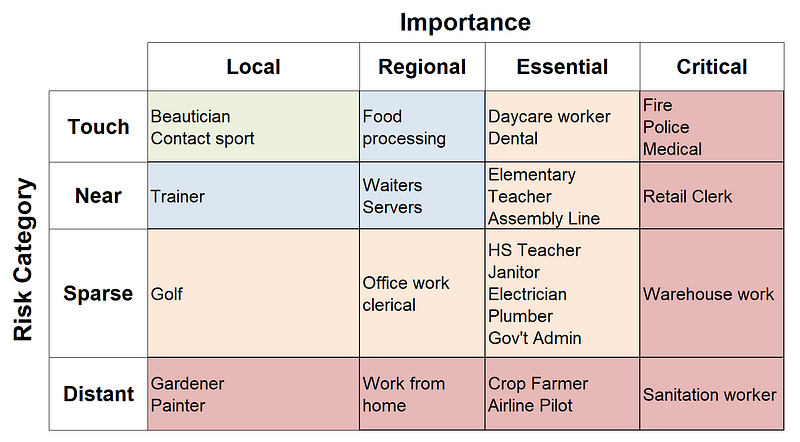
The color coding is for phases of restart with Red (Phase1) being the first phase of workers to restart and Green (Phase 4) being the last.
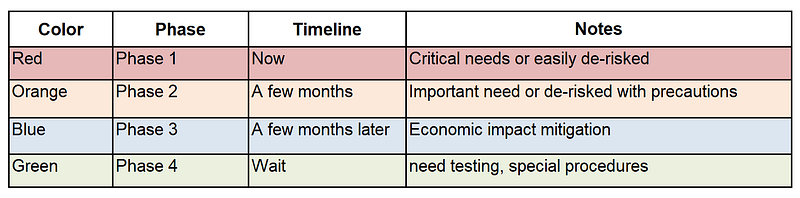
Note that these tables combine restart priority by balancing critical needs (such as medical and safety) with economic needs (gardener). This is because there is simply no reason to keep a gardener or other low-risk (from Corona point of view) job held back. We must get the economic value from as wide a section of the economy as possible.
The staging is important to balance the time to get testing and tracing out along with the time to ramp up PPE supplies and related post-corona procedures.
Summing Up
We need to restart the economy soon or the effects of a deep recession will be as severe or worse than Coronavirus disease. To do this requires safe restart procedures, proper coordination, and aggressively making the needed equipment and supplies. We must also increase our medical capacity so that if we see some resurgence of cases we can manage them efficiently and effectively. This may mean keeping extra regional field hospitals on standby for a time.
We will not have a chance to be normal until a treatment is found and even then certain industries will have permanently changed. However before we get an effective treatment for Coronavirus we can restart our economy as long as we leverage the right precautions.
Let’s work together now to balance health and economics for our collective good.
References & Links
A companion piece on leveraging data to treat Coronavirus is here.
The following online resources cover aspects of restarting the economy from several perspectives
- https://www.nationalreview.com/corner/a-covid-cost-benefit-analysis/
- https://www.nytimes.com/2020/03/22/opinion/coronavirus-economy.html
- https://www.nytimes.com/2020/04/06/upshot/coronavirus-four-benchmarks-reopening.html
- https://www.nytimes.com/2020/03/20/opinion/coronavirus-pandemic-social-distancing.html
- https://www.imperial.ac.uk/media/imperial-college/medicine/sph/ide/gida-fellowships/Imperial-College-COVID19-NPI-modelling-16-03-2020.pdf
- https://www.foxnews.com/politics/johns-hopkins-doctor-identifies-5-key-factors-for-relaxing-social-distancing
- Food Supply Chain facing difficulties


