
Buzz Pollinators or Gardeners that Sound like Jet Engines
It’s not a bird or a plane, it’s a native Australian bee!
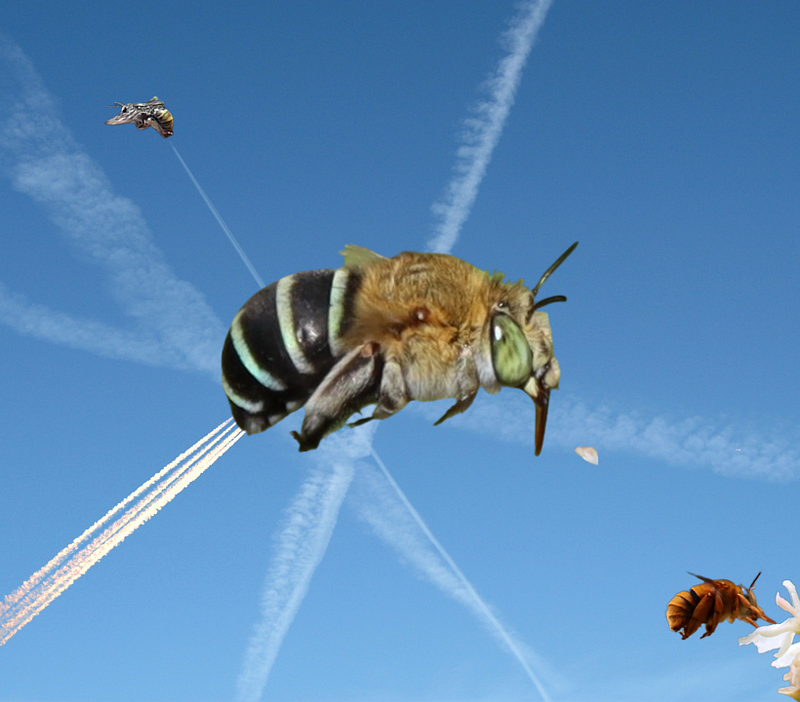
I always hear Blue-banded and Teddy Bear bees before I see them. They are LOUD. Whether they are flying or pollinating, they are buzzing like the proverbial busy bee. Other species of buzz pollinator are far more difficult to find as they are quiet and small.
A recent trend has seen people experimenting with them as an alternative for crop pollination. Their European cousins (Apis melliferis) that are used to produce honey, are not buzz pollinators. Their main competitor for buzz pollination of Australian crops is the controversial Bumble Bee (Bombus terrestris) which is being used in experiments on the geographically isolated island state of Tasmania. This bee has proved invasive on that island, as well as having the potential to bring in pathogens that threaten commercial honey bees and pollinating weed species that are limited at this time. For more on the potential risks of Bombus terrestris on the Australian environment, click here.
I am fortunate to see them in my own garden, because these bees are shy and wary. I witnessed why one afternoon when I was watching one. Right before my eyes a Grey Butcher Bird flew in and snapped it out of the air. This was an impressive feat.
Why?
Because these bees are fast and they don’t fly straight. They zig zag all over the place making them almost impossible to photograph let alone catch in a relatively small beak! In comparison, the Western Honey Bee is slow and meandering in habit, making it far easier to photograph and presumably for predators to pluck from the air.
What does a buzz pollinator do?
More than half of all bee species are buzz pollinators. This means that as they harvest from a flower they also vibrate and there’s a very good reason for this.
Some plant species store pollen inside their anthers (male parts of the flower) that release the valuable powder when it is agitated by the vibrations of buzz pollinators. Without this buzz pollination the pollen remains inside and the plant doesn’t produce any fruit. This is unlike other plants that have readily available pollen that adheres to the small hairs on pollinators when they brush past them.
Apparently, plants have to put a lot of work into making pollen and it requires significant proportions of the plant’s nitrogen supplies. Plants that need buzz pollination don’t produce nectar making buzz pollinators generalist feeders that visit a wide variety of flowers.
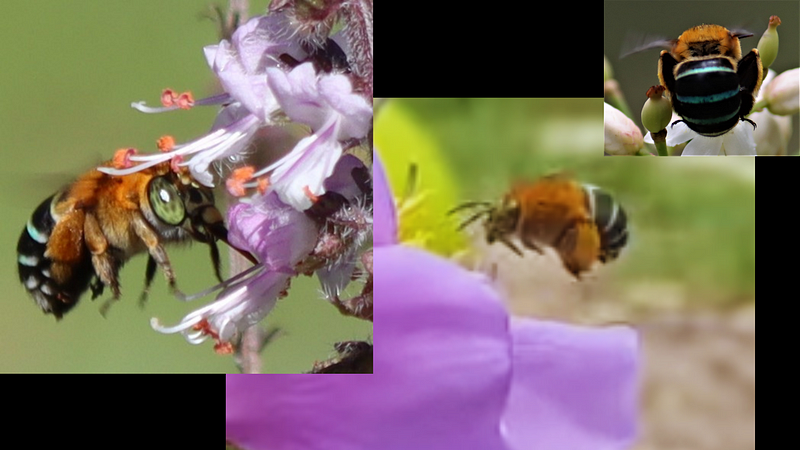
Introducing the buzz pollinators: blue banded Bee
There are three buzz pollinators that I have managed to get on film. The first and most prolific in my garden is the gorgeous Blue-banded bee. This is an Amegilla species. Which one? I have no idea. There are 12 species which only experts can distinguish from one another.
They all have big green eyes which are mesmerising, stripes of hair coloured from white to bright iridescent blue and every shade in between and a lovely furry body.
The females have four “bands” while the males have five. The females dig a burrow on their own and fill little brood cells with food and an egg, before sealing the nest for the incubation of larval/pupal stages of development.
Blue banded bees tend to nest in hard dirt walls or banks. We have lots of retaining walls built roughly with sandstone. I’m sure there are nests between the rocks, but I am yet to find any!
My next goal is to find out where the blue-banded bees in my garden are gathering at night. That’s right! They roost, often in groups, sleeping together on sticks or canes of plants.
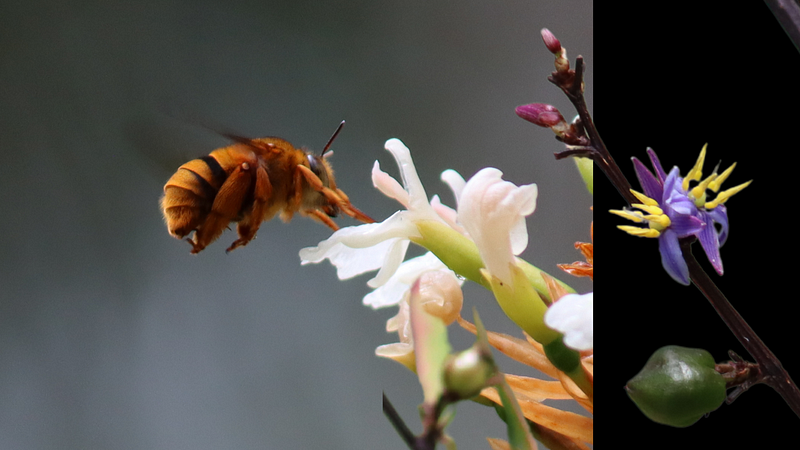
Introducing the buzz pollinators: Teddy Bear bee
The loudest bee I’ve ever heard is the gorgeously fluffy Teddy Bear bee or Amegilla bombiformis. Despite its grand size when compared other native Australian bees, it’s fast! It’s so fast that today was the first time that I managed to get a photograph.
My sightings of this species are few and far between. I’m crossing my fingers that as my garden slowly fills with native flowers, I will get to observe them more often.
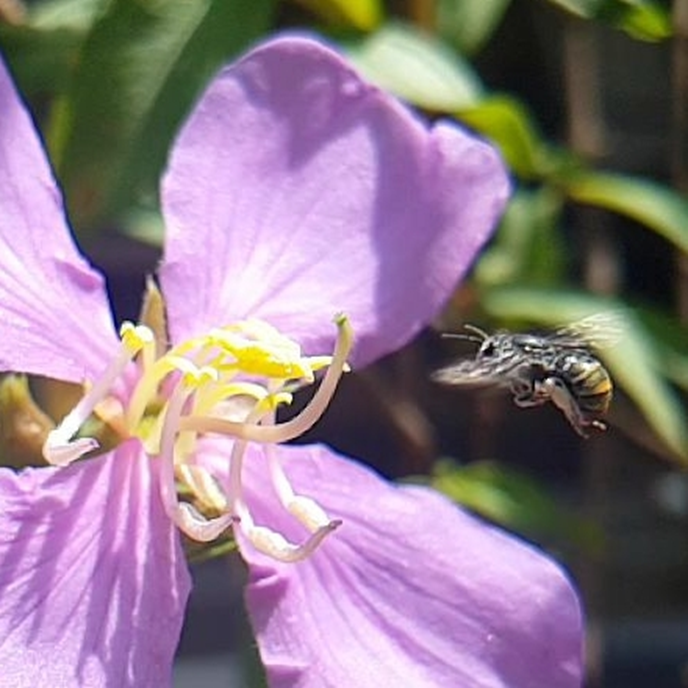
Introducing the buzz pollinators: Nomia and Lipotriches
The 56 species of bee in the Lipotriches genus don’t get common names as a rule. They are tiny (only 6–11mm long or less than half an inch) and shy like their other buzz pollinator relatives. I caught one in a video purely by accident!
They used to be in the Nomia genus. The main difference is that Lipotriches species have light coloured hair bands on their abdomen while the Nomia species have bright coloured enamel-like bands, called exoskeleton.
These bees are burrowers and in fact, most burrowing bees are capable of buzz pollination. This is because by sonicating their bodies, ground nesting bees can more easily lift and push out the soil as they evacuate their nest burrow.
Again, I haven’t found them gathering in aggregations but some reports say that they can be found gathering together in the hundreds!
Benefits of buzz pollinators in the garden
Last year I was sitting on my back patio enjoying a lunch break when I heard a loud buzzing. I looked around expecting to see a hornet or a wasp, but was delighted to find a Blue-banded Bee instead! This was only my second time seeing a Blue-banded bee and last time my attempts to photograph it were stymied by its speed and agility.
This time I hit record and watched in awe as it buzz pollinated my Blue Tongue Plant (Melastoma affine).
Watch the video here:
Afterwards I examined the petals and discovered little grains of pollen that had fallen from the anthers. I have three of these plants that regularly produce berries so we must have lots of buzz pollinating visitors though we rarely see them.
With some more research I discovered the reason for so many Australian native plants storing their pollen this way. The nutrient deficient Australian environments mean that plants have to be efficient with their distribution of resources. Many Australian natives also tailor the positions of their stamens and stigma to maximise the chance of pollen transfer and therefore, fertilization.
Buzz pollinators are also very effective for pollinating plants that don’t lock away their pollen. The agitating movement shakes pollen loose from the anthers as well as redistributing it to the stigma (female part of a flower) when the pollen shakes off the bee.
A researcher from the University of Adelaide, Dr Katja Hogendoorn, completed a research study that showed that Blue-banded Bees could be kept successfully in greenhouses and would pollinate tomatoes as effectively as the European Bumblebee (Bombus species). It’s not the only study that suggests that this is a great option for growers. Other species that benefit from buzz pollination include blueberries, cranberries, chillies, kiwi fruit, eggplant and capsicum.
Final Thoughts
Buzz pollinators are non-aggressive species that perform essential ecosystem services in their home environments. In Australia, this includes maintaining the viability of many species that lock away their pollen.
They are also stunningly beautiful and fascinating to observe. To make sure that they visit and flourish in our gardens we can plant lots of native species and minimise the use of pesticides.
When we talk about “saving the bees”, we need to concern ourselves with more than just the Western Honey Bee (Apis mellifera). Although the various native species don’t give us honey, they perform essential ecosystem services and without them some of our beautiful native plants may not survive.
These truly are garden friends. Without them, many plants would not be able to produce fruit or seed. I feel really lucky to have them visit and pollinate in my garden.
Edited to add: I’ve now had the pleasure of seeing another Buzz Pollinator in my garden! The Great Carpenter Bee is Australia’s largest bee. Read a shortform about the encounter here or watch a video here.
This story was fact-checked by Megan Halcroft, an Australian native bee expert, who generously gave her time. Thank you Megan! Visit Megan’s Etsy store to purchase her wonderful field guide:
Here’s my review of her field guide:
Like writing or musing? I can recommend Medium as an outlet! For a measly $5 a month you can earn money for writing and read as much as you like. Since my third month, I have earned more than my membership fee. If you use the link below you’ll also be directly supporting my writing at no extra cost to you!


