Buzz Guide to Coffee Brewing
The 10 most popular methods to get caffeinated

You’re a coffee lover. You wake up in the morning and can’t start your day without a cup of joe. But lately you’ve been feeling like your coffee just isn’t as good as it used to be. You’ve tried all the different brands and roasts, but nothing seems to be making a difference. So you decide to take matters into your own hands and learn how to brew coffee yourself.
You start doing some research and quickly realize there are a lot of different ways to brew coffee. You had no idea there were so many options each one has its own set of advantages and disadvantages. It can be tough to figure out which one will give you the best results.
Another challenge people face is not knowing how to use the brewing method they’ve chosen. Every method is different, and if you don’t know what you’re doing, it can be very difficult to get the results you want.
Finally, people often find that they don’t have the time or patience to brew their own coffee. Brewing coffee can be a time-consuming process, and not everyone has the patience to wait for their cup of coffee to brew.
If you’re facing any of these challenges, don’t worry! This article will provide an overview of ten different ways to brew coffee. For each method, I briefly explain how to use it, as well as its main advantages and disadvantages. By the end of this article, you should have a good understanding of the different ways to brew coffee, and be able to choose which method is right for you — or at least give a couple a try, if just for fun!
1. Drip coffee maker
Drip coffee makers are one of the most common ways to brew coffee. They’re easy to use and can be found in almost every household (as well as convenience stores and restaurants). To use a drip coffee maker, you simply add ground coffee to the filter and pour water into the reservoir. The machine will then heat the water to a boil. The water travels up a tube to drip over the grounds, which then drips into the pot below. Now you know how this way of making got its name
Advantages
Drip coffee makers are very easy to use, which is one of their main advantages. They’re also relatively fast, so you won’t have to wait long for your cup of coffee. Another advantage of drip coffee makers is that they’re very affordable.
Disadvantages
They can produce coffee that tastes “burnt” or “overcooked.” This is because the water is heated to a very high temperature and then drips over the grounds, which can extract too much flavor from the coffee. Another disadvantage of drip coffee makers is that they can be difficult to clean. The coffee grounds can get stuck in the filter if you use a “gold filter” which is reusable. Cleaning the water reservoir can be hard to reach as well.
2. French press
French presses are another popular way to brew coffee. This is the type I use each morning. They’re also very easy to use, and they produce coffee that has a richness and body that drip coffee makers can’t match. To use a French press, you add ground coffee to the carafe and pour hot water over it. Then, you put the lid on and let the coffee steep for a few minutes — my rule of thumb is 4–10 minutes. After that, you press down on the plunger, which forces the grounds to the bottom of the carafe. The coffee is then ready to drink.
Advantages
French presses have a few advantages over drip coffee makers. One is that they’re very easy to use. They’re also very affordable, and they produce coffee that has a richer flavor because, unlike paper filters, the French Press allows the oils to stay with the coffee.
Disadvantages
One is that they can be difficult to clean. The coffee grounds can get stuck in the mesh filter, which can be hard to reach if they cannot be disassembled. Another disadvantage of French presses is that they don’t always produce consistent results. If you don’t wait long enough, the coffee can be weak; waiting too long results in coffee that may be stronger than what you like. Additionally, if the press container is made of glass, it can break more easily.
3. Pour-over coffee
Pour-over coffee makers are another simple way to brew coffee. They’re also very easy to use. To use a pour-over coffeemaker, you add ground coffee to the filter and pour hot water over it. Similar to drip coffee, the water then steeps through the coffee and filter and into the carafe or into a coffee cup. Unlike the drip coffeemaker, you add the water almost all at once into the filter container. The coffee is then ready to drink.
Advantages
The advantage of pour-over is that they’re very easy to use. They’re also very affordable. They are basically a drip coffeemaker but you are the drip who needs to boil the water before it is poured over the coffee.
Disadvantages
There are a few disadvantages to pour-over coffee makers. One is that they can be difficult to clean if you use a reusable filter. The coffee grounds can get stuck in the mesh filter, which can be hard to dislodge. Another disadvantage of pour-over coffee makers, if you don’t get one that is machine washable, is that the cone shape can be somewhat difficult to clean (are you seeing a trend here?).
4. Moka pot
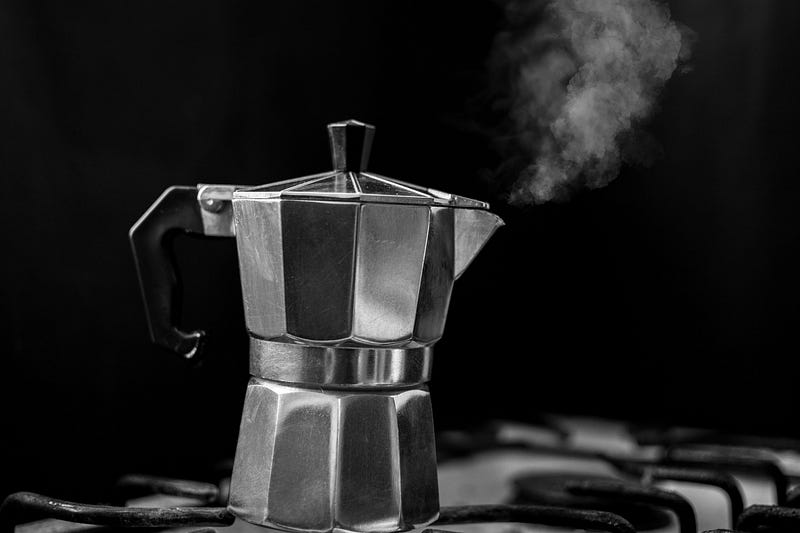
Moka pots are a popular way to brew coffee in Italy. My wife and I used one when we lived in the UK. They produce coffee similar to espresso because the water in the lower chamber boils and the steam is pushed up through the finely ground coffee in a small basket in the boiling chamber, across a filter mesh, and up into the upper chamber.
Advantages
Other than making rich-flavored, espresso-like coffee in small batches, Moka pots don’t have many advantages.
Disadvantages
There are a few disadvantages to Moka pots. One is that they take some effort to set them up. Then, yes, they can be difficult to clean. Still, it may be worth a try if you like espresso coffee in slightly larger batches than one cup at a time.
5. Cold brew coffee
Cold brew coffee is now a popular way to make coffee. It’s also very easy to make, and it produces rich coffee. To make cold brew coffee, you add ground coffee to a container and pour cold water over it. Then, you let the coffee steep for 12 hours in the refrigerator. After 12 hours, you strain the coffee and enjoy it cold or over ice.
Advantages
Cold brew coffee is very easy to make. It’s also very affordable, and it produces coffee that has a richer flavor.
Disadvantages
The biggest disadvantage of cold brew coffee is that it takes a long time to make; it’s not something you can whip up when friends pop in on a hot day.
6. Turkish coffee
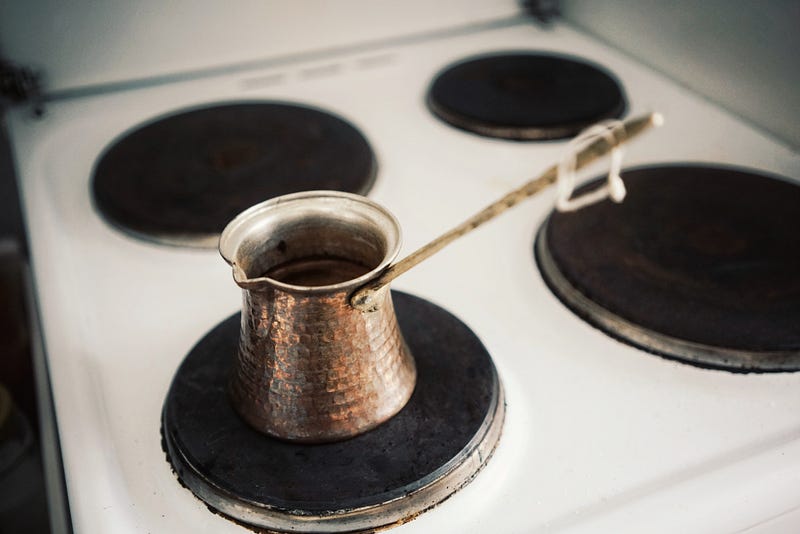
Turkish coffee is a popular way to brew coffee in Turkey (ya think?!). To make Turkish coffee, you add very finely ground coffee to a pot and pour hot water over it. Then, you put the pot on the stove and let the coffee brew. After a while, the coffee will be ready to drink. There can be an entire ritual to preparing and serving Turkish coffee.
Advantages
Turkish coffee is pretty easy to make.
Disadvantages
There are a few disadvantages to Turkish coffee. One is that (blah, blah, blah) it can be difficult to clean. The coffee grounds can get stuck in the pot, which can be hard to reach. Another disadvantage of Turkish coffee is that until you get the hang of it (and to do it right, you need a special brewing pot), it doesn’t always produce consistent results. If you don’t brew the coffee for the right amount of time, the coffee can be too weak or end up tasting burnt.
7. Espresso maker
Espresso makers are now a popular way to brew coffee. They’re also very easy to use, and they produce coffee that has a richness and body that drip coffee makers can’t match. To use an espresso maker, you add finely ground coffee to a container basket that is then attached to the machine where hot water and steam is forced through it. This produces small amounts of rich, aromatic, full-bodied coffee.
Advantages
Espresso makers have a few advantages. One is that they are NOT difficult to clean. Typically the brewing area just needs to be wiped down, and the coffee basket can be rinsed, and many are machine washable. Espresso makers are also becoming more affordable, and they produce coffee that has a richer flavor than drip coffeemakers.
Disadvantages
There are a few disadvantages to espresso makers. One is that they are a pain for making a large number of coffees (just ask Starbucks) — they only make one or two cups of espresso at a time. Another disadvantage is that, even with lightly roasted coffee, espresso has a strong flavor which not everyone prefers.
8. Siphon or vacuum coffee maker
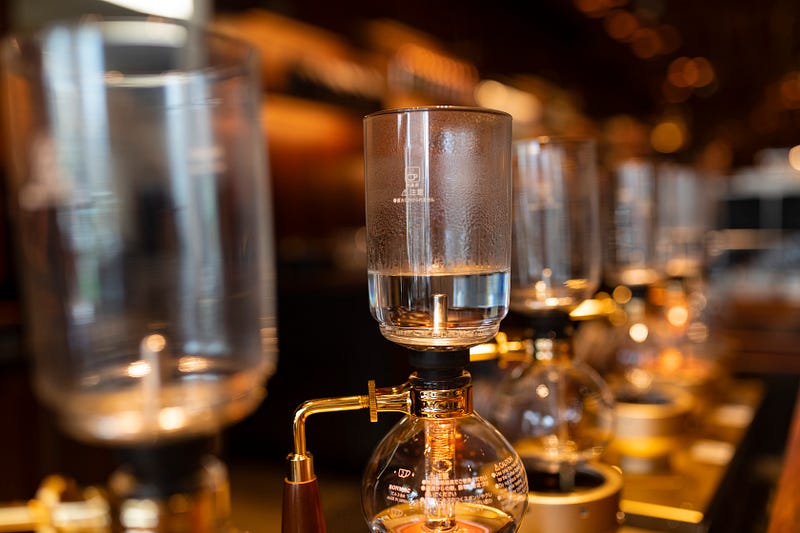
Siphon coffee makers are a popular way to brew coffee — in coffee shops! To use a siphon coffee maker, you add ground coffee to the top chamber and water in the lower chamber. Then, you put the pot on the stove where, as the water boils, the steam and water is forced (more like sucked) up into an upper chamber where it condenses through the coffee and down into the upper serving pot.
Advantages
Siphon coffee makers have no advantages I can tell other than looking very cool — like something out of a steampunk movie. I am sure they provide a different coffee tasting experience as well, though I don’t think I have that discerning of a palette.
Disadvantages
It takes special equipment to make siphon coffee which can be fragile. Some, rather than being able to use on a stove top, need a special heating element or fuel as well. Cleaning is also sometimes a challenge. Like I said, something you might want to try in a coffee house.
9. Percolator
Percolators are a popular way to brew coffee — particularly in church halls and flying squadrons (we called it “the silver bullet). They’re very easy to use, and they produce coffee that has a richness and body that filtered drip coffee makers can’t match. To use a percolator, you add ground coffee to the basket on top and heat the water in the chamber. As the water boils, it is forced (perculates) up a central tube and falls onto the coffee in the upper basket. The coffee then drips down into the water chamber where it continues to cycle up through the basket. After a few minutes, the coffee will be ready to drink.
Advantages
Percolators have a few advantages. One is that they’re very easy to use. They’re also very affordable, and they produce coffee that has a richer flavor.
Disadvantages
There are also a few disadvantages to percolators. One is that, depending on the design, once the coffee stops boiling, it continues to “cook” and get stronger. If it is brewed stovetop and the heat is then turned off, the coffee flavor is preserved, but then after a while the coffee cools and needs to be reheated.
10. Instant coffee
Ah! The coffee smell without the grounds. It’s also very easy to make. You just add the desired amount of water to a cup and then add the instant coffee powder (or you put the instant coffee into the cup and add the hot water — there are heated debates over which is the more effective way!). Then, you stir the coffee and it’s ready to drink.
Advantages
Convenience and it’s also very affordable. That’s about all I can think of. No grounds to clean up, no special equipment (and if you have a microwave, all you need is the cup and water).
Disadvantages
Flavor! While I know there has been an improvement in the flavor of instant coffee over the decades, I have yet to find one that gives that full, rich body and flavor you get from any of the other above methods.
The dregs
That is a pretty comprehensive list of the variety of ways to brew coffee, each with its own advantages and disadvantages. The best way to choose a method is to experiment with the different ones that interest you and find the one that produces the results that you like the best. In the end, it isn’t that there is a superior way to make coffee, rather it is the one that produces the coffee-drinking experience that you enjoy most. Happy brewing!