
Buyer Personas: Understanding Our Customers Better
Businesses can target their marketing more effectively by segmenting customers into groups of people with similar characteristics.

Every customer is unique.
But there are different groups of customers with similar needs.
Businesses best reach each customer group with a different marketing method and distinct message, so having buyer personas is key to businesses enhancing the effectiveness of their marketing.
This blog is about buyer personas and how businesses can effectively target their ideal clients or customers.
What is a buyer persona?
Personas are fictional and generalised representations of real people.
Buyer personas are fictional and generalised representations of real customers.
Buyer Personas are a relatively new topic, first discussed in the late 1990s. They have sprung to relevance with the rise of social media, where businesses can now target marketing to specific market segments.
Buyer personas represent a firm's unique customer groups. Businesses create these profiles to depict their ideal customers by describing their personality types: Accountant Andy or University Student Denise. These are fundamental examples.
Moreover, buyer personas represent the types of people we want as customers.
It is not just your best, long-term customers; but your competitors' customers, new profitable customers, and potential customers that do not know your service exists, but it could be valuable to them. To get the complete picture, we need to know about the people who have not bought from us yet.
It is common to have multiple buyer personas for business, each with different motivations and backgrounds. Some personas have families and a spouse who plays a vital role in the household decision-making. Some do not.
The variations between personas are based on customer demographics, behaviour patterns, motivations, and goals.
“A buyer persona is a semi-fictional representation of your ideal customer based on market research and real data about your existing customers.” (Ravella, 2011)
Why should businesses use Buyer Personas?
Using buyer personas helps us better understand the types of people who are our best customers, better understand their needs, and attract more of those people.
It helps us empathise with customers and understand their daily routines, challenges, and decision-making process. We can then do a better job of acquiring and serving them.
You cannot position your product's ability to solve a person's problem or meet customer needs without knowing anything about these people. We need to know their backgrounds, demographics, goals, challenges, or personal interests.
You want to attract the most valuable leads and customers to our business as a business, right?
We want to reach the people most likely to become long-term customers and advocates. Knowing these people and their similar characteristics enables marketers to tailor targeted marketing. It gives direction to marketing strategy.
People prefer to purchase from brands and people they trust. A way to build this trust with people is to understand them and their problems.
Creating buyer personas and using them to guide your decision-making helps keep you focused on your customers' needs.
For small businesses, it helps you tailor your experience. For example, you could be offering music lessons from a website.
After a while, you could realise that your best-paying customers are middle-aged men wanting to learn the guitar. You would then focus your copywriting, blog posts, video tutorials and other content on this group of people.
Combining similar customers into persona categories helps us tailor our marketing to target these market segments more effectively. It gives marketers the confidence that they know what matters to their target audience.
“It’s an archetype, a composite picture of the real people who buy, or might buy, products like the ones you sell.” (Revella, 2011)
Better Marketing ROI
One of the benefits of using Buyer Personas is that you have a better return on investment. It helps you make better decisions o such as what channels you focus your marketing on.
Your marketing becomes more personalised to these individuals. You can target a more specific market segment, yielding a better return for cost-per-customer than your advertising directly to people most likely to be customers.
Customer-focused marketing
Creating Buyer Personas help us gain a deeper understanding of a buyer's purchasing decision. We need to know who we are speaking to so we meet their needs and create an experience that resonates with each of them.
Often there is a conflict between rational decision making based on needs and pricing and other emotional factors, which could be at home, at work, for play. Anything.
We like to pretend everything is rational. Having buyer personas helps us uncover some of these factors.
Going through this process helps you understand your current customers a lot better, and you may realise your most profitable customers are not the type of person you thought would be your customer at all!
Targeting your most profitable customers
Inbound marketing is about creating marketing content that encourages engagement between you and your ideal customers within the channels they feel most comfortable with.
Buyer Personas give our ideal customers a human story and help us focus and define our marketing content for these people.
The tone, style, and delivery are designed to best communicate directly with each persona type.
Use quotes from your buyer personas to bring them to life and think about keywords and phrases to associate with each group.
For example, if you do an E-Newsletter, you can have five different variations suited to your different persona types instead of the one generic email for everybody.
You could also run ten different Facebook adverts for the same product, with assorted adverts' styles, targeting different personas. Some could be video-based, and some text and image.
“Inbound marketing is adapting the content to the “buyer persona” who came naturally and voluntarily to the company. …The “buyer persona” plays a central role, since if it’s not identified correctly, the entire marketing strategy will become a fiasco.” (Patrutiu-Baltes, 2016)
Other uses for Buyer Personas
The process of building buyer personas is valuable. It forces you to ask questions about your business that you never have before. You will notice things you have never really given any thought to.
This information is not just relevant to marketers — it can inform everything from writing more effective copy to developing better products. Align this information across the organisation.
It is vital to know how these people might use your website, for example, becoming 'user personas' for your web developers.
Buyer personas can also help your sales team build rapport with potential customers by better understanding what the prospect is dealing with and coming prepared to address their concerns.
Customer support teams can use personas to serve your customers better. When they understand their problems better, your team can empathise with them. You can create scripts and dialogues around common issues.
Product development can use buyer personas when building product roadmaps. Creating these personas will help identify and prioritise changes to your offering based on what your customers need the most.
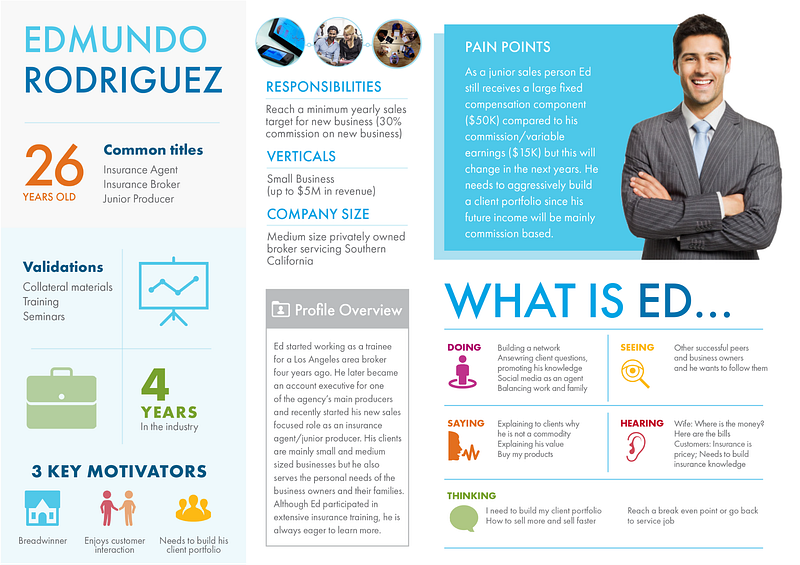
Creating your buyer personas
Every business owner should have at least one buyer persona in their head — they know who their best customers are.
I was in real estate sales for four years.
An example of three buyers who could be interested in the same run-down property on a large section could be:
- young first-home buyers,
- a seasoned investor looking for another rental property,
- or a property developer who wants to knock it down and build apartments interested in the same house.
These are already three distinct buyer personas, without delving into their financing needs, how many properties they have looked at, or other characteristics that could use to categorise a buyer.
If your business has somebody in charge of marketing, you should have data to analyse where your leads have come from for your most profitable customers and who they are.
To find more of these people, you need to understand them. Analyse your best customers.
Interview these people if possible, and they will become your first buyer persona and your most vital.
The more detailed you are with creating your buyer personas (within reason), the better you will understand your customers and the people you want as customers.
Give your main buyer groups their own "Avatar" — a character representing them and their traits.

Collecting Data Online & Observation
Observation of online behaviours is a powerful tool to understand how people work.
Observe communities where your customers interact and discuss your products or services ideas, such as social media, forums, and groups. You can also collect information from people who visit your website by giving away something for free such as an eBook.
For the free piece of content, ask a few basic questions to form important persona information. Even from the people who do not end up being your customer, you can determine what type of people are researching your services.
Understanding buyer motivations
Buyer Personas provide a framework to sort and analyse buyers. When creating these personas, consider their behaviour patterns, motivations, and goals.
The more detailed you are, the better. But not so much that you get bogged down in more refined details and characteristics.
The most common mistake marketers make creating a persona for every characteristic a customer has ever had. It is more about the common goals — looking for similarities in patterns, shared frustrations and shared personality traits.
Some of the buyer motivations you can explore are:
Priorities: What are the main problems or objectives to dedicate time and budget? What is their overall view of the world? If one of your products addresses one of their priorities, they are one of your most important buyer personas.
Success motivations: what tangible or intangible rewards do they associate with success? What is the underlying reason for consumption? This is where emotions and irrational decision making often occurs. I want this sports car because it makes me look wealthy.
Perceived Barriers: What creates uncertainty in a consumer's mind to become one of your customers? Why would they question whether you provide their solution? It is something behind the scenes — perhaps the wife will not let them, or vice versa?
Buying Process: We need to understand our personas' process, from researching and exploring options to selecting solutions. We need to understand their approach for each step of the buying process.
Where do they research, and how much time and effort do they put into it?
Who is the primary decision-maker in the household?
As a business, we try and provide resources to customers to help with the process.
Decision Criteria: A few questions are:
- What are the criteria for making a purchase decision?
- Who makes the decision?
- Is it based on price, features, convenience?
- How are alternative brands/products evaluated?
- What is most important when it comes to decision-making.
We want to understand the people who purchased and chose a competitor or nothing at all.
Demographics and other persona characteristics
Once you have been in marketing long enough, you subconsciously start asking yourself the "W" questions. It is essential to ask these questions about your Buyer Personas.
- Who: what is the biography of your ideal customer? Where they work, and their responsibilities and commitment to family goals.
- What: describe their goal for consumption. Is it a family goal? Is it part of a bigger plan?
- Where: Where do they hang out? Any clubs or communities they are in, online and offline.
- Why: The goals described under "What", why are these important? What are the deeper motivations?
- When: Where are they in the buyer cycle? Are they ready to purchase or just starting to research?
- Content: What forms of content do they enjoy consuming? Videos? eBooks?
- Channels: What social media do they use as the best channel to start a conversation with these people?
- Trust touchpoints: Identify the most significant issue consumers want a solution for and their preferred content and channels. You can aim to intercept them here to build trust.
- Pain touchpoints: identify any objections your buyer personas may have to your brand along their buyer journey related to your brand, content and the channels you use.

Managing your buyer personas
Buyer personas will evolve as your business does, and with the world evolving as it rapidly has with the introduction of smartphones around ten years ago.
Your buyer personas will not stay relevant forever.
How many buyer personas do you need?
There is no correct answer for how many buyer personas you "need", as it will differ from business to business.
First, there should be clear differentiators between each one of your personas. If you are a niche brand in a niche market, you might have 3–5. If you are a large brand with numerous product lines, it could be 20 or more.
When a buyer persona is too vague, you waste your time and remove it.
If five unique buyer personas make up 90% of your business, focus your marketing on those five.
Have the same attitude as your existing list of personas. If it is getting uncontrollable, you need to be as objective as possible and cull the unimportant ones. It is not worth producing a persona if you cannot identify specific purchase goals and buying behaviours and patterns.
Suppose you launch a product to a new segment of the market than you currently target; you will need to consider the distinct characteristics that purchasers of that product might have and how they differ from your current personas.
Once you start getting data from the purchasers of that product, you can decide whether it warrants a new persona.
Negative buyer personas
Why advertise to people who will never be one of your profitable customers? When your company segment out the people who do not make you money, the customers you do not want can become more profitable per customer.
Think about who you do not want as customers, but tend to attract. Make a profile for this person, and make sure you do not target them with your marketing. Try and stay away from platforms they populate. Not all business is profitable.
Final Words
In summary, buyer personas are fictional characters that represent the target customer types for a firm.
Creating these personas helps a firm gain a better understanding of the behaviour of its target audience. The knowledge attained from this process is helpful to a firm as it allows businesses to create marketing to attract these customers.
This article has outlined the benefits of creating buyer personas, explaining how businesses can create their own.
Thank you for reading.
If you enjoyed the content, you might find this article on Market Segmentation helpful.
Read as many Medium articles a month as you like
Non-Medium members can only read 3 articles a month.
If you liked the content and would like to read more articles like this, sign up to become a Medium member for only $5 a month.