
Buy Stocks and Never Sell
The Long-Term Vision of Investing in Stocks
How to Get Rich with Investing (without Getting Lucky)

Dear Investors,
I often reflect on the wisdom of Warren Buffett, one of the most successful investors of our time.
His approach to investing, particularly his philosophy of buying stocks and holding them for the long term, is a lesson in patience and understanding market dynamics.
Buffett’s strategy is simple yet profound: invest in quality stocks and hold them for an extended period.
Also, to read:
He likens stock ownership to owning a farm where you don’t constantly check the price but focus on the farm’s long-term value.
This analogy is crucial; it underscores the importance of viewing investments as long-term assets rather than short-term profit opportunities.
Consider his investment in Coca-Cola.
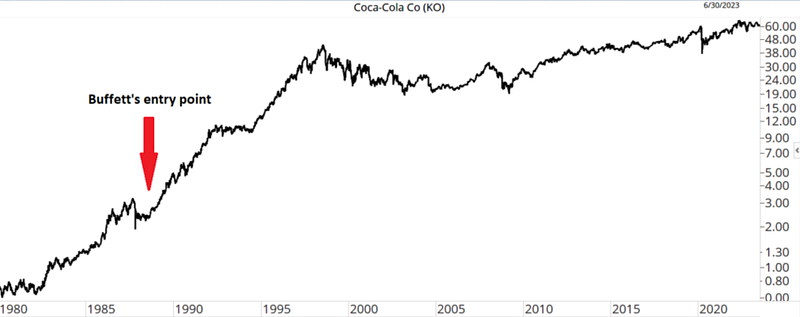
Buffett began buying shares of Coca-Cola in 1988, a decision not based on short-term market trends but on the company’s strong brand, dominant market position, and consistent performance.
Decades later, despite various market cycles, this investment remains a substantial part of Berkshire Hathaway’s portfolio, showcasing the power of long-term, value-driven investing.
Today, Warren Buffett Collect $736,000,000 in annual-dividend income from Coca-Cola!
One of the most striking aspects of Buffett’s philosophy is his stance on market fluctuations.
He acknowledges that stock prices can drop significantly — even by 50% or more.
However, instead of panicking or selling off in such situations, he advises investors to remain confident in their choices as long as they believe in the fundamental value of their holdings.
For instance, during the dot-com bubble, while many investors chased high-flying tech stocks, Buffett maintained his focus on fundamentally strong companies, despite criticism for missing out on the “new economy.”
This discipline paid off when the bubble burst, and those who had chased ephemeral gains suffered significant losses.
Buffett’s approach was vindicated as Berkshire Hathaway’s portfolio, heavy with “old economy” stocks like insurance and consumer goods, remained robust.
This approach requires a strong psychological makeup, resilience against market fear, and an unwavering belief in one’s investment choices.
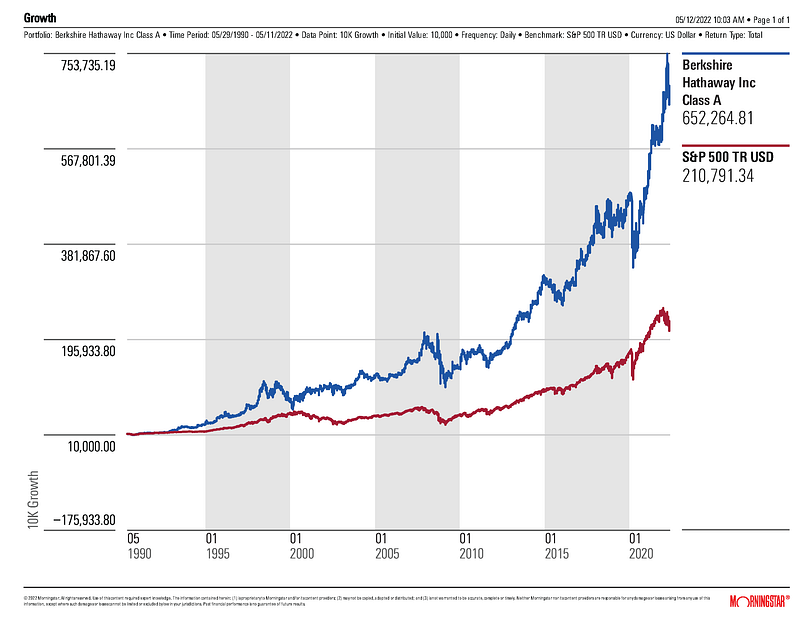
Berkshire’s stock has experienced significant drops several times in its history.
Yet, these moments didn’t define the company’s long-term success.
Instead, they were temporary fluctuations that didn’t affect the intrinsic value of the business.
Buffett’s investment in American Express further illustrates his philosophy.
During the 1963 Salad Oil Scandal, American Express’s stock plummeted.
While others saw disaster, Buffett recognized the company’s enduring value and bought a significant stake.
This contrarian move, driven by a focus on intrinsic value rather than market sentiment, led to substantial gains as the company recovered.
Another key aspect of Buffett’s strategy is the emphasis on understanding one’s investments.
He advocates investing within your “circle of competence,” meaning sticking to industries and businesses you understand deeply.
He cautions against relying on others’ opinions or getting swayed by market trends.
Instead, he advocates for a deep personal understanding of your investments, ensuring you’re not influenced by external factors.
Regarding index funds, Buffett remains a staunch supporter, even in an era where some believe their time has passed
His rationale is straightforward: index funds offer a low-cost, effective way of investing in a broad market segment, which is more likely to yield positive returns over time than trying to outguess the market.
He famously instructed in his will that 90% of his wealth left for his wife should be invested in index funds.
This endorsement of index funds over actively managed funds is based on the historical performance showing that index funds often outperform managed funds when considering fees and expenses.
In summary — Buffett’s strategy is deceptively simple: invest in quality companies and hold onto them for the long term.
This approach is akin to buying a farm, as Buffett often analogizes, where you don’t obsess over daily price fluctuations but focus on the farm’s productivity over years and decades.
Also, to read:
His approach to investing within his circle of competence has proven effective for decades, especially during market downturns.
This strategy, combined with his skill in identifying undervalued companies and his skepticism towards market trends and fads, underscores the wisdom of his investment philosophy.
I highly recommend you embrace these principles for success in the complex world of investing! It paves the way for greater wealth!
Sincerely,
The Pareto Investor


