
But I, Being Poor, Have Only My Labor
I have sold my pitiful labor for a wage; thread softly because you tread on my spirit.

I’ve spent my most depressive years working paycheck to paycheck. I don’t remember the paychecks. I remember the depression.
— quoted from Alan Trapulioni, “11 Things in Life that Just Aren’t Worth It
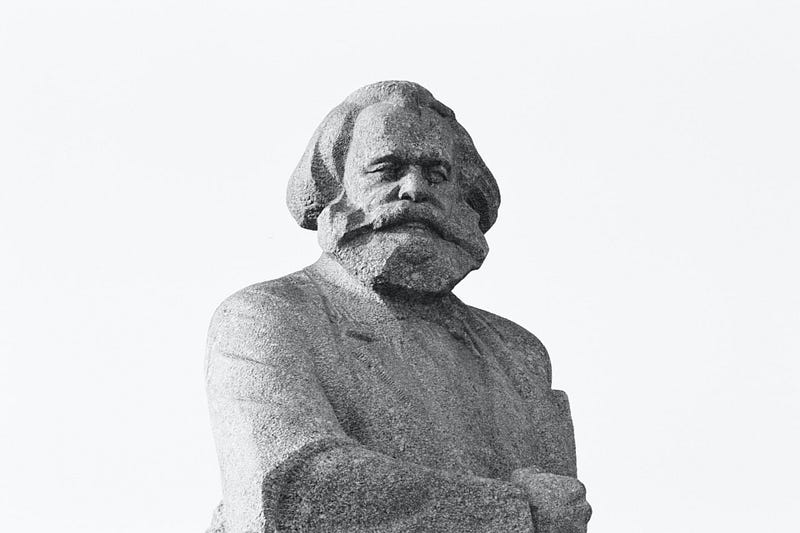
Before I became a seller of my labor, I was a graduate student. In graduate school, I studied sociology and read a lot of difficult books by dead European men. One of these guys was pretty smart. You may have heard of a guy called Karl Marx. You may have also heard that he invented an economic system called Communism.
But did you know, that before Karl Marx wrote the Communist Manifesto, he was first an foremost, a humanist? Back in the day when I was only a student, his words meant something to me intellectually.
Now that I am a wage slave, I feel in my body, mind, and spirit what he was trying to get at. No, this work is not the Communist Manifesto. It’s from a lesser known work, called the Economic and Philosophic Manuscripts, written in 1844. They were lost and then rediscovered and published in 1933.
It’s not holy scripture. It’s not Chicken Soup for the Soul. It’s a difficult German text (the original is in German).
But I find a lot of comfort and solace revisiting some of his penetrating insights. They’re not easy reading, but I hope they help you make sense of the situation you may be in.
1. As wage slaves, the more we produce, the poorer we become.
The worker becomes all the poorer the more wealth he produces, the more his production increases in power and size. The worker becomes an ever cheaper commodity the more commodities he creates. The devaluation of the world of men is in direct proportion to the increasing value of the world of things.
The more create, the more profits your company makes. The more profits your company makes, the lower your relative compensation. Why do you think your company can afford to pay you and still be profitable?
All profit is created value not returned to workers.
And so, the more you create the poorer you become.
How many iPhones do you think the average iPhone factory worker makes in a year? And many of those iPhones do you think they own? How many hours do they need to work to even afford an iPhone they helped to assemble?
2. We are but commodities to be sold on the labor market.
Labor produces not only commodities; it produces itself and the worker as a commodity — and this at the same rate at which it produces commodities in general.
Don’t like the terms of employment? Fine, you’re happy to leave. But try as you might, you’ll just be trading one employer for another.
Got a job interview? Got the job you say?
You’ll likely do the same activities every day. What’s that, you ask?
Helping your company generate profit, which is then paid to shareholders.
Remember, every dollar in profit your company makes is every dollar they’re not paying you or your colleagues.
You can ask for a raise. Maybe they’ll give it to you. Most likely, HR will give you some reason why they can’t. But no matter, you can leave again, right? For a higher price. Selling your wage labor again and again. Because you, being poor, have only your labor. You have nothing else. You don’t own the means of production.
You don’t own the means of production, and that makes all the difference.
3. We experience alienation from our human nature through wage slavery.
Human beings are unique among all animals. We create the world physically and also symbolically.
All of this work takes creative energy.
And through this act of creation, of making something out of nothing, do we human beings experience ourselves as being uniquely human. Yet, in conditions of wage slavery, we do not fully realize our human potential. In fact, we experience ourselves as being separated from our sense of self.
What’s worse? You do not own the activity of work, since your time belongs to your employer when you are at work. Even if you are working from home — mind you.
Just to get through the day, you need to resort to subtle tricks of mind control to get people to do what you need them to do, so that you can get work done. And it’s work you don’t necessarily really care about.
Planning schedules? Arranging meetings. Working to make create more work. Really?
Have you ever felt like you didn’t own yourself at work? You can’t wait until it’s Friday? Only felt truly free during lunch time and during toilet breaks?
As a result, therefore, man (the worker) only feels himself freely active in his animal functions — eating, drinking, procreating, or at most in his dwelling and in dressing-up, etc.; and in his human functions he no longer feels himself to be anything but an animal. What is animal becomes human and what is human becomes animal.
I take silent comfort in the fact that I will probably not be able to overthrow capitalism. With each passing day, I quietly toil away, growing older each day. As days turn into weeks into months, into years and decades, I will continue to selling my wage labor for my monthly paycheck, as I dream of the day I can be free from this capitalistic hamster wheel.
References: Estranged Labour, Marx, 1844 (marxists.org)
If you enjoyed this article, leave a clap or comment, and I would appreciate you following and subscribing. You can support my writing by signing up to become a Medium paid subscriber and get unlimited access to all Medium articles! If you use the link here, I will receive a small commission. Don’t worry though, the commission is measly and won’t be enough to liberate me from my proletarian chains.
Click here to become a Medium paid subscriber: https://medium.com/@alvintanwx/membership