
Busted and Worn Out:
Running, Grief, and Coping
My dad’s sneakers were always blown out. It didn’t seem to matter if they were only a month old; they were split on the sides, covered in dirt, and the shoelaces were frayed and untied. He thought the solution was to buy better quality shoes, but that didn’t seem to make a difference. He wore his shoes until it seemed like some kind of miracle of physics that they would even stay on, with his toes poking out and his heels slipping in and out. I worried about his footwear when the weather was sloppy, but otherwise, that’s just how he rolled.
He walked long miles through our town, with the neighbor’s dog by his side, up the longest, steepest hill and back down again. He was trying to stay healthy, but more, he loved being immersed in the “everything-ness” and had a capacity for rapture like no other human I’ve known.
Not a Eulogy
I’m not trying to write a eulogy here. It’s only that no matter how much time passes (over five years) there he is again.
Last week I found myself on the Oregon Coast. For Covid reasons, a weekend trip to attend a memorial service turned into a ten-day holiday hanging on my aunt’s couch, working, and taking walks. No kids or family life. I made chicken and dumplings and we ate off the leftovers from the service. The area, which can be known for torrential rain and grayness, delivered only sunshine and fifty degree weather, which for my Alaska bones, might as well have been tropical.
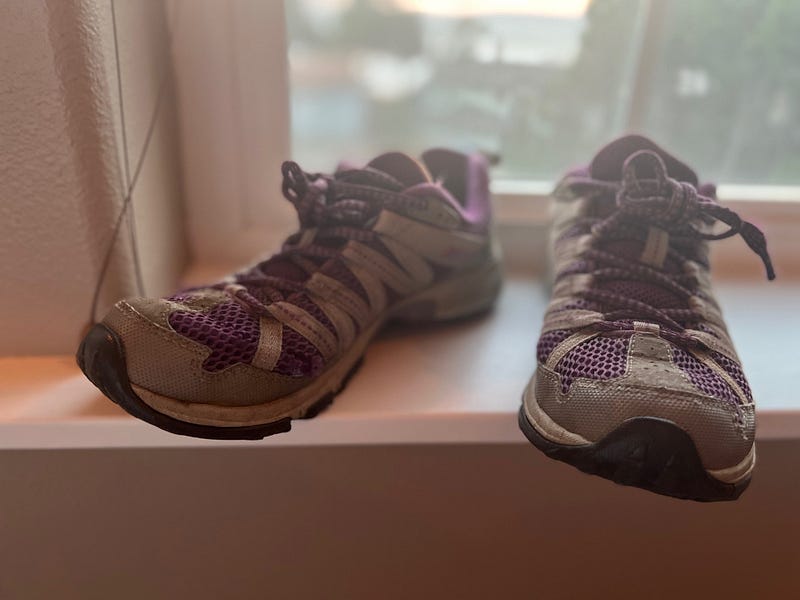
I was bragging about the awesomeness of my sneakers to my aunt’s friend, on my way out for a walk along the beach, when I realized they were busted at the sides, the fabric stretched and worn with all the places they have taken me.
My sneakers are several years old, and have done their job. Still, it made me sad to see them falling apart, looking like my dad’s feet, my heart cinched.

Running On Grief
When my dad died unexpectedly on the last night of April 2016, it verified to me T. S. Eliot’s assertion that April is the cruelest month. That first night my heart felt as though it had folded itself in quarters: grief took residence in a physical way. My heart hurt in a way that I imagined a heart attack would feel like. I laid in bed looking at the god-awfully beautiful night sky and felt my dad so far and near at once, and knew that people went to the hospital if their hearts hurt as much as mine did in that moment. I was no stranger to deep grief, and yet, this was different from anything I had experienced before — it felt threatening to my life, as if in the pain of loss I might die too.
It sounds melodramatic; I know. But at the moment it was so real that I forced myself to look out at the black night and imagine my future with my kids. I rooted myself to the reality that I was very much needed in the flesh to tend and raise and protect my kids from the very thing I was feeling.
I fell into a fitful sleep, and for thirty seconds when I woke up, I forgot everything that happened the night before. I laid in the warm sun falling over my quilt thinking, “there is something I’m supposed to remember…”
And then I did, and my heart began its ache all over.
It was spring in Alaska, which means everything was mud brown, breaking ice and dead grass. My heart wouldn’t stop hurting, so I made it hurt worse: I started running. At first only half a mile, then slowly longer. I wasn’t in shape and would never have identified myself as a runner before. But somehow, running two or three times a week, matching my heart ache for another kind of heart pounding, was the only thing that gave me solace. And of course, as fate would have it, I live on a hill, so I always had to run up, up, up.
Two or three times a week, and my strides got longer and farther. I dubbed a particularly steep climb “grief hill” and when I reached the top, I would hide in the trees and bawl my eyes out. I live in a small town and I didn’t want to be seen losing my shit, so I would hide and watch the cars drive by. And then when I was done, I would run back home, stopping on our dirt road to cool down, listening to The Steeldrivers or Bob Dylan or anything that felt like my dad giving me life advice.
The Sneakers
As the years went on, I reached for my sneakers every spring. Until after one gray run, my knees hurt. Like, maybe I couldn’t keep the practice up, kind of hurt.
My friend, who is a “real” runner and had worked at a popular shoe store for runners, looked at my footwear and said simply, “I think if you go up a size your knees will stop hurting. I’ll bring you my extra pair.”
Every time I put on those purple sneakers I thought of her and my dad and how life is imperturbable. It just keeps going and going. In early grief, that feels pretty cruel. Three years into my running as therapy routine, it seemed pretty groovy.
Somewhere in there we moved, the scenery changed, the kids grew from toddlers to elementary students. I kept wearing the shoes my friend gave me and my knees stopped hurting. Running stopped being about grief and started being about life itself. I often say to my husband “I hate running, but I feel so good afterward, so I have to do it.”
I found a five-mile loop by my house that has a half-way stop overlooking the bay and mountains. It’s my favorite loop. I get to the top, and I salute my dad.
But the Hurting Never Stops
So there I am, about to go on my walk and realize that my shoes are blown out. My friend had warned me about this — that when shoes break down sometimes peoples knees and hips start hurting again.
Guess what?
The reason I’m walking instead of running is because my knees have been hurting a little bit. My hips do too. (Do I blame being 40 or that I don’t stretch enough?)
And guess what else?
The reason I’m going out for a walk is because somebody I care about died. Again. That’s the only reason I’m on the Oregon Coast, and Covid is the reason I stayed longer.
And you know what else?
Not a day goes by when I don’t feel my dad’s absence.
I often tell my friends that grief is a gift that keeps on giving. Sometime I mean it with a smirk, but more often I mean it just as it sounds. Just when you think your loss is tucked away in some deep closet inside of yourself, out it pops again like a pair of worn out shoes.
Octopus Heart
That thing I experienced with my heart? It’s a real thing that women are especially prone to experiencing. It can mimic the feel of a heart attack and is brought on by intense grief or trauma, and is called Takotsubo cardiomyopathy or “broken heart syndrome.” I call it “octopus heart” because the left ventricle of the heart enlarges to like a Japanese octopus trap called “Tako-Tsubo.”
In the years since my dad’s death, every time I tried to write, it was about him — even if it wasn’t. It was always about how we live alongside absence and how it felt like I was hovering three feet above ground.
I take something else from my busted out shoes — maybe my grief has finally busted too. Maybe it’s finally not the primary force driving me. So now I show up for other people’s deep grief and sometimes I sit with them and call them and ask them how they’re doing because octopus heart may fade in a month, but that deep loss abides. It’s the reason that I couldn’t miss the memorial and why, deep-down, I was glad to hang with my aunt for a little longer.
Grief doesn’t define us as humans, but it certainly informs how we engage with life.
I really need to get a new pair of shoes, but these will last a little longer.


