
Bush Of Ghosts
The haunted music of Kate Bush
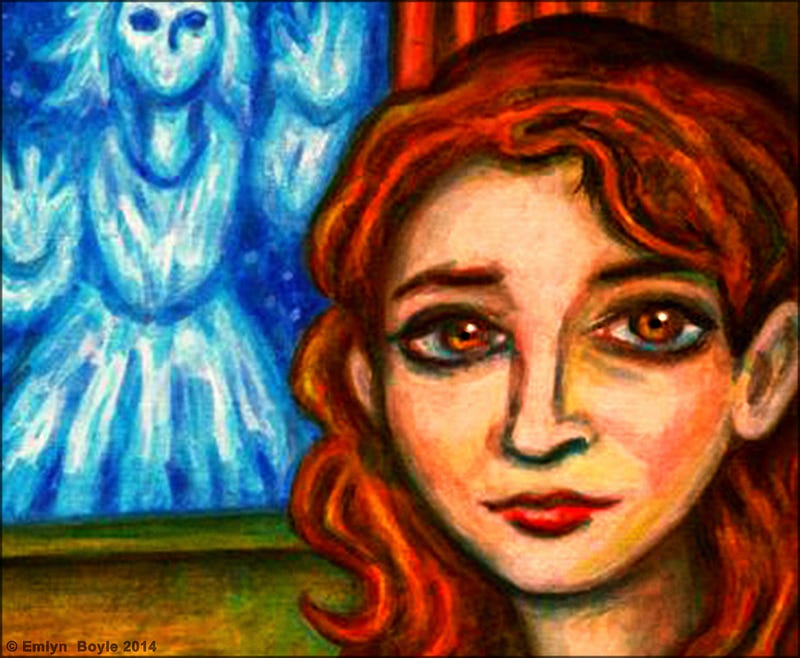
This is a revised article that I originally wrote and illustrated seven years ago. For a magazine that never took off, so I’m republishing my piece here.
An eerie undercurrent saturates much of Kate Bush’s music. Her lyrics and soundscapes invoking an England that partly exists in an imagination filled with cold weather, dark seas, theatre stages, windy moors and fairytales. And Bush’s work is also haunted by ghosts, whether they be literal phantoms, purely metaphorical or both. Let’s look at some of them.
For her first ghostly foray and debut single Wuthering Heights, Bush conjures up the specter of Catherine ‘Cathy’ Earnshaw. Although the song is named after Emily Brontë’s classic novel of the same name, Bush has admitted to not being directly inspired by the book itself (though she later read it for further inspiration). But rather the closing moments of a re-televised 1967 BBC adaptation, when a terrified Mr Lockwood encounters Cathy’s ghost. The restless spirit having returned to her ancestral home and wanting anyone within to ‘let me in your window’. The song itself is gorgeously gothic, the epic arrangement and almost banshee vocals capturing both the moorland feel of Brontë’s masterpiece and a certain seventies English spookiness. So whether you’re a Kate Bush fan or not, this most famous of her tracks can still grab the imagination like Cathy’s cold hand reaching through that broken window. It is something both beautifully told and chilling, like any good ghost story should be.
In the song Hammer Horror, Bush evokes a more contemporary and original story inspired by a love of the Hammer horror films she grew up with. An actor playing Quasimodo in a film production of The Hunchback Of Notre Dame finds himself haunted by the friend he replaced (after a tragic on set accident). And while the song has more black humor than Wuthering Heights, this specter seems more malevolent, and its shadowing of the unfortunate protagonist is creepy indeed. Bush sings that the dead friend “taps me on my shoulder”, and that the protagonist always needs to “keep the lights on to ease my soul”. This really invokes the territory of M.R. James or Susan Hill — though this spirit seems far less deadly than the stalking horrors conjured by these two authors. The lyrics also invoke images of a somewhat sad figure haunting the empty sound stage after all lights are switched off and everyone has gone home, rather like another Phantom Of The Opera. For both the music video and live stage performances of Hammer Horror, Bush dances against darkness, while a sinister black-clad and masked figure follows her every movement from behind. Bush invokes a somewhat similar atmosphere in the song Wow (also from the album Lionheart), with her singing that we are ‘all alone on the stage tonight’, although no apparent ghosts haunt this theatrical stage.
Much like Wuthering Heights, The Infant Kiss was inspired by both a classic novel and its later adaptation — in this case, Henry James’s The Turn Of The Screw and The Innocents (superbly directed by Jack Clayton). The somewhat repressed protagonist in both versions, the governess Miss Giddens, slowly finds that she longs for the young boy in her charge. And yet she is also scared of Miles — seeing “a man behind those eyes” (as opposed to Bush’s The Man With The Child In His Eyes). The song focuses mainly on the twisted love story at the book’s heart — with what possesses Gidden’s thoughts far more disturbing than the evil spirits possessing both children (the girl Flora being controlled by Miss Jessel, the former governess who drowned herself — foreshadowing Bush’s future theme of water-based ghosts). So again, like Wuthering Heights, warped affections merge with the supernatural.
In Houdini Bush takes on the role of Harry Houdini’s wife Bess, who believed — despite her husband’s famous skepticism — that it may have been possible to contact his spirit via a séance. And although she is soon disappointed by fraud (the spiritual medium being as much a showman as her husband was), the song still invokes the haunting image of Houdini floating in a water tank onstage — bound in chains for his escapist act. The lyrics “Through the glass/ I’d watch you breathe/Bound and drown/Paler than you’ve ever been” also echo back to a ghostly Cathy beyond the windowpane, while the song also returns us to the world of performance and stage like Hammer Horror and Wow.
In Get Out Of My House, Bush is again, if more loosely this time, inspired by a book — Stephen King’s The Shining. And she sings of a house alive with strange forces (like the Overlook Hotel, or indeed the terrifying Hill House from Shirley Jackson’s The Haunting Of Hill House). The track is one of Bush’s more experimental pieces — both lyrically and sonically — and this suits the material perfectly. Although its parent album The Dreaming suffered an undeserved critical mauling at its time of release, Get Out Of My House still retains a power to assault the senses. Especially with what could be potentially funny, but is instead unnerving bonkers…Bush baying her guts out like a possessed donkey.
While no more full-blown ghosts appear over the next few Kate Bush albums, instead being more metaphorical like the moving Moments Of Pleasure (where Bush remembers loved ones who have passed away), there are two very ghostly associations on what is still regarded as her masterpiece — The Hounds Of Love. The first involves use of the infamous line “It’s in the trees. It’s coming!” at the beginning of the title track. Originally uttered in a séance scene (echoing Houdini) by actor Maurice Denham, in the classic British chiller Night Of The Demon, a film in turn adapted from the M.R. James short story Casting The Runes. So Bush is yet again inspired by the adaptation of a text, rather than the source material itself, and uses it for her own storytelling purposes, though the line is used as a metaphor for love than any actual ghost or demon. While in the song Under The Ice, the protagonist dreams of going for a wintry skate over a frozen river, but she soon senses a presence following her . . . and eventually finds a face looking up from a crack in the ice (as the title playfully hints at). Perhaps a doppelganger of sorts, and which harks back to the being-followed idea of Hammer Horror, though it is never clear whether this ice-bound figure is a ghost or just an omen of death. Either way it’s pretty unnerving stuff, the image of a figure locked behind ice (or water, or glass) again echoing both Harry Houdini in his water tank, and a ghostly Cathy at the window.
On her more recent album 50 Words For Snow, Bush offers a more delicate and completely original ghost story than previous efforts. Lake Tahoe is beautifully eerie rather than scary, though that image of a dead woman in Victorian dress (with skin like a “porcelain doll” and eyes that are open “but no one’s home”) rising from a cold lake is somewhat nightmarish. And again this echoes the water imagery of Under The Ice and Houdini. But despite this unsettling vision, the overall song and subsequent music video are ultimately moving affairs. We see the dead woman’s beloved dog Snowflake, now old and dying, returning to his former owner via a form of astral projection. Being more Lassie than Black Shuck, the faithful hound’s spirit flies over fields and lands in the “Spooky Wood” before reaching his final destination. Shadow puppetry is used here to wonderful effect — a technique that complements the ghostly magic of the piece and harkens back to a time when stories were literally handmade and theatrical, and left more to imagination before the arrival of cinema. Nevertheless, shadows and light have always been the realm of ghosts, theatre and indeed film. The moving picture being a literal medium that conjures up dead people still walking and talking — a true form of life after death.
What has driven Kate Bush’s use of ghosts and ghostly imagery in her work remains unknown, though her artistic inspirations are known to be fairly eclectic (and she has expressed a love of scary movies for one). But the themes of water, the stage, being trapped and séances reoccur again and again throughout her ghost-tinged tunes, as well as a deeply human element (as opposed to full-blown horror). Having partly Irish roots may have also infused Bush with a sense of Celtic twilight and mysticism — most certainly to be heard in some of her soundscapes, if not so obviously in her lyrics. Still, an Irish spookiness is certainly felt, if largely unseen to be sure, the almost wail-like quality of her early vocals having an again banshee beauty to them. The promotional videos for Wuthering Heights further reinforced this spectral waif image (and created an early image of Bush that she is still associated with).
I’ll end on a note of fanciful speculation. In an interview for The Sunday Times a few years ago, the artist’s brother John Carter Bush stated that the 14th century farmhouse he and his younger sister grew up in was supposedly haunted. So, did the young Catherine Bush experience a real ghost that (perhaps unconsciously) continues to inspire her from album to album? Much like the ghostly face that a young M.R. James may have seen at the gate of his childhood home (fictionalized in his final short story A Vignette). Who really knows…but seeing as Kate Bush already has enough mystery attached to her, let’s instead hope for more amazing music from this most haunting of artists.