
Burkina Faso, Part 3 of 3
I love the sound of the name Ouagadougou [wogga-doo-goo]
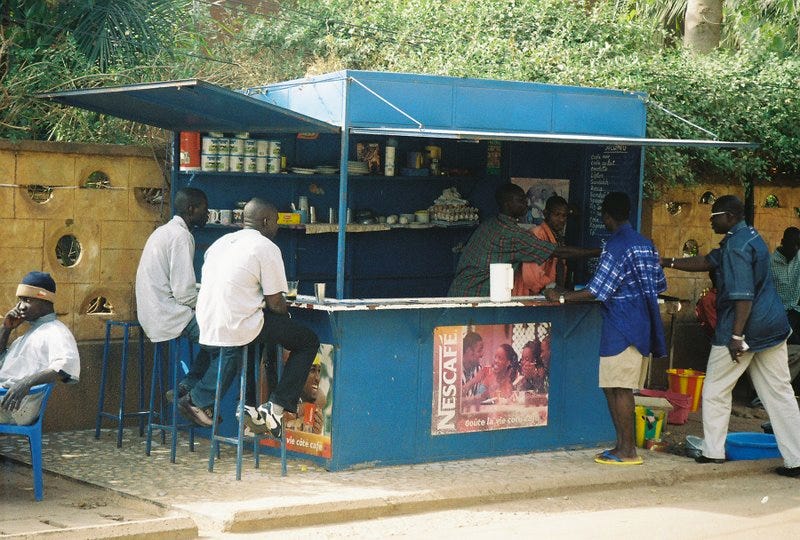
My first stop in town was at the American Embassy, situated on Avenue John F. Kennedy, where I registered with the local warden so that my whereabouts were known. Before the guard put my luggage through the X-ray machine, he told me that I should remove any medications that may be in there. “Toothpaste, too,” he advised. Since the Peace Corps is not on the Lonely Planet guide map, I asked the guard at the embassy where its bureau was, how to get there, and how much the taxi should cost. Before I went to the Peace Corps, I was off to the Rec Center, located around the corner.
The Rec Center and embassy are part of a complex that also includes the Martin Luther King, Jr. Library and the American Cultural Center. I had heard of the Rec Center before I came here — a little slice of Americana in this foreign outpost. Peace Corps Volunteers who have been to Nouakchott (the capital of Mauritania, where I was living at the time) have raved about it, with its snack bar, swimming pool, and library. Those entering the Rec Center fall under one of three categories, and sign in accordingly: member, guest, or Peace Corps Volunteer. It was nice to see us welcomed, which is in stark contrast to the situation in Nouakchott, where there is no facility anything like this, and where the current ambassador, shortly after assuming his post, banned PCVs from using the swimming pool and other facilities at the embassy.
Avocados are plentiful in Burkina Faso, and I have been eating avocado salads almost every day. I ordered one at the Rec Center, and then made my way to the Peace Corps bureau.
The Peace Corps house is called a hostel here, and after I arrived, I learned that while it is all right for PCVs from other countries to spend time there, we are not permitted to spend the night. I visited with some people, including friends of Mauritania Volunteers, raided the library, and then headed back to town to get a hotel room.
The hotel was comfortable enough, and I had an air-conditioned room, though I imagine I could have made do with a fan, considering that it is not too hot at night nowadays. When I was unpacking, I saw that my bottle of medications had slipped out of the bag that I had removed at the guard’s request, to avoid being X-rayed. That meant it had been X-rayed at the embassy after all, and I wondered if there would be any danger in taking the medications. Then, in the middle of the night, I realized that my camera and film had also been through the X-ray, so I lost some sleep over the fact that I may also have lost my photos.
My first stop the next morning was a photo lab. I didn’t want to wait until I got back to Nouakchott to see if all my pictures were lost. If worse came to worse, I could always prevail upon my friend Carl to make some copies of photos that he took in Mali, where we had traveled together, so it would only be the Burkina photos that I would be without. When I picked up the developed photos, I saw that none of them had been damaged.
My next task was to go back to the Peace Corps bureau to see the Country Director briefly. The Director in Mali had told me that if she had any information about my telephone [which had been stolen in Mali], she would be able to contact me through the local director. So far, there was no news. I checked in with the Medical Officer and told her that my medications had been X-rayed. She didn’t think that there would be a problem taking them, but she also offered to replace them for me. It was nice to have the hassle-free medical service!
Crocodiles are revered here, and there are many rivers and lakes where they proliferate. In fact, near Ouaga, there are sacred lakes where visitors may buy a live sacrificial chicken from kids who are there expressly for the purpose of selling them to be fed to waiting hungry crocodiles. I did not make this a must-see sight on my itinerary. Who’s going to call PETA to inform them of this one? I wondered.
I recently heard a proverb, said to be African [but without a specific country]: “You can throw a log into the river, but it will never become a crocodile.” I like the sentiment behind that, the recognition that each of us has our own natural inclinations that are never going to change. I immediately thought of the balancing act that I am performing as a Peace Corps Volunteer — both being myself so that I can accurately portray what an American is like (the log) and finding ways to integrate culturally into the society where I am living (the river).
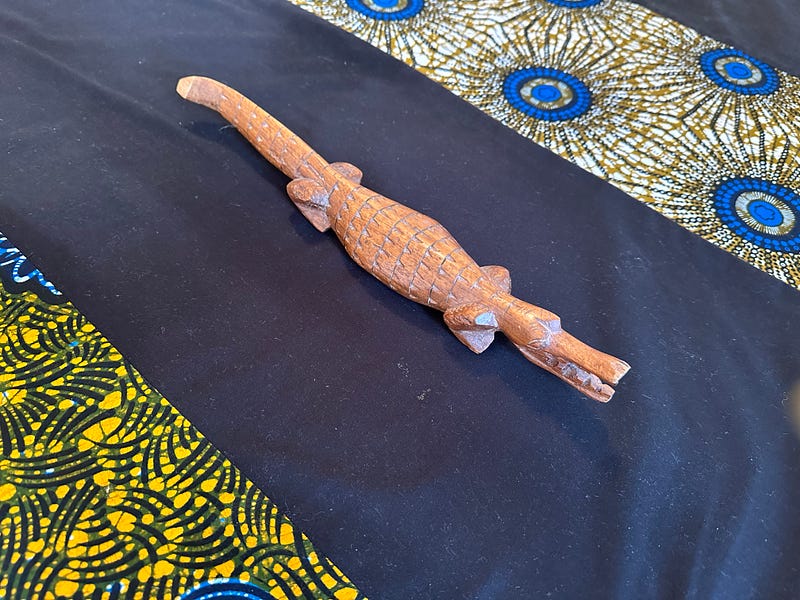
With that in mind, the crocodile has taken on some new symbolic significance for me. I thought, I’ll see if I can find a small replica of a crocodile as a souvenir. Based on my Mali success in trading things in the marketplace, I thought that I would try to get my crocodile by seeing if any shopkeeper was willing to trade the heavy bronze sculpture that Ousmane gave me for a lighter and smaller wooden crocodile.
I set out to a long row of handicraft stands near my hotel, brass sculpture in a black plastic bag. The first stall owner I spoke to expressed interest in the bronze, but I made the mistake of not looking first to see if he had anything I wanted; he didn’t. That followed the laborious greeting, entering, examining, and then explaining that each stall in turn, about twenty altogether, did not have anything that I wanted.
The last stall had two wooden crocodiles that I liked. The owner readily saw that the brass sculpture was more valuable than the wooden crocodile, and he agreed to the trade. The little croc is carved just crudely enough to be charming. I’m calling him Ousmane.
A photographer has to be careful in Burkina Faso. There is a long list of items that are not allowed to be photographed, including: airports, bridges, bus, train, and taxi stations, gas stations, government buildings, grain warehouses, industrial installations, police stations, poor people, post offices, radio and television stations, and reservoirs.
Ouaga is a pleasant city in which to walk around. Whereas Bamako seems to be an oversized village, Ouaga has the feel of a large city and is graced with lots of well-landscaped areas, buildings with distinctive architecture, and wide paved roads. Not all the roads are paved, though, and one doesn’t have to go far off the principal arteries to find the same reddish dirt that causes the dust to fly. There are lots of motos in town, a chief form of transport, as well as buses.
One of the qualities of people on the street here, which is similar to other large African cities I have visited, are the men and boys who walk around selling their wares, not easily giving up after a simple “Non, merci” reply, even after I calmly repeat myself several times. I have been addressed as “chef,” “patron,” “capitain,” “général,” “ton-ton,” “grand,” and “blanc.” I guess that when they call me “vieux,” meaning “old,” they mean it to be a compliment. In all instances, I am calm and polite in refusing whatever it is I don’t want.
For the salesmen of telephone cards, they stop when I tell them I don’t have a phone. For the cigarette-sellers, they stop when I tell them I don’t smoke. Other than that, a simple “Non, merci” is evidently seen as the beginning, rather than the end, of negotiations. The only success I had in deflecting the salesmen was to point out that I had already said “non” three, four, or five times, and then I asked them how many more times they needed me to say it.
On Saturday morning, I wanted to go to the Musée National. The Lonely Planet map had it listed in a central location, but there was also a notation in the book that it would soon be moving to a new building. On Friday, I went to the place indicated on the map, to find out that it, indeed, was no longer at the place listed. In order to find the museum’s new location, I began by asking at my hotel’s front desk, to see if an employee knew where it was now located. Nobody did. I then went to a bigger hotel, where there was a map that had buttons to indicate where certain sights were. Push the button and the path to the destination lights up. It appeared to be in walking distance, so I headed over on foot.
While I was on my way to the museum, I checked in with a few people to be sure that I was on the right track. It had appeared to be a fairly short walk from the hotel, but I didn’t come upon it. Never have I seen the location of a building to be as debatable as this National Museum: “It’s next to the hospital,” “It’s behind the presidential palace,” “It’s very far away,” “It’s very close, just around that corner.” There were also scores of people who had no idea where it was.
By contrast, there are two stadiums in town — the Stade Municipal and the Stade du 4 Août — that are signposted every few blocks, with arrows pointing in their direction. People obviously place higher value in getting to the stadium than to the museum. I decided that it would be better to take a taxi and be at the museum than spend time looking for it. Several taximen who stopped, though, had no idea where it was, either. While I was waiting, a guy drove up on his motorcycle and asked me if I needed any help. I told him I wanted to go to the museum; I had been told it was nearby. He said no, it was far away, but he would take me there. I asked him how much, and he said, “No! Get on!” meaning that he was not going to charge me. I shrugged and got on the back of his moto.
Yes, indeed, it was far. I didn’t like the way he was driving, though, and I didn’t feel safe on the back of his motorcycle. I asked him to stop, and I got off. I tried to get another taxi. The fourth driver knew where the museum was located, and agreed to take me. As we drove, he pointed out the newly-constructed wall on the perimeter of the museum grounds. I could see by the length of the wall that the grounds were immense. That must be some museum! When he dropped me off at the front gate, I looked into the grounds and saw two fairly small completed buildings, two more small ones under construction, and a vast area on which a decent-sized American university would be able to fit its campus. There were a few trees in there, but the entire area was mostly rubble and debris.
I made my way to one of the buildings that looked completed. As I arrived, I asked if it was the Musée National. “Yes,” one of the employees told me.
That was a relief.
And then he added, “We will open on the twenty-third of December at 16:00 hours.”
So much for spending much of the day at the museum! At least I got some good exercise out of the morning, though.
After finding that the museum was not a possibility for spending a massive amount of time, I went to the American Rec Center, but it was probably just too early on a Saturday for there to be many people recreating.
I thought that I may as well pick up a few bottles of wine to bring back with me, since it is widely available in Burkina and not in Mauritania. I also finished a roll of film, so I had that developed, too. I usually wait until after a trip to have film developed, because photos are much heavier to carry than film canisters. But this way, I could have all reprints made in Ouaga and get them ready to mail out to friends.
On Sunday morning, I prepared to go to the airport. I had some trepidation about the schedule of flights, but they were the only ones available: the first flight from Ouagadougou to Bamako, the second from Bamako to Dakar, and the third from Dakar to Nouakchott — four countries in a little more than seven hours!
Unbelievably enough, all went off without a hitch, and I was back in Nouakchott shortly after 21:00.