
Greatest Albums Reviews
Burial — Untrue
Album Commentary & Listening
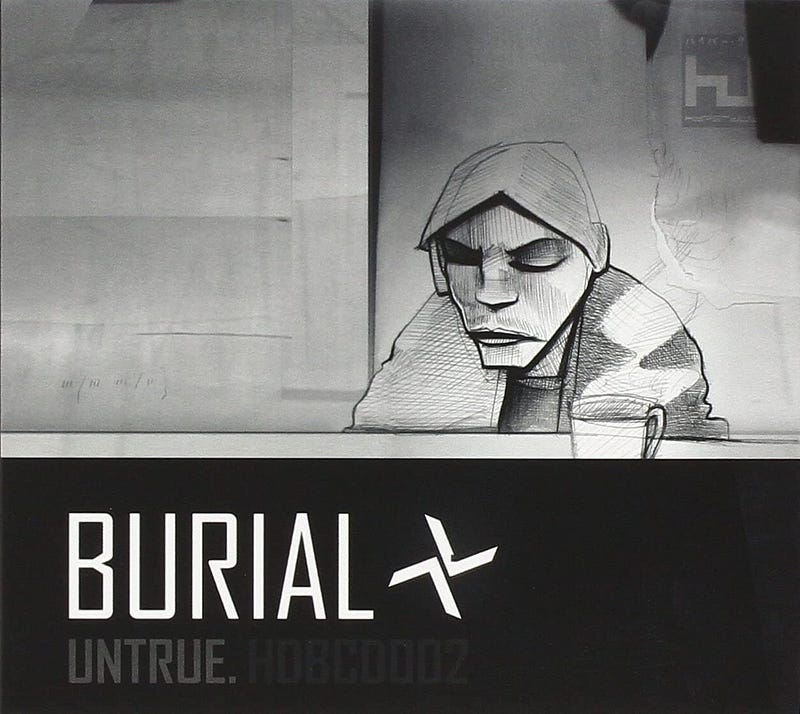
In 2007 the dubstep phenomenon was in full swing. After all, a lot of water had already passed under the bridges, and rivers of words had already been wasted on the entire movement, starting with the first, fundamental tips provided a few years earlier by Mary Anne Hobbs through BBC Radio.
The genre was immediately considered a sort of postmodern and nihilistic fusion of his majesty Goldie’s drum and bass, from Lewis “EL-B” Beadle’s 2-step garage / broken beat, with splashes of trip-hop at the Tricky.
A style that became mature and “independent” through a series of fundamental events, such as the radio project of Kode9, which in turn changed into the foundation of the praiseworthy Hyperdub, and the development in the field obtained by the various Coki, Loefah, Youngsta, therefore the famous DMZ and FWD evenings.
However, to intercept the exact moment in which all this began, it is necessary to go back to the winter of 2000, at the precise moment in which the boss of the Tempa Neil Jolliffe wrote the business card to be turned to the insiders with the intention of exhibiting some credible and tantalizing promotional coordinates of the first single of Horsepower Productions, “When You Hold Me”: “It’s like 2-step, but it’s got dub in it. It’s kind of like … dubstep”.
Here, for to talk about dubstep history you have to start from here, and then focus your attention on some mandatory stops, such as the birth and experience of the magnificent Skull Disco label by the duo Shackleton / Appleblim and the first productions on the Playstation of the two very young friends Skream and Benga circled at parties by veteran Dj Hatcha.
Then there is him: William Bevan, aka Burial. The top man. The absolute paladin. Or more metaphorically the one who changed things, pulling them towards himself like a sort of supermassive black hole, and then maybe spitting them back into a new dimension. Its size.
A unique space in which to spread the material by following laws that belong to no one, if not your own sensitivity and infinite introversion.
The story also tells us that ours was pushed by his older brother to create a series of rhythmic structures paying homage to the raves in the London garage of the end of the millennium.
Then came the right man, the fibrillation talent scout: the aforementioned Steve Goodman, aka Kode9, in that particular red-hot historical moment of passion for the dub genre and every possible mutation.
It was he who sensed the potential of that young boy, all home and rave, science fiction films and video games.
In 2004, Burial was a huge rough diamond and Kode9 the expert of precious stones, the cultured craftsman who has the task of cutting and making everything feasible, shiny. Yes, because William’s is a world of its own, in which sampled, disjointed voices, glimpses of light and raindrops alternate to hypothesize a bleak and at the same time heavenly picture.
It is the spring of 2005 when the boy decides to reveal his music to the world, exporting it from his den to the rest of the planet thanks to the good Steve.
The first two EPs in his name, “South London Boroughs” and “Distant Lights”, anticipate the moods of the eponymous debut. The first contains four tracks to provide a draft of one’s temperament.

Low lights and a rhythmic restlessness from a post-apocalyptic scenario characterize the first four cries of the young William. In the second, an excellent remix of Kode9 and three other pieces subsequently inserted in the debut album emerge.
The namesake LP will shortly provide electronic modulations, an industrial “perfume” never smelled before, rising like a “toxic” and very dark cloud in the London sky.
“Untrue” comes a year later, to be exact on November 5th. With it the sound of the night becomes definitive, totalizing. A work that embodies a variety of sensations, such as walking alone in the dark and cold after leaving the club, with water vapor continually coming out of your mouth like instant fog.

A very vast imaginary takes on altitude, bristling with cold lights that project on impersonal buildings, night buses that ply deserted streets while accompanying the last “warriors of the night” (precisely!), in a deserted London a few hours before the hectic routine was revealed again. Loneliness as a palliative, darkness as a set design, music as a catalyst: this is the message of Burial, and of his exclusive combinatory art.
The boy doesn’t have a group, doesn’t have tools, doesn’t have a studio, in short, he misses almost everything. His world is all in the few square meters of his bedroom: a computer and nothing else.
Soundforge and off you go. In this space, an extreme synthesis of his intimacy, his artistic soul releases the best of himself: hood on his head, rain beating on the windows, smoke coming out of the glass of coffee on the desk, all at a time between one and five in the morning.

Here William cuts, creates, destroys, reassembles, restructures, distorts, puts all his soul (and even some of ours), and delivers to the very trusted Steve Goodman as a new and shy Renaissance painter employed by his Master.
An unconfirmed voice, never but probably apt, wants moreover that William uses for his songs samples of telephone calls received; records the voices, involving mother, sister, aunt and those few around him.
And then he uses them in his tracks, making them extraordinarily distant, distorted, suffering, ethereal.
01 — Untitled
In short, it seems a very complicated figure to decipher, that of Burial, yet in the very rare interviews released, prior to the release of “Untrue”, a quiet, not at all chaotic soul shines through. He is probably a person with unusual empathy.
Yes, because “Archangel”, which opens the disc beautifully, was composed following the death of his dog; a loss that has ruined his heart and can be clearly understood from the total mood of the track. This time William assembles an absolutely overwhelming soulful refrain, confirming his melodic sensitivity. And so, the verses “Holding you / Couldn’t be alone / Loving you / Couldn’t be alone / Kissing you / Tell me how can you / Tell me I belong / Tell me I belong” become the refrain of the decade, his absolute workhorse.
02— Archangel
As already revealed, Burial takes them almost everywhere: from films, video games, conversations, television recordings, hailstorms. Every noise can be for him a source from which to draw inspiration. To this personal trend, there is a strong propensity for modern soul music.
In addition to drawing sounds from his human and geographical surroundings, Bevan surgically extracts small vocal parts, subsequently distorted with the time stretching technique, thus intervening on the speed of the audio signal, by artists of the r & b, pop / dance, and neosoul scene such as Beyoncé , Ciara, Ray J, India.Arie; all without counting imperceptible samples of the various D’Angelo, Roots, Mary Elizabeth McGlynn, up to real personal gems deriving from the unbridled passion for video games and for Metal Gear Solid 2, such as the theme composed by Harry Gregson-Williams and Norihiko Hibino, honored in the same “Archangel”.
Subsequently, Bevan combines this melting pot of sounds and micro-melodies in a brilliant plot that will be called soulstep.
03 — Near Dark
Burial also has a unique way of sampling female voices. In his pieces it is as if they were singing in unison angels and ghosts. And the masterpiece “Untrue” is all like this, imbued with this melancholy, introverted, gloomy mood. There is always this hint of loss around the corner that anguishes, dominates; sadness as an ennobling feeling for man, useful to understand that we must be there for the things that remain.
04 — Ghost Hardware
And Burial enhances this concept, amplifies it through a series of rhythmic combinations and sudden ambient stops, sometimes very acidic. Although starting from a nihilistic approach, his is a feeling full of hope and revenge. To understand it, it would be enough to listen to “Endorphin”, with its vocal inserts that seem sampled in some room of paradise, and its soothing, gentle, extremely conciliatory electronic flow.
05 — Endorphin
A mixture of intent that reaches its maximum point through the muffled beat of the supreme “Ghost Hardware”, with lots of killer basses that enter and leave, between a moment of quiet and the other, and a filtered voice with celestial tones that kidnaps, bewitches and hangs.
But Burial is above all a careful observer of the reality that surrounds him. His observation remains external and penetrates inside the context often like a ghost flying over the spaces of the city, observing them from a third perspective.
06 — Etched Headplate
The only “In McDonalds”, with its two minutes of sulphurous candor, fully embodies this inclination. The two step rhythm, surrounded by the usual soul sauce refrain of the magnificent title track, amplifies once again the stylistic integrity of Burial and his being absolutely unique within the same reference genre.
07 — In Mcdonalds
Moreover, “Untrue” also hides a surprise of the caliber of “Raver”, in which William shows his most extroverted side, as a perfect clubber, leaving everyone speechless and thus confirming his unpredictability, which will take on unstoppable tones through subsequent flash productions.
08— Untrue
Ultimately, “Untrue” is the compositional pinnacle of a simply extraordinary artist. After its release, the most enterprising declared that Burial was a whim of Kieran Hebden or Norman Cook, giving rise to a very funny hoax. And for a very short period of time, Burial-mania went mad.
09 — Shell of Light
In the underground scene Bevan became a divinity and in all the most unknown forums all he did was talk about him. The final questions were always the same: who is this boy? Why don’t you come out the shelter?
10 — Dog Shelter
It all ended when Bevan himself decided to share one of his photos, followed by a very brief but intense press release, in which he thanked everyone, including music journalists.
11 — Homeless
For his part, William has always carefully avoided any stage. The crowd bath is not part of his things. His “shyness”, at the limits of sociopathy, has always been a feature that has made us curse him infinite times.
12 — Raver
But if the “price” to be paid for this total confidentiality is a masterpiece like “Untrue”, the absolute milestone of the electronics of the new millennium and of all music, we cannot do anything else than bow to this “ghost”, to his touching sway in the world of contemporary music.


