
Bullies, Teenagers, and Technology
How Your Hurtful Words Get Amplified Online

“Sticks and stones may break my bones, but words will never hurt me” simply does not apply in a world where those words can be amplified. When your words can be sent instantly to 1,000 people with the push of a button, the potential virality of any given post makes them exponentially worse.
Bullying is not something new, but the technology used to proliferate emotionally damaging words at an exponential rate is. Unlike bullying of yesteryear, the imbalance of power created by technology between the victim, the bully, and now enablers allows the bully to hide behind a screen, to escape any possibility of adverse consequences resulting from their behavior, and to multiply the assault through a variety of methods created by any individual social media platform.
In a high school environment, it is a parent’s worst nightmare. It’s beyond frustrating to see children treat each other so callously and to know that there is no way to put a stop to it. I have lived this experience a few times with my teenage daughter and I have seen it on numerous occasions. Cyberbullying is ubiquitous, but it happens on such a small scale that those in positions of power choose not to address it. The current cultural attitude towards cyberbullying is one of acceptance (e.g. “it comes with the territory” is often expressed in regards to celebrities or increased social status), and simply ignored at the micro level (e.g. “suck it up”, or “everyone gets bullied”). If an incidence of cyberbullying doesn’t rock the boat enough, it’s not worth taking the risks to address it.
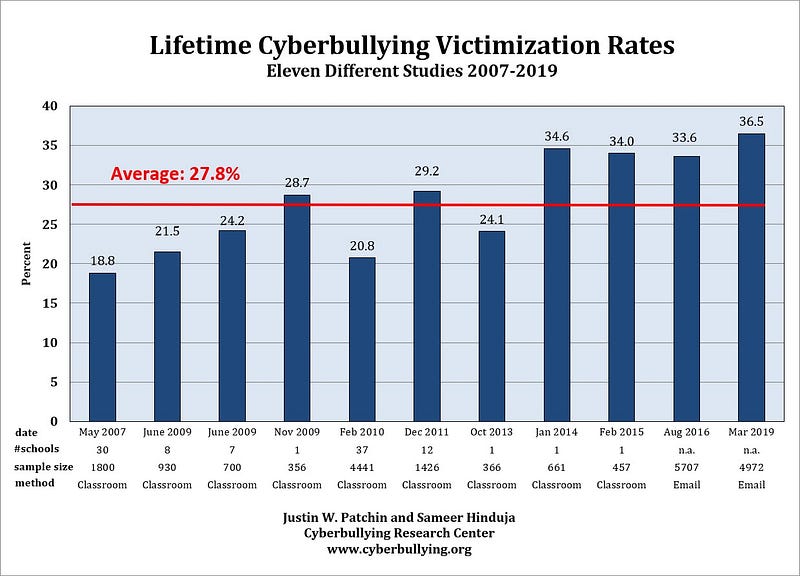
The nature of bullying is vastly different than what we might have experienced ourselves as kids. Ten to twenty years ago, bullying typically occurred between a bully and a victim in a linear fashion. They were isolated incidents without the possibility of anonymity. The experience and interaction were limited to those who were present to witness the bullying first hand. The impact of the event dissipated over time. Today in high schools, cyberbullying is communal and circular. They are recurring attacks that are concentrated, often extending into the real world and over time. The people who see these social posts all go to the same schools, have common friends and connections. Incidents of cyberbullying are propagated through social sharing over time. The more viral the assault, the longer and more often it is displayed in user feeds. By the end of the day, everyone in your school is aware of it, talking about it, and pointing out who the victim is, while the bully remains anonymous. As a teenager, seeing your identity dragged through the mud and being reminded of it online and in-person amongst your peers is a life-altering experience.
Incidents of cyberbullying usually aren’t deemed worthy causes that warrant intervention, but they leave behind a trail of devastation that has long-lasting psychosocial effects. A longitudinal study conducted by The American Academy of Pediatrics of over 4,000 children concluded that both chronic and current bullying are associated with substantially worse health, citing that 44.6% of children bullied in both the past and present were at the lowest decile of psychosocial health. This is not a matter of sucking it up.
The overall net effect of cyberbullying on the mental health of teenagers is evidenced in the substantial increase in the number of teens attempting suicide, and the growth of clinical depression amongst teenagers by 37% since 2005.
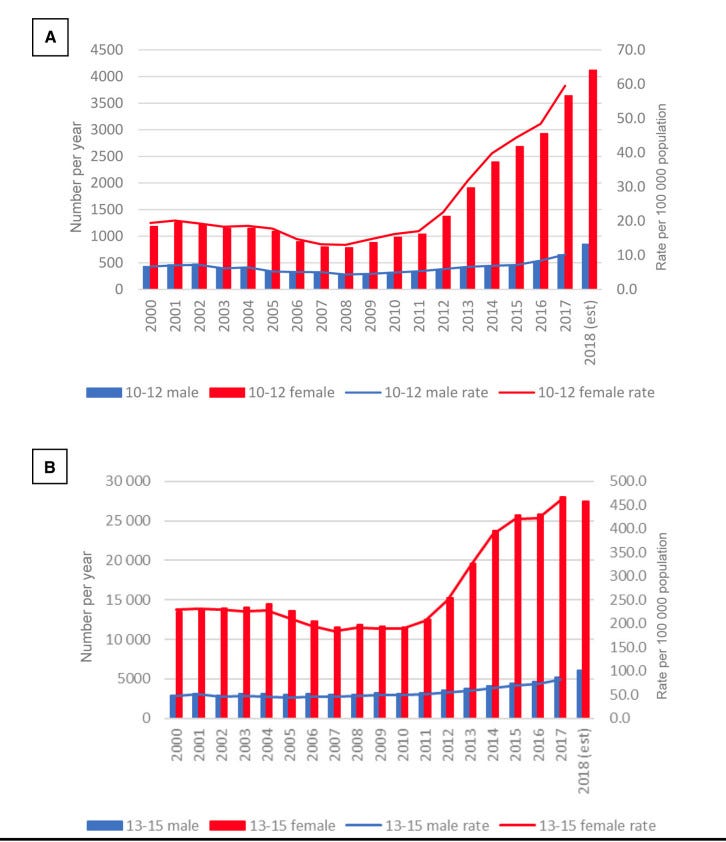
The internet and social media are not safe environments for children. Social media companies are not interested in protecting children from harm, and parents stand no match against a multi-billion dollar industry keen on keeping kids connected. I don’t mean to pick on Facebook, but the truth is that a child’s well-being is low in terms of their business priorities. They repeatedly mislead their user base by convincing them that their platform is about connecting the world when in reality it is about making money. Facebook is not a non-profit. Their entire business model is based on changing behaviors such that users keep scrolling, and in doing so are exposed to more ads. The early history of Facebook reveals a lot about the company’s leader, his character, and his motivations. Let’s not forget Facemash, an early program created by Mark Zuckerberg that laid the foundation for what has become Facebook, “allowed users to objectify fellow students by comparing photos of their faces and selecting who they deemed hotter”.
How to Stop Cyberbullying
I’ve emailed principles, spoken to teachers, and have tried to work with anyone willing to help, but most often their hands are tied because incidents of cyberbullying do not occur on campuses.
There is no one to contact on Facebook or Instagram. They do not provide a phone number or email address you can use to express your grievances with any reasonable expectation of a reply. Instead, they encourage you to report the account or posts through the app (never mind if you’re a parent that doesn’t have, nor want the app installed on your device).
With no help from Facebook or Instagram, I contacted the account holder, but reasoning with a teenager who lacks the ability to truly understand their impact on others is futile. There is a fine line between freedom of speech and the right to destroy a kid’s life with your words and actions. In my conversation with these bullies, they denied they were bullying anyone, but that other people were. They claimed that they were guilty only of creating a space for people to speak honestly and freely and that they have no control over what other people say. In this particular case, they were using an Instagram Story Template, a feature in which you have the ability to create a fill in the blank sentence, and allow your users to complete the sentence. The reality, without getting into too many details, is that they make it possible for people to hurt others when they create sentences such as “______ is a fuccboi/fuccgurl”, and they know it. Their complacency speaks for itself, and these billion-dollar companies by extension are equally guilty.
As uncomfortable as it might be, technology has changed the way we communicate, and perhaps we need to think about our teenagers' free speech in their social accounts within the context of the potential harm it might create. We need to ask ourselves if it truly is worth protecting in the manner in which social media companies demand, i.e. carte blanche.
Our children are not going to put their phones down, and they will find ways to connect. We cannot simply take their phones away. We also cannot blame them, the bully (who often is a former victim of abuse) or the victim. Ultimately, they all are the victims of cruel markets that prey on their impressionable minds.
What are we supposed to do?


