
PRODUCT TEAMS
Getting the most out of product teams
Building, structuring, and leading high-performing, cross-functional, and collaborative product teams
Successful traction of a product could be misleading as 70% of companies fail within their first 10 years of activity. For a product to succeed over the long term, companies need to innovate and improve current products over time or bring new ones to the market. The best way to do so is by building a product-focused organization where the right people, right processes, and right company culture come together to build the right products. To achieve this, a company needs to perform the following four steps:
- Structure product teams
- Structure organizational processes
- Structure product development efforts
- Develop and empower ‘ product cultures’

Structuring product teams
Company structure
How does the product fit into the organizational chart? In the past, companies typically broke their organization into functional divisions, such as sales or support, that worked within themselves. Gradually organizations began to embrace product roles, such as product managers and designers, by placing them within the marketing or engineering divisions of their organizations. With the growing role of the product people, divisional goals got muddled up. The marketing team expected product people to operate as a marketer and engineers maintained focus on building the ‘product — right’ instead of building the ‘right — product’. However, a product manager or designer needs the freedom to focus on understanding the customer and discovering the right product to build for them. This is why the ‘product management and design divisions’ were created.
The ‘product management and design divisions encompass product managers, product designers, data analysts, and an independent VP. This ensures product teams are represented in the executive meeting among all other VPs and the CEO so that the VPs can work together to make sure they know what each employee is working on and assign the right people to the right product teams. This way, employees from different divisions cross-collaborate, working on assigned product teams, and are equally held responsible for their team outcomes. This allows everyone on the product team to work much more closely and quickly discover the best product to build. Plus, it helps instill a strong product culture throughout the company. This structure needs to scale within the organization, allowing for new product teams to be formed in tandem with prioritizing the product vision and strategy.
The VP of Product (V.P.o.P)
While most businesses begin with their founders as the product visionaries, to grow as a product-focused organization, a dedicated VPoP with multiple product teams and product managers. The VPoP tends to oversee all product-related roles including product managers, product designers, data analysts, and scientists. The VPoP is a challenging role that needs to be able to perform in the following four areas:
- Team development: recruiting and training strong and diverse product managers and designers.
- Setting the product vision and strategy: the product vision is the organization’s north star driving and inspiring the company. The VPoP is the biggest champion for the overall product vision that ensures product teams are aligned and that they aren’t doing duplicate work. Moreover, the VPoP needs to pair extremely well with the CEO. If the CEO is a product visionary, the VPoP needs to champion that vision and help the team execute it. If the CEO is not a product visionary, then the VPoP needs to provide that vision. It’s important to avoid having two visionaries with competing ideas or missing a product vision entirely, leaving product teams without a direction.
- Executing the vision: The VPoP needs to be constantly pushing the organization to define the right product and deliver on it. This requires the VPoP to be fluent in all current best practices including lean development, agile methodology, design thinking, prototyping, and design experience. The VPoP needs to know which of these practices to use as the teams grow in size, ensuring they’ll be set up for quick and consistent product delivery.
- Creating and leading the product culture: The best product-focused organizations have distinct cultures that enforce ‘scientific’ methods by encouraging people to hypothesize, create prototypes, test, reevaluate based on data, and question assumptions to get the right answers as quickly as possible. The best-performing product teams focus on outcomes rather than outputs.
What are product teams?
Most currently huge products were initially created by a very small product team. For example, in 2012 Instagram had 26 million users on iOS with only 13 employees. Today, Instagram has many product teams working on different aspects of the same core application. Whether a startup or an established company, the product team’s ability to work together and bring the best products to market — quickly — can make or break a company.
A product team is a cross-functional group of people who are given the freedom to find a solution to a difficult problem. They possess and share different skill sets to create or improve products or specific aspects of a product. These teams are strategic and practical with typically one dedicated product manager, a product designer, a marketing manager, and somewhere between two and 10 engineers, and usually, one of those engineers will be designated as the technical engineering lead.
Why do we have product teams?
In the past, many companies worried about building the ‘product — right’ vs. building the ‘right — product’, incentivizing teams to get a product out of the door rather than getting the right product to customers; and consequentially, many products would flop when they hit the market. In response, product teams were built to help companies get out of a project-oriented mindset and focus on outcomes. Therefore, these days, product teams are held accountable for the results of a product launch. They’re responsible for releasing a product that solves a real problem in a meaningful way, creating value for and being loved by the customers.
Today, product teams are simply tasked with the desired objectives, and then it’s wholly on that team to find the best solution to achieve those objectives. These objectives may be reaching a new target market, developing a new offering for an existing market, a solution to a security risk, or launching a current solution on a different platform, such as Android. But whatever the objectives, it’s important to form well-balanced and highly functional product teams. Product teams that trust each other and work effectively to solve real customer problems while serving organizational needs.
Developing effective product teams
High-performing product teams are formed when members respectfully collaborate around a product vision that inspires them to create a product people love. Product teams operate best when there is no hierarchy, everyone feels ownership over the success of the product and is committed to one another. In a high-performing product team, engineers continue to report to the VP of Engineering, product marketing managers to the VP of Marketing, and product managers and product designers to the VP of Product. As there is no hierarchy, members will have to work together, trust each other, and get candid input from everyone.
Moreover, product teams should not be created and recreated on a product—by—product basis but rather should stay together as consistently as possible as they take on new challenges. Ideally, the same teams should work together on the same product for a long period of time and if a new problem needs to be solved, it’s better to move an entire product team to that issue rather than to reassign certain members. This will allow the team to build trust and a style for working together. Additionally, this approach allows the team to develop a deep specialized understanding and be more creative and innovative.
Product teams should work physically next to each other allowing for a constant sharing of feedback and ideas. The more efficiently a product team communicates and iterates, the faster they’ll find product-market fit.

Structuring organizational processes
Product vision and strategy
We know Apple for its innovation, Walmart for low prices, and Amazon as an online marketplace where one can buy just about anything, and these company positionings are clear because they have clear visions and missions that they keep delivering on.
When a corporate mission is made, the product vision and strategy help deliver this guiding statement. Each product a company creates should have its own vision and strategy. The product vision is where you want your products to be in the future, it’s inspirational, can change as the company grows, and lines up with the company’s mission statement. For example, Amazon’s product vision for their Echo could be ‘enabling anyone to order any item online by voice and receive it faster than visiting a retail location.’
A layer below the product vision, we find product strategy, where things become more specific about how the product vision could be accomplished. Product strategy is a step-by-step process to achieving the product vision over time. For example, Amazon Echo’s product strategy may have been ‘to initially develop a working prototype and then an ecosystem that gives developers the ability to create their own applications for the Echo’.
The product vision
A product vision needs to inspire employees and customers and, based on the video above by Simon Sinek, a compelling product vision starts with why a product exists. A product should either address a deep desire people have or solve a problem. In the case of Facebook, the product vision for its News Feed could have been to be ‘the best place for people to stay up-to-date with everyone in their life’, a grandiose vision, serving a core human desire — connecting with others.
Moreover, a product vision needs to last several years, and once created, companies need to stick to it. Companies that change product visions too quickly risk damaging the company’s product culture. It may not be known exactly how the vision will be achieved on day one, and details will change, but the product vision should not.
Additionally, talk about your product vision a lot within your company. It’s easy to get tangled in everyday work and lose sight of the product vision, but it should act as the guiding north star of the team.
Be stubborn on vision but flexible on details — Jeff Bezos, Founder of Amazon
The product strategy
The product strategy will help a company achieve its vision. With the vision acting as a destination, the strategy is merely the road to getting there. Product strategy is a logical, step-by-step process for achieving the vision, with the steps acting as the specific projects or initiatives that the company plans to take on to get there.
For example, in the case of Dropbox, if the product vision is ‘to become the one central place for people to safely store all of their files’, the product strategy may start by ‘creating a software that can store one single file, scale it, then create the infrastructure to store one gigabyte of data for everyone in North America, then global expansion, then infrastructure expansion for monetization’. And with each new release, Dropbox lays one more brick in the road toward its destination.
The most effective product strategies are based on pursuing a specific target market that is focused on one user persona. They initially lay out the strategy based on those end-user needs, and as they grow, they expand into other segments. Trying to be all things for all people will fail. Once the target customers are known, the product team should obsess over their needs and create a step-by-step plan to meet those needs.
Team members should constantly talk about the product strategy across the whole organization helping to reinforce the product vision
The OKRs
An organization needs to set clear and actionable goals and measure its performance to make sure new products meet customer needs while staying aligned with business goals, and that’s where the OKRs are used (objectives and key results) — to measure the success of product teams. The OKRs help ensure that product teams are focusing on the right things. OKRs will shift the organization towards making better products by working on the most important things first.
- Objectives, offer specific goals for the company as a whole and teams and divisions, use words like increase, decrease, and improve, but don’t provide a specific measure (e.g. increase monthly active users or make it easier to share). Objectives need to align with the product vision and strategy with team members knowing how their projects contribute to the overall goals of the company.
- Key results help measure the degree of success in achieving objectives. Typically, there will be three to four for each objective, they will be quantifiable and tough to achieve but not impossible. For example, some key results of a social media application could be the successful launch of the app within the first month, 50% of users opening the app every day, or 30% of users actively engaging on the app daily.
OKRs are the frameworks that help set, communicate, and monitor goals across the company. Typically, company-wide OKRs are set annually by the company leadership while the VPoP creates internal quarterly OKRs for the product teams. Also, make sure to prioritize product team OKRs over divisional ones so employees have clarity on what to work on.
Monitoring OKRs
The VPoP should constantly be evaluating whether or not the OKRs are helping to achieve the desired outcomes.
- Before setting any OKRs, ask whether the company has any major goals such as revenue growth, new customer attraction, or customer satisfaction. OKRs should stem from organizational goals.
- Start small, in terms of how many OKRs you’re implementing. One — OKR — per — team until you see the teams can handle more.
- Create OKRs for the entire company, so that everyone feels like they’re working in the same direction. Try to always include revenue growth goals (e.g. month over month).
- Follow company-wide OKRs when defining OKRs for product teams. The product team objectives should be directly impacted by the product strategy they’re following. For example, if the company has a goal of adding new users, and the product strategy is to build a referral feature, the product team’s OKRs could be to increase new user signups by 10% month over month via the referral program.
- Adjust OKRs, if all product teams are regularly hitting all their OKRs.
- Look back at the OKRs, if teams are not achieving their objectives. Create a safe space and ask members of the teams why they think they’re missing objectives. Reasons for failure could be a misalignment, confusion, or placement of aggressive goals.
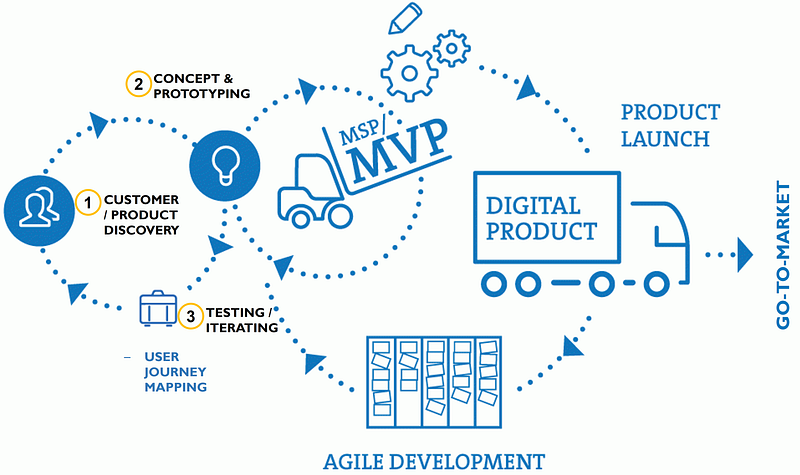
Structuring development efforts
Customer discovery
42% of startups fail because there’s no market need for their product. The best product-focused organizations follow a systematic process to develop products quickly through customer discovery. Customer discovery is the process of figuring out who your customers are and identifying a problem that’s truly important to them. By performing proper customer discovery, companies will know whether there is a place for their product in the market.
Customer discovery is essentially a three-step process:
- Finding and honing in on the target customer and building assumptions about their needs, desires, and behaviors
- Conducting user research to validate assumptions and hypotheses
- Making adjustments based on customer feedback
Product discovery
Generally, final products are nothing similar to what the founders had expected. Products that break through the market tend to go through an intense period of product discovery. Product discovery is the process of creating, and testing products that ultimately meet customers’ needs.
- Spend enough time during customer discovery to fully understand customer problems. You need to know who your customers are, and what problems they have before coming up with possible solutions.
- Choose one pain point to tackle for the user base. You can’t solve all customer problems, but you can solve one and this will become the goal for the product, so the team can start brainstorming ideas.
- Make sure to target a large market size, with high demand volumes and profitability margins, so that later investments make sense.
- Quickly and cheaply find the best solutions to customers’ problems by creating several prototypes or MVPs, and gathering user feedback.
- Keep experimenting, the best product teams never stop discovering things about their customers, and continually make new prototypes based on those findings.
Conceptualizing and prototyping
Building a fully functional product takes a lot of resources, and when the product gets in front of customers, things need to be changed or fixed. That’s why making prototypes is an important task for product teams. Prototypes are built so businesses can learn something without all the time and effort it takes to build the full product.
Prototypes are often described by the degree of their complexity as high-fidelity or low-fidelity, meaning how close to a fully functioning product the prototype is.
- Low-fidelity prototypes can be as simple as drawing diagrams on a napkin. This simple prototype may be enough to learn if a fully built product would solve a problem for the user.
- High-fidelity prototypes are much closer to real products. Sometimes allowing for real user traffic, or pulling in real-time data. High-fidelity prototypes often help us understand whether we can technically build something in a certain way.
More times than not, simply creating a prototype will uncover unexpected challenges and questions, it is much better to discover those things early on before investing heavily in building the full product. The faster and cheaper companies test things, the better off they’ll be in the long run.
Testing and reiterating
User testing is at the core of prototyping and happens with real users testing four main criteria:
- Value: does it solve the user’s problem? Does it help them achieve a desire? The product must provide more value than the user’s existing options. Will they use your product instead of other products, or prefer to use nothing at all?
- Usability: in today’s world, products can’t just be functional. They need to be easy to use and have a great UX/UI.
- Ability to build: make sure your team can actually build the product, understand how the user wants to use the product, and what’s technically possible for your team.
- Investment sensibility: whether or not it makes sense for the company to invest in the final product due to factors such as the rate of adoption.
Ultimately, great testing comes down to great listening. See how your users try to use the prototypes. Ask them to use the product to accomplish something specific such as:
- Where do they get stuck?
- What seems unclear to them?
- What’s frustrating?
- What were they expecting?
- What else do they wish they could do?

Developing and empowering a ‘product culture’
People are attracted to a company’s culture — its personality, values, what it stands for, and how it operates. In the beginning, a startup’s culture is an extension of the values of its founders, and to continue that culture it needs to be a central part of both the hiring process and the company structure.
- Hire missionaries — companies should strive to hire missionaries over mercenaries. A mercenary is someone who may be opportunistic but is ultimately most concerned with getting the job done, but a missionary is someone who feels and acts empowered with a sense of purpose towards the product or company vision. When hiring for missionaries ask yourself: does the candidate get excited or care about the company’s mission?
- Build an organizational structure that preserves the culture — if you want to be surrounded by mission-driven employees you need to give employees the freedom and ability to act as missionaries. As explained previously, this is why the non-hierarchical structure of product teams makes them so powerful. The longer a team works together the more they feel a sense of ownership. So it’s not a surprise that the highest performing teams are those who have been working together on the same product for an extended period of time and who are trusted to get the job done.
By hiring well and creating team structures that give employees the freedom to find their own solutions for the company’s objectives you empower employees to work as missionaries instead of mercenaries.
Be data-driven
The principles of customer and product discovery should extend outside the product teams and permeate the entire company, and that’s why the best product-focused organizations have a data-driven culture. Being data-driven means that decisions aren’t made based on assumptions and are backed with actual evidence.
Moreover, the most successful teams use every opportunity to think critically about why they should operate in a certain way. For example, if someone recommends that you focus on making it easier to create an account, you should ask why. If such a recommendation is based on data such as: ‘what 40 customers have said or what retention rates are saying’, then it’s rooted in hard evidence and will unite teams and deliver successful offerings.
This is true of not just product teams but other divisions as well. It’s not that people’s assumptions are wrong, it’s that data lowers the risk of making poor decisions. With better decisions, an organization will fall upon instances of winning and success one after another.
Constantly measure performance through KPIs
What gets measured gets managed — Peter Drucker, ‘The Practice of Management’, 1995
Every team should be measuring its progress toward objectives and making decisions based on real data. KPIs are objective measures of how different aspects of an organization are performing. KPIs impact overall business objectives such as monthly recurring revenues (MRR), customer support calls, repeat customers, and more. Note that KPIs are not goals but measures of how you’re doing right now. On the other hand, OKRs are where you want to be in the future. For example, if your revenue KPI shows that you’re on track for $9,000 this month, you still have some work to do to hit your OKR of $10,000. Here is a list of important metrics to think about when designing OKRs and KPIs.
Also, you should not need to build KPIs around every company's OKR or measure. Businesses should not measure extremely specific things that are relatively unimportant to their goals such as the number of mobile app users that have uploaded photos to their profiles. These kinds of data are good to have but there is no need to set goals around them. Think big picture such as revenues, the total number of installed apps, the number of monthly active users, and so on. Take a look at the video above by Anu Hariharan from YCombinator on the different business models and the metrics investors want to see.

In summary…
After a company gets its start due to the success of an initial product and scales, it becomes extremely important to put the right processes, people, and culture in place to thrive as a ‘high—performing’, ‘product—focused’, organization. Great product companies excel at both creating an innovative product vision and executing a strong product strategy. This will only happen if people are empowered to operate as missionaries and find their own ways to solve hard problems. To achieve these goals:
- Structure the product teams, appropriately
- Structure the organizational processes, appropriately
- Structure product development efforts, appropriately
- Develop and empower ‘product culture’, appropriately
Hope you enjoyed reading this article! :)
If so, then:
- Follow me on Medium
- Become a Medium Member
- Subscribe to hear more
- Let’s connect on LinkedIn