Building Bridges with Concept Maps: Linking Design Thinking, Systems Thinking, and Business Model Generation
Discover the forgotten gem in every thinker’s toolkit
When you walk into a room of people that is part of a SMB (small to medium-sized business), you are quickly reminded of the once popular motto, “Keep it bleeding edge -1 or -2, not bleeding edge.” You have to drop your big corporate thinking at the door.
There is no time for the latest buzzwords or complicated tools. The objective is to establish common ground as quickly as possible. What is the business all about? What is the problem or opportunity? How can we use this time together most effectively?
Often times, the best tool to grab from the toolkit is one that has been around for a long time. Something that has been scientifically proven to work in situations like this where everyone is attempting to arrive at a common understanding; a common vocabulary; to collectively engage in discovery learning — ultimately to walk away with some kind of plan of action in as short a time as possible.
Fortunately, there is a tool that came out of learning psychology research: concept maps. Prof. Joseph Novak was the one who first developed and designed these maps with a learning focus. The theory behind concept maps is based on D. Ausubel’s work on meaningful learning in educational psychology.
Ausubel made the very important distinction between rote learning and meaningful learning. Meaningful learning requires three conditions:
- The material must be conceptually clear, and it must visually present an example that is relevant to previous knowledge.
- Everyone present in a session where the material is discussed must have relevant prior knowledge of the topic at hand.
- Everyone present must choose to learn meaningfully. This normally requires a commitment to incorporating new meanings into prior knowledge.
So much of creation is about discovery — and you can’t discover anything if you can’t see what you are doing. You cannot change something unless you understand it. Concept mapping allows you to visualize the structural aspects of knowledge.
Design thinking, concept maps, and the psychology of learning
Out of the many case studies that could be used, we will use the popular EU-Rent Car Rental fictitious business described in the OMG (Object Management Group) standards documentation. It is popular because it describes a system most people use, thereby making optimal use of the scientifically proven importance of prior knowledge in meaningful learning. Here is a short description on the OMG website:
“EU-Rent rents cars to its customers. Customers may be individuals or companies. Different models of cars are offered, organized into groups…A car may be rented by a booking made in advance or by a ‘walk-in’ customer on the day of rental… EU-Rent records ‘bad experiences’ with customers…”
For the sake of brevity, the description of the business has been shortened, but the full text can be found on the OMG website. The diagram below is a representation of the description in words.
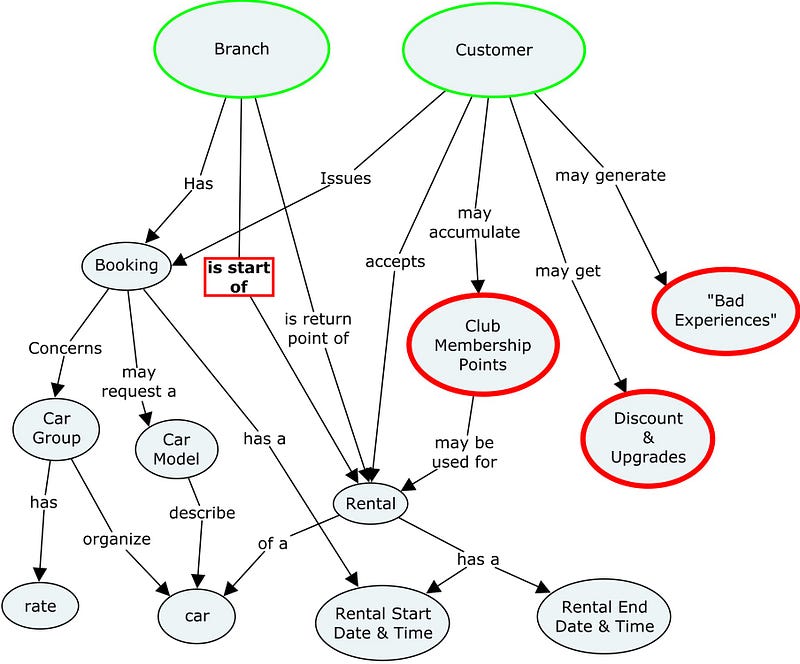
The diagram speaks for itself, which is the whole idea. It starts with a customer and a branch—the focus questions—linked to one or more concepts. The linking of concepts using words forms a preposition that facilitates meaningful learning.
By traversing the hierarchy from top to bottom, you can read sentences like; “customer issues booking”; “Car Group has a rate”; “customer might have bad experiences”; “membership point may be used for rental” and so forth. The sentences are visual; the brain instantly connects the lines between the concepts.
The concept map is logically divided into two sides. On the right is the focus question about customers UX(User Experience Design) or CX (Customer Experience). On the left is the focus question about the business (Business Model Design). The crosslinks between the two focus questions are generally referred to as DDD (domain-driven design) — where technology meets business. The concept map, the two domains, and the links between the domains create a situation in which design thinking is typically used to understand existing problems in order to quickly envision different scenarios that may reveal new opportunities.
Concept maps have an inherent narrative that tells great stories when the session participants are motivated to find new solutions. Anyone can use design thinking; it is not just for professionals and academics.
Design thinking, systems thinking, and business model generation
Both design thinking and systems thinking offer valuable approaches to problem-solving, but they can sometimes appear at odds. A concept map(s) can remedy that. Since I am a longtime student of systems thinking, I label them as design thinking lite and systems thinking lite to get rid of the friction.
When working with the lite version of both frameworks, the following approach offers clarity of thought:
Recognize the value of design thinking: While it might seem “hammer-centric” at times, design thinking excels at understanding user needs, iterating on solutions, and fostering empathy. These are crucial aspects of systemic change, even if the focus on individual solutions can feel limiting.
Seek complementary perspectives: Don’t discard design thinking as useless; instead, use systems thinking to bridge the gap. Ask yourself questions like: What are the larger systems underpinning the user needs identified in design thinking? How can solutions be scaled beyond individual cases to address systemic issues?
Look for systems within the design thinking body of work: While design-centric, the advocates for design thinking do acknowledge the broader context in play. Try to identify references to systems, feedback loops, and unintended consequences. How can you interpret the case studies through a systems-thinking lens?
Compare and contrast approaches: Actively compare design thinking ideas with systems thinking concepts like feedback loops, dynamic complexity, and emergence. Consider how these frameworks can enhance or challenge each other.
Seek diverse perspectives: Don’t limit yourself to one or two dominant thinkers in design thinking. Explore how other authors integrate design thinking with systems thinking.
Focus on practical application: Ultimately, the best way to read design thinking material is to think critically and apply your systems thinking knowledge to real-world challenges. Can you use design thinking techniques to address complex systemic issues in your field?
Remember, both design thinking and systems thinking are valuable tools. By viewing them as complementary rather than conflicting, you can gain a richer understanding of how to tackle complex problems and drive positive change.
Merging Alexander Osterwalder’s Business Model Canvas with the other two: Remember, your starting point is ideation, with Osterwalder’s framework guiding you through value propositions, customer segments, channels, revenue streams, and key resources. Osterwalder’s ideation and value proposition align with design thinking’s user-centric approach. Leverage Osterwalder’s framework to brainstorm innovative business models that address identified needs and contribute to the desired systemic change.
Key take aways
This article attempted to highlight the synergy between three powerful frameworks—design thinking, systems thinking, and business model generation—and how concept maps can be used to harness their combined potential.
The key points are:
- Concept maps excel at visually organizing information, facilitating meaningful learning and collective discovery.
- Design thinking fosters empathy, user-centricity, and rapid iteration, which are crucial for understanding and addressing user needs.
- Systems thinking provides a broader lens, considering interconnectedness, feedback loops, and unintended consequences.
- Business model generation translates identified needs into sustainable solutions with clear value propositions.
By using concept maps to combine these frameworks, you can:
- Gain a deeper understanding of complex problems.
- Develop innovative solutions with a broader societal impact.
- Drive positive change through sustainable business models.


