
Building a Post-Pandemic Skillset: The F.A.I.R. Pillars of Success
Flexibility, adaptability, insight, and resilience are keys to thriving in a changing world

Serving in the armed forces made me a better human. After seven years, my commission was over, and the army discharged me.
Soon after, life took a downward spiral. I was unemployed and living an unmeaningful life; therefore, I faded into depression.
“If you don’t know where you’re going, any road will do.”— Lewis Carroll
My life was a continuous cycle of failed job opportunities until that day in January when an interview went sideways and became a game-changer.
I was stressed and tired; the employer had scheduled an appointment for the afternoon. I showed up on time and did the usual Q&A. Initially, it all went fine; the interview was finished, and all I had to do was drive for another hour to get back home.
That same evening, while preparing supper, I got a call; the HR manager wanted to see me again ASAP.
I felt that it was a touch-and-go moment and confirmed the meeting. I turned off the stove and saddled up for another long journey with high hopes about the position. While driving, my mind drifted to the reason for such an urgent call.
I felt confident that my luck was about to change.
It was around 9 p.m. when I arrived. The manager greeted me at the door; next to him was a behavioral psychologist. They had decided to run a battery of personality tests on the remaining three candidates. I realized the matter was urgent because they were in a hurry to get it done before heading back home to the capital.
You can imagine how upset I was at that point. Nonetheless, I took the battery of screening tests head-on.
One hour had passed, and I found myself adrift in my thoughts while walking back to the car. I got the feeling that the game was rigged, and I was the congenial runner-up.
I was right.
While driving back home, I was angry and skeptical. The road ahead felt like an existential metaphor of life passing rapidly before my eyes, somewhat creating a tunnel vision effect, as the street lights dashed like shooting stars.
Suddenly, I had a flash from the past and recalled an old army lesson about taking points in decisive moments. That insight inspired me to take a leap of faith. The world was moving fast, and I fell behind by simply allowing others to run the show. From that moment on, I would no longer rely on someone else to pull my strings and sit in the corner as the broken-up doll in the puppet show.
Building Leadership in a New Reality
Back then, it was a lesson on the principles of strategic leadership as defined by W. Bennis and B. Nanus that helped me regain control over my inner self at a crucial moment. Only then did I manage to overcome a life crisis.
Now, the COVID-19 pandemic crisis has warped our world, making the future unforeseeable. So, the post-pandemic world will be all about these touch-and-go moments.
It’s in this challenging context that I’ve found the motivation to help others find their insight, develop a new mindset through active mindfulness, and take one step forward in the quest for existential fulfillment.
The empowering legacy of VUCA
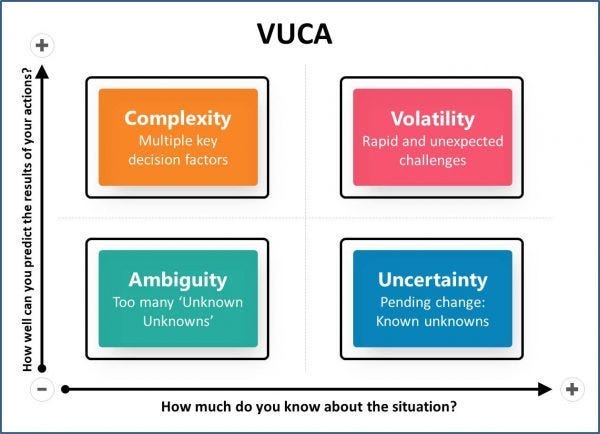
VUCA stands for Volatility, Uncertainty, Complexity, and Ambiguity. This concept was a game-changer at a moment when the conventional geostrategic type of conflict was fading away. The enemy could be anywhere, and state-of-the-art strategies to seek it out and react to aggression became necessary.
Likewise, our world is continuously mutating, adapting, and evolving, thus becoming more unpredictable. We cannot suddenly anticipate events or develop solutions due to their complexity. Thus, understanding the VUCA concept and methodology becomes significant:
- Volatility: the speed of change makes it challenging to predict scenarios and prepare solutions;
- Uncertainty: the globalization of information generates multiple scenarios that introduce doubt into the system; hence, disruptive changes presume new paradigms;
- Complexity: traditional models of risk management and decision-making can no longer deal with the number of variables in these interconnected contexts;
- Ambiguity: we can analyze any context from multiple perspectives, so this systemic and globalized view amounts to various interpretations.

From Bootcamp to the Global Playing Field
For seven years, I served in the Portuguese army. I was exchanging my teacher’s pen for a G3 assault rifle. My academic studies had been in languages and literature, and until then, I only worked in teaching.
From a theoretic leadership point of view, teaching was, for centuries, to be led from a pedestal. However, that paradigm is changing nowadays, even in academic environments.
However, enlisting in the military meant that I had to utterly change my teacher’s mindset, as teamwork becomes paramount in any military aspect. The army urged me to become my best self and take control of my life. I realized that the best practice is to avoid pushing ourselves to the limit.
Nowadays, blitzscaling is more challenging than ever because there are too many big fish dominating the pond. Hence, if we want to upscale our game and join the global playing field, we need to develop vital skills to allow playmakers to thrive in the post-pandemic world.
Here are some tips straight from boot camp:
- More than stamina or IQ, the critical aspect here is emotional intelligence (EI). To find stress points in our structural integrity and prevent failure, we need to develop reflective comprehension via auto-analysis. Only by knowing yourself can you focus on building strength out of weakness.
- If you want to scale the team, then empower the individual. During boot camp, the best tip I got from my drill sergeant came from an insight by Thomas Reid: “A chain is no stronger than its weakest link.”
Army training has helped me understand how post-pandemic pathfinders must excel in what I like to call the F.A.I.R pillars of success: Flexibility, Adaptability, Insight, and Resilience.
Introducing the F.A.I.R Pillars
1. Flexibility to deal with uncertainty
The world presents new challenges, such as a constant state of doubt and uncertainty. That state can lead to emotional instability and low performance.
Focusing on difficulties and problems will only fuel negative, self-destructive, and demotivating feelings and drive you to a state of chronic entropy.
The path to stability and a prosperous lifestyle must focus on the solution and not on the problem. Hence, it would help if you follow these simple performance-boosting strategies:
- Question yourself;
- Anticipate problems;
- Seek alternative solutions;
- Prioritize;
- Discard the irrelevant;
- Think creatively.
Takeaway: Focus on the solution, not on the problem.
2. Adaptability to deal with complexity
We need to improve our skills to maximize performance, thus promoting personal growth.
An effective plan for skill development must follow a well-structured methodology. To this end, it will help if you follow these steps:
- Identification: what skill should I develop to achieve my goals and objectives?
- Reflection: what do I lose by not investing in a specific talent;
- Assessment: assess what skills are necessary to achieve precise objectives;
- Acquisition: considering the competence to improve and develop an action plan;
- Experimentation: testing new behaviors;
- Practice: experimenting to separate right from wrong;
- Application: take advantage of opportunities (or create them) that arise to apply the learned skill.
Takeaway: Develop skills and update professional know-how.
The value of autonomy is a trending concept in the business world that can effectively lead to productivity benefits.
Therefore, we must strive to reach higher standards of autonomy. To achieve this, you can put into practice the following:
- Know what to expect of your work;
- Master tasks and skills;
- Understand the consequences of failures;
- Maintain a balanced relationship of trust with everyone in your team;
- Assess your performance frequently.
Takeaway: Focus on developing autonomy.
3. Insight to deal with ambiguity
Speed and volatility are the cornerstones of the current business context. Thus, you should avoid procrastination and open your mind to insights, seizing every opportunity that can lead to success. Hence, I strive to plan as follows:
- Prepare;
- Get involved;
- Keep an open mind;
- Be optimistic;
- Never stop learning.
Takeaway: Strive to successfully grasp opportunities.
In a globalized world, technology plays an increasingly decisive role in operationalizing different strategies.
On the other hand, people skills and emotional intelligence become paramount, as everything comes down to creating and delivering value to people.
Moreover, the ability to adapt is a requirement, given that a context of permanent evolution imposes new challenges and offers opportunities at any given moment.
Thus, if you cannot interpret and act on change, you are irremediably condemned to fall short of your potential. If you want to be successful, you have to stand out.
The following actions will help you raise your game:
- Focus on cultivating emotional intelligence;
- Have the ability to acquire, process, and accept new information and adapt;
- Analyze failures and achievements;
- Have functional versatility;
- Be curious and creative.
Takeaway: Keep up with trends.
4. Resilience to deal with volatility
Crises are highly volatile, and things can smoothly go awry and drive you to a downward spiral that will cripple your potential.
In threatening scenarios, proactivity generates resilience that will help you ride the wave even in stormy waters.
In short, the proactive leader takes responsibility for a specific action, choice, or resolution when facing a challenge.
The main characteristics of proactive behavior are as follows:
- Train yourself to see beyond the obvious;
- Don’t wait for orders to perform tasks;
- Anticipate problems and present practical solutions;
- Optimize the timely execution of tasks.
Takeaway: Be proactive and take the initiative
Crises like the COVID-19 pandemic can have devastating effects on your relationships with others.
Ensuring the best work environment and an enthusiastic team capable of reaching its goals is paramount. But staying motivated and generating motivation is also one of the most demanding challenges.
Thus, we need to understand that each person is unique and has different ways of life, specific career objectives, and life goals.
The leader has to work on his “people skills” to motivate each individual, particularly the team in general; productivity spikes with everyone’s commitment to the proposed objectives.
Some argue that the intrinsic factors matter the most for people to feel motivated, while others think otherwise, pointing out the importance of the extrinsic factors.
- Intrinsic motivation is related to projects, interests, and personal goals reflected in work behaviors that allow them to feel enthusiastic, fulfilled, and the author of their own lives.
- Extrinsic motivation refers to the context, situations, and organizational climate, namely, remuneration, training or activities carried out, recognition by peers, benefits, incentives, etc., that help people stay involved with their work.
Only a motivated and cohesive team can solve management, communication, and coordination problems. Therefore, to promote motivation, it may help if we keep in mind the following guidelines:
- Use positive reinforcement;
- Establish clear and precise objectives;
- Share a vision of the future;
- Value innovation and creativity;
- Invest in self-motivation.
Takeaway: Be motivated and motivate others
Lessons learned
1. Build adamant teams with VUCA
For a team to thrive, you need to create a favorable environment for sharing and creating new knowledge and collective learning.
It is essential to develop professionals and create integrated processes that enable the development of a dynamic, collaborative, and results-oriented organizational culture.
Implementing the VUCA methodology helps managers gain command and control over their businesses and develop outstanding professional skills to meet the increasingly global and systemic demands of a new reality.
Thus, a comprehensive and forward-looking vision is the most effective way for leaders to reinvent themselves when facing market changes during crises.
2. The ultimate productivity insight
The adamant legacy of VUCA resides in the subliminal superpower of insight toward productivity. Though my instinct tells me to fall back into a comfort zone during a crisis, this is utterly the wrong mindset. In the face of uncertainty, many of us will focus on individually assessing the situation, yet this will ultimately hinder our productivity goals.
3. Boost productivity with VUCA
VUCA keeps you focused on assessing problems from a systemic viewpoint while bringing others into the equation, thereby fully engaging all available resources in a common objective.
4. To win the post-pandemic game, we have to:
- Focus on the solution, not the problem;
- Develop skills and update professional know-how;
- Promote autonomy (for ourselves and our peers);
- Grasp opportunities;
- Keep up with trends;
- Be proactive and take the initiative;
- Be motivated and motivate others.