
Building a Life We Don’t Need a Vacation From
Our farm and our home provide us with what many people look for elsewhere.
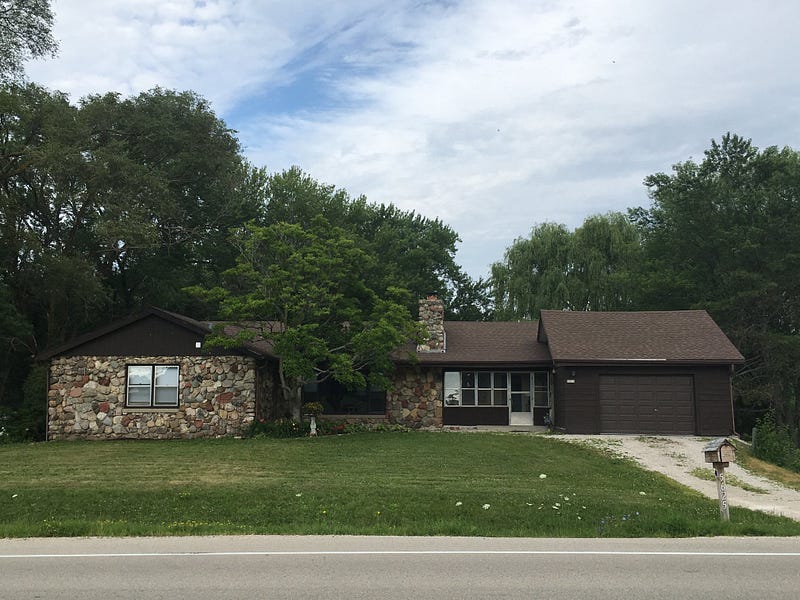
We’ve been “farmers” for a little over four years, sort of. I say “sort of” because we don’t have cattle and pigs and big tractors, though we have had chickens and there is talk about having ducks and maybe goats. We have a small place with four acres, a stream, a small spring-fed pond, and two fields. Our house is made of rock and has two fireplaces. It’s not a fancy house, but it’s cozy. And it is home.
Let me tell you about where and how we live.
How We Got Here
In 2017, the school I worked for in Minnesota offered an early retirement incentive. Their goal was pretty transparent — get the older, higher-paid teachers out the door and replace them with more, um, “affordable” new teachers fresh out of college. When schools have to choose between experience and money, they choose money most of the time.
My wife and I decided to take the early retirement payout and move to southeastern Wisconsin from the Minneapolis, MN area to be closer to the kids and grandkids. We wanted to buy a place in the country so we could raise as much of our own food as we could and create the kind of life you don’t need a vacation from. We envisioned raising our food in large raised beds, having chickens for our eggs and possibly meat, goats for milk and cheese, and maybe a dog or two.
One evening my wife asked me if we could drive by a place she had seen listed. It was a little out of our price range, but I went along with it just to see, and we decided to make an appointment to take a tour.
On the agreed-upon day and time, we met the realtor at the house. She explained to us the owner was an older woman who lived alone, and that she was preparing to move to where he daughter lived, some 150 miles away. The realtor introduced us to Laverne, the owner. She gave us a tour of the house, which was severely dated. Laverne was 85 years old, and her husband had died five years prior. It was obvious she had not done much to the house in quite some time. Around every corner was a project.
Next, Laverne took us for a tour of the four acres the house sat on. We passed the small barn and a corrugated metal shed. Next, we came to a small bridge that crossed a running stream, and beyond that, a pond. At this point, my wife had tears in her eyes, and I knew this was the place we would call home. To make a long story short, we made an offer, and after some back and forth negotiations, the house and the land were ours.
Our House
Our house is made of rock and was built in the early 1950s. These rocks are not the small stones you might see in a typical fieldstone house. These are large rocks, most of which are too heavy to be lifted by just one person. Inside, we have a kitchen, an eating area, a large living room with a fireplace, and three bedrooms. One is for us, another has a 3-level bunk bed for the grandkids, and the other is for our office.
The house on the inside had not seen improvements or updates in a very long time. It needed a lot of work, and I mean a lot. Laverne was simply unable to keep up with it all. We knew if we bought it, there was much that needed to be done. The list of improvements I was making in my head grew with each area of the house we entered.
There was even a dial phone still hooked up to the phone line, though the line was dead.
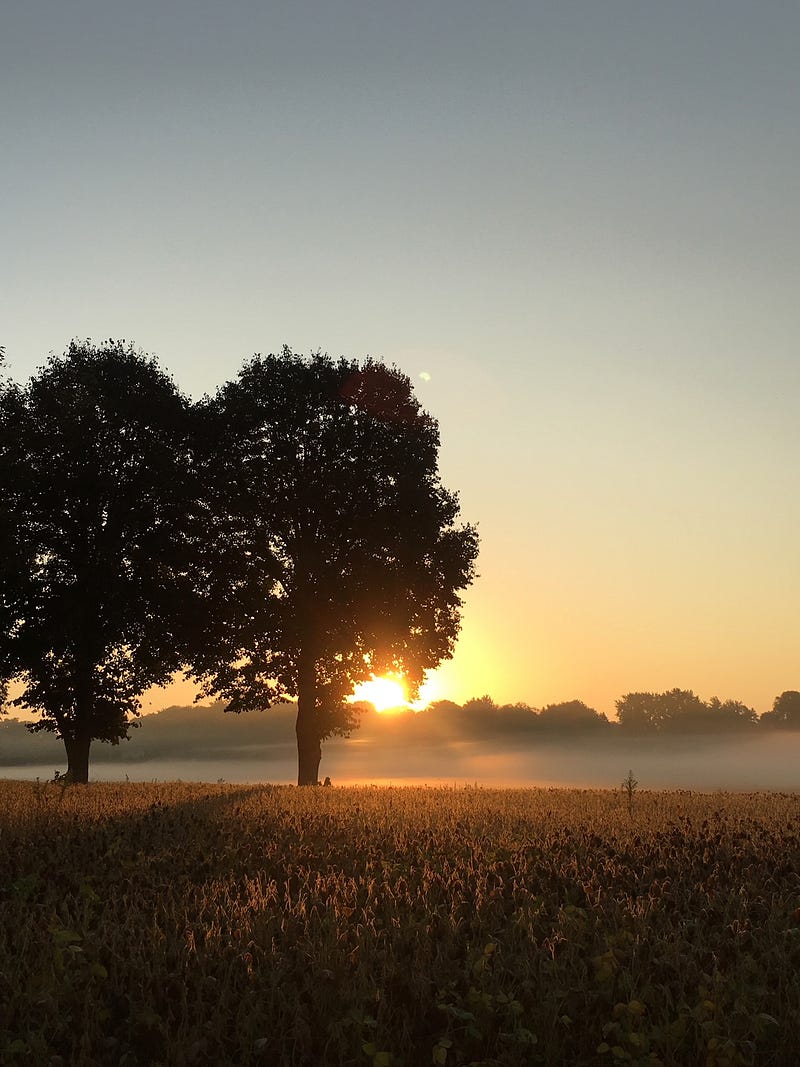
Our water comes from a well, not the city. We had our water tested by the State of Wisconsin, and they told us we have wonderful water and should drink it straight from the faucet. I thought we should at least use a glass. Ahem. That is one of the features of this house we like best. No bottled water or intricate (and expensive) filtration system for us. Along with not having city water, we also do not have city sewer. We have a septic tank. The large windows look out over our fields to the west, and across the road to the east. We can quite literally watch the sun or moon rise and set from our living room.
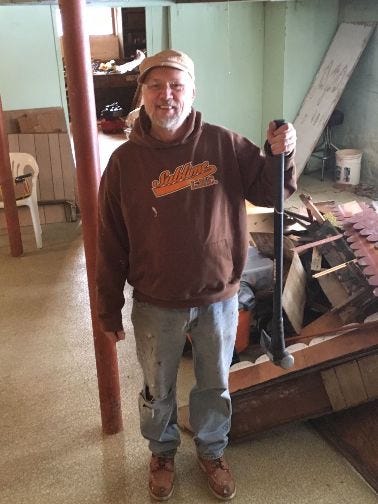
The basement originally had a bar and a pool table, a small work area, and a ping pong table, all seriously decrepit, out of date, and musty-smelling. We gutted the entire basement right down to the cement. Today there is only the laundry area, an area with grow lights for starting our plants, and a small work area with a table saw, wrenches, and other tools necessary to keep our place in good repair.
The Land
When we first came to see this farm, it was the land that captured our attention more than the house. The house sits on 4 acres of land that at one time had been a small, active farm. The 4 acres are somewhat divided into distinct areas. On one acre, the house sits surrounded by large trees. There is a small barn, and a building made of corrugated steel. The trees are mostly silver maples, though there is a large, ancient willow near the corrugated building I call “the old woman.” Immediately outside our walkout basement are several picnic tables so that we are able to eat outside when we have company. This area is also the scene of many a water gun fight, where young grandchildren take on their elders in a fight to the finish. It is also not unusual for me to take a golf club and knock a ball or two into the back field. Who said farms can’t be fun?
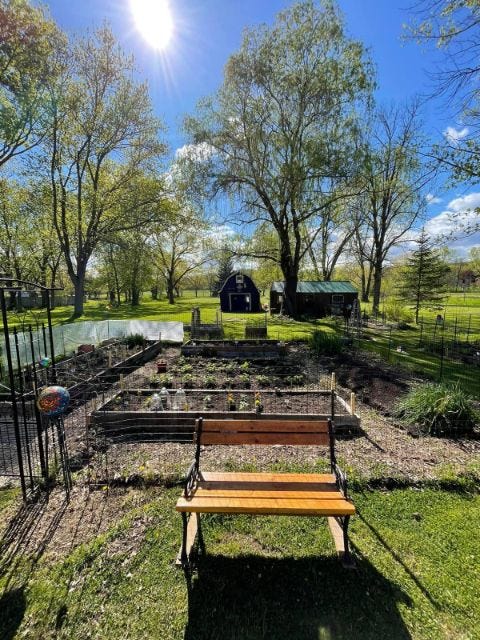
This area also contains our raised bed vegetable gardens, as well as two herb gardens. In these gardens, we grow tomatoes, beets, carrots, potatoes, sweet potatoes, broccoli, cauliflower, sweet peppers, onions, garlic, spinach, various lettuce, and strawberries. The reason there are two herb gardens is that one of the gardens grows herbs for culinary purposes; the other garden is for growing medicinal herbs.
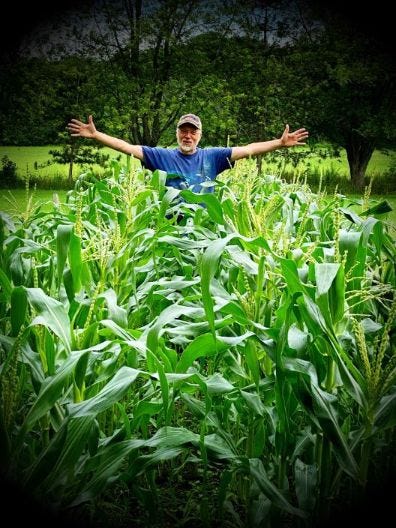
Beyond the house to the west lies a spring-fed stream over which a bridge takes us to the first open field, which is also roughly an acre in size. In this field, we are developing a growing area of sweet corn and squash. We don’t have large farm equipment to till an area of this size, so we have to do things gradually and expand it each year. In this field, we also have a pumpkin patch. Along the side of this field, we deposit grass clippings and leaves to make compost to use in our gardens. We are small-scale. We are organic. We are low-tech.
To the south of the field lies a spring-fed pond that is surrounded by woods. A small dock reaches out into the pond, which is a favorite hangout for ducks and geese, and serves as a permanent home to our resident muskrat. On summer evenings we can hear bullfrogs sing bass, while the peepers sing the melody.
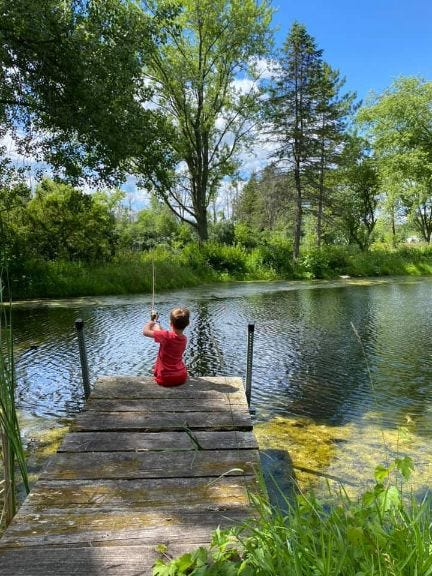
One ambitious week two summers ago, I contacted a company called “Chip Dump” that delivers wood chips for free. The chips come from local arborists who have cut down trees and need to dispose of the chips. They brought me ten cubic yards. I used a brush cutter to cut down some of the growth surrounding the pond and created a walking path that winds around most of the pond. There are several small openings from the path that lead down to the shoreline where the kids can catch frogs, throw rocks into the water, or cast their line in hope of catching a small fish. There the visitor might run into our muskrat, who can be seen swimming along the surface. The muskrat, however, is an introverted soul who likes his privacy and will dip below the surface of the water if he senses company. It is not at all unusual to find ducks or geese swimming in the pond and an occasional blue heron on the shore. Wild turkeys cross our land on occasion as well.
Our Chickens and Organic, Free-Range Eggs
As if rehabbing the house wasn’t enough, our first spring at the farm we decided to raise chickens for eggs. We bought five Buff Orpingtons and five Austrolorps, two breeds that are known for their excellent egg production. Our goal was to have a steady supply of free-range, organically grown eggs.
We converted the corrugated metal shed into a predator-proof chicken coop. The last thing we wanted was for the local coyotes, hawks, raccoons, mink, and opossums to wipe out our little flock. Inside the coop, we constructed laying boxes where “the girls” could lay their eggs. Next to the laying boxes was an elevated roost where they could gather together to sleep. Outside the coop was a fenced-in “run” where the chickens could spend their days hunting and pecking for whatever was in the ground, chasing each other, and just generally being chickens.
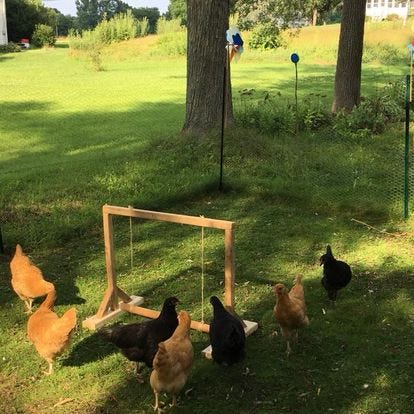
Each day we harvested anywhere from five to eight eggs, and before long we were selling them to friends and family members. While we didn’t get rich, we did have fun and we coined a motto that read: “If you want fresher eggs, you’ll have to lay them yourself.”
To assist us in keep rodents and other animals away, we adopted two kittens from a farm down the way. We named them Hazel and Willow, and they took their job seriously. They were given the other side of the chicken coop as their own, and they cohabitate with the girls. Willow I think secretly wanted to be a chicken because we often found her in the chicken run hanging out with the girls. It was hilarious. I guess you could say she was an honorary chicken.
Hazel and Willow were “working cats,” or “barn cats,” or at least that was the intention. They patrolled both the house and the chicken coop and kept unwanted rodents at bay. We put brightly-colored collars with bells on each of them so songbirds would hear them coming and fly away. We wanted them to go after rodents, not birds, and for the most part, these collars did the job.
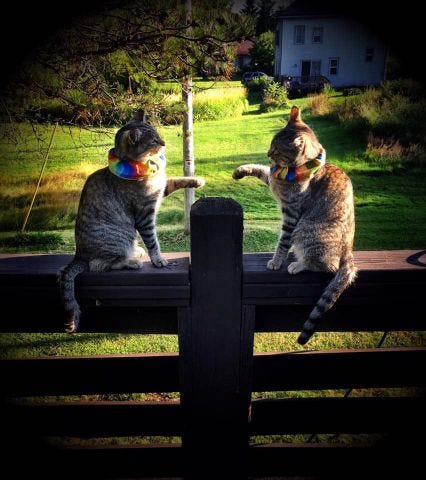
Of course, it wasn’t too long after Hazel and Willow came to live with us that they worked their way into our hearts as well. As the months passed, they became less and less “barn cats” and more and more members of our family. They loved to climb, and before long we were that crazy house that had cats on the roof.
The Orchard
Wisconsin is known for its apple production, at least in the southern part of the state. Nothing screams “autumn” like biting into a fresh Cortland apple on a sunny day in September or October. It was with this in mind we decided to carve out a portion of our back field to develop into an orchard.
We purchased 13 apple trees and decided to put nine of them in the back field, and four of them in our front yard lining the driveway. With over 100 varieties of commercially-grown apples and 2500 different varieties of apples in the United States, deciding which varieties to grow was a big decision. We settled on Cortland, Macintosh, and Honeycrisp. Paramount to our endeavors was the construction of a fence to keep out the deer. Deer love apples and apple trees, and we have a lot of deer in this area.
It takes about five years for apple trees to produce fruit in any quantity, and we are three years into it. We have sampled a few apples (which were delicious, by the way), but we are probably two years away from a decent harvest.
The Future
In the years to come, we are looking forward to raising as much of our own food as possible, organically and as sustainable as possible. In the years to come, we are hoping to expand the gardens, add ducks and maybe goats, and continue developing this land into the little slice of heaven it is. We have a vision we are working toward, and with each new accomplishment or addition, we take a step toward that vision.
\


