
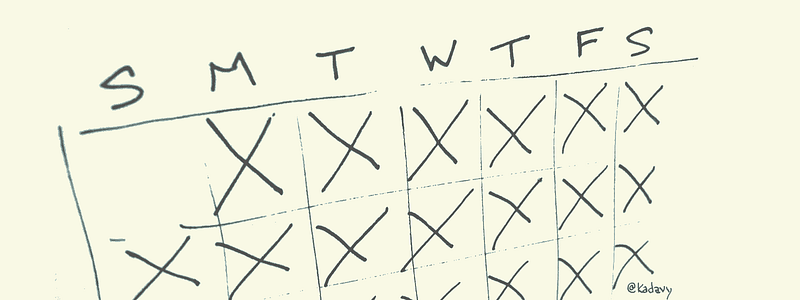
Build the habit first
You can listen to an audio version of this article here.
We all have habits that we’d like to build. We want to go to the gym three times a week, we want to meditate 20 minutes a day, or we want to write 1,000 words a day.
As is usually the case, we dream a little too big. The vision of that dream gets in the way of making it a reality.
These sound like modest goals, but they’re actually big and scary. They’re just big enough that excuses are easy to make. We’re kinda tired, so we’ll go to the gym tomorrow, or we don’t have time to meditate this morning.
The Pressfieldian Resistance is too much, and the excuses we make protect us from feeling bad about not building the habit. So, the habit never gets built.
The problem is that building the habit itself is an accomplishment. Writing 1,000 words for one day, in itself, is another accomplishment.
Your brain can only handle so many accomplishments at once. When you start bunching them together, it makes it easy for your ego to hide, like a wounded monkey in a tree, far from the tiger’s reach.
The solution is to build the habit first. You have to set a ridiculously modest goal, and make a modest agreement with yourself:
- Write 100 words a day for one week at [this time and place] each day.
- Go to the gym 3 times in one week on [these days and times], for 15 minutes each session.
- Meditate for 2 minutes a day for one week at [this time and place] each day.
This works because you’ll feel ridiculous if you make an excuse that you can’t write 100 words. Your ego isn’t that good at hiding. It’ll be like a grizzly bear behind a bamboo stalk.
But something happens as you start to build your ridiculously easy habit. You start to feel good about it. When you feel good about it, you start to enjoy it. When you enjoy it, it’s easy to do.
Once you’ve finished a week, you may decide to do a month. Keep your ridiculously modest goal. Don’t raise your goal until the habit has been built.
Notice these important elements of building the habit:
- The habit is ridiculously easy.
- You’ve only agreed to a week at first (because that’s ridiculously easy), and you’ll do a month if that works out. You have no way of knowing if the habit will serve you beyond that.
- You’ve pre-established a time and place to perform your habit. This makes it harder for your habit to slip away.
- Whenever possible, make the habit every day. If it’s every day, it’s harder to put it off.
When I wrote my latest book proposal, I committed to one hour a day. When I get back into meditating, I make it 5 minutes a day. I recently published a 500-word Medium article every weekday morning for two months.
Don’t let your dream of the ideal habit hold you back from having a habit. With a little Motivational Judo, you can hold The Resistance at bay, let your ego pass by safely, and build the habits of your dreams.
Want to 4x your creative output? I’ve got a free toolbox for you »


