
Build Networks Through Classical Music
You won’t attend a networking event again after reading this.
Network, network, network is the mantra I’ve heard throughout my career as a public relations professional. I began to rethink that idea in the fall of 2018, as I neared the end of my public relations studies at Georgetown University — and it’s been to my benefit.
That semester I completed a course on personal branding at Georgetown University’s Chinatown campus. In the class I learned everything from how to communicate my identity on social media to tell someone what I do at work.
Yet, one of the most intriguing concepts I learned in this class was when the instructor told us that she gave us permission to never attend a networking event ever again. Why shouldn’t you go to networking events? Part of the problem with professional networking events, I learned, is the networking events themselves.
Think about what happens at your typical professional networking event. Attendees gravitate to the people who they already know — and only reluctantly talk with people they don’t know. If you do muster the gall to speak to a complete stranger at a networking event, it often feels like an awkward first date.
Aside from working in the same industry, you may or may not have anything in common with your conversation partner. You also won’t have any rapport or personal history with them either.
An alternative to the awkward networking ‘first date’ is to build connections with people by inviting them to participate in an activity that is unrelated to work. That way, the focus of your conversation is the activity itself, not the state of the industry or what job is next on the horizon.
This is how Tina Roth Eisenberg started CreativeMornings — to build a community that would benefit creative professionals in New York City. Eisenberg started small, but now more than 180 cities host monthly CreativeMornings sessions. Meanwhile, Jon Levy, a social scientist, became famous for building connections by holding dinners in which he instructed his guests not to talk about their trade as they cooked their own dinners. Levy’s strict no ‘shop talk’ rules meant that guest had to talk about common interests, and thus build bonds through their shared interests, which is the way it should be.
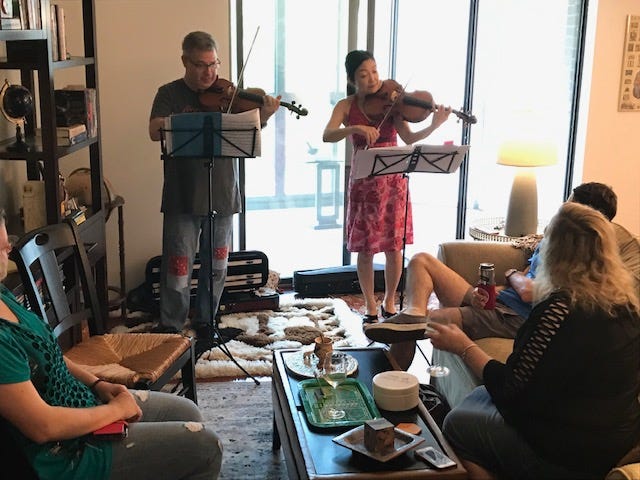
I’m impressed enough with the community-building efforts of Eisenberg and Levy that I’ve started my own community-building endeavor. Last weekend I hosted a classical music concert out of the comforts of my own home. Several guests were old friends of mine, while others were people I had never met, and had no connections to.
The 12 attendees of the concert at my home came from all walks of life — but they shared an interest in classical music. Together we reveled in our appreciation for listening to music we love, while also building connections with new people. Meanwhile the musicians, who also have performed with the National Symphony Orchestra, earned more than $170 for their gig at my home. Each attendee contributed to the pot. I didn’t take a cut for myself, but meeting new people was music to my ears.


