
Build Muscle Efficiently With Myo-Reps: Why Are They So Effective?
Sculpt your physique with this fantastic intensity technique.

An athletic and muscular physique has been appreciated and desired since the days of the Ancient Greeks. You only have to look at some of their statues… Fast forward to the twentieth century, and fitness culture is rife, with millions of gym selfies being uploaded to Instagram daily (probably).
Most people who work out want to build muscle or change their physique. But it can seem so overcomplicated — a scroll through social media can bombard us with influencers finding novel ways to use fitness to gain fame and views via social media.
Anyone attending the gym to build muscle or shape/tone their physique should exercise with intent using a workout routine/programme designed to maximise the recruitment of their muscle fibres.
But what actually works? How do we train to optimise muscle growth?
Well, one way is Myo-reps. And yes, it works.
What is Myo-reps?
Myo-reps, short for ‘Myofibrillar Repetitions’, is a training technique condensing exercise volume into a shorter amount of time and increasing its intensity. It is a sub-category of rest-pause sets more commonly used in weightlifting.
We first perform a regular set between 10 and 20 reps, making sure we go close to failure. After a small rest until the burn fades (less than 15 seconds), we perform mini sets with the same weight of as many reps as possible. We keep doing these mini sets with this minimal rest until we can no longer complete 4–5 reps.
The aim is to highly fatigue a target muscle in a much shorter time than usual.
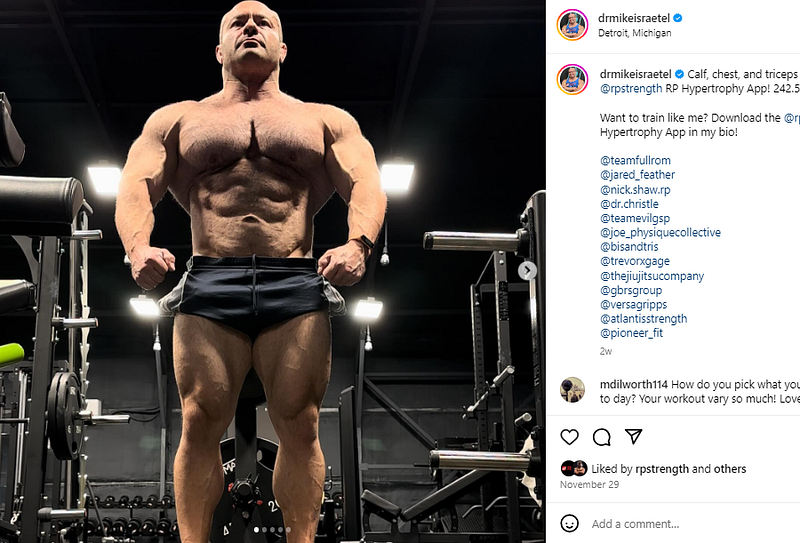
Using myo-reps is endorsed by Dr Mike Israetel, a Professor of Sports Physiology, who has a prominent social media presence with Renaissance Periodization. Mike typically uses science and experience to discuss hypertrophy and strength training best practices and has many popular videos working out and coaching other prominent bodybuilders and fitness influencers/personalities.
“Choose a weight for 10–20 reps, stop near failure, rest until the burn fades, then repeat.” — Dr Mike Israetel*
*All the quotes used in this article are from Dr Mike.
The benefits of using Myo-reps
There are a few reasons you might use myo-reps in the gym.
Firstly, you want to improve your physique and strength levels. Myo-reps are highly hypertrophic (muscle building).
Secondly, myo-reps provide a more time-efficient approach than traditional workouts to do large amounts of volume targeting specific muscle groups if you are short on time for the gym.
Thirdly, intensity. You might prefer your workouts to be short and intense! Myo-reps will increase your heart rate over a typical workout, getting a real sweat up and giving you a great pump.
Finally, myo-reps provide efficient volume accumulation of effective reps. This is because more of our workout is spent doing challenging reps in the zone close to failure that is highly stimulating for muscle growth. Some of our smaller muscle groups respond best to a lot of volume, and one myo-rep set could have 5 or 6 approaches to failure, which takes a lot more time with straight sets.
Implementing myo-reps into your training
We have just learnt the benefits of using Myo-reps in your training. But what is the best practice for implementing them into our training? In this section, I will explore best practices for using Myo-reps and discuss myo-rep matching as recommended by Dr Mike, which works slightly differently.
There are four general phases for myo-reps — an activation set, rest periods, mini-sets and repeat.
Activation Set: The first set is referred to as the activation set. Aim for a rep number between 10 and 20 and choose an appropriate weight that is challenging to complete for this amount of weight. This is not a warm-up — take that set close to failure (1–3 reps in reserve).
With Myo-rep matching, your activation set has 18 straight reps.
Rest Periods: Myo-reps have a tiny rest between sets compared to traditional training. You should only allow 5–10 seconds of rest, which is just enough time to catch your breath and for the burn to stop.
For myo-rep matching, use a typical rest period of 2–5 minutes after the first set. However, between the mini sets, rest between 5–15 seconds. Once the target number of reps is achieved, rest for 2–5 minutes to sufficiently recover and hit the next set of mini myo-reps with the same high intensity.
Mini-Sets (Myo-reps): for the myo-rep sets, use the same amount of weight as the activation set. However, the number of reps you can complete will be reduced due to the small rest. If you can do the same number of reps, the activation set did not challenge you enough, or you rested for too long.
With myo-rep matching, we again use the same weight as the activation set. We complete mini-sets with as many myo-reps pauses as required to reach the 18 reps achieved in the first set. These mini-sets will often have fewer than five reps — for example, to finish the 18 reps, the first set might have 10 reps. Then, 4 reps, 3 reps, and then 1 rep.
Repeat: Continue the mini sets (myo-rep sets) with 5–10 seconds rest in between until you can no longer complete 4 to 5 reps. At this point, you are highly fatigued.
For Myo-rep matching, repeat the process to complete 3–6 total sets (there will be far more mini-sets than this).
“Choose a weight that you can do close to failure for between 10 and 20 reps in one set. Then you do your first working set, stopping it whatever rep shy failure you have for that week… Rest just long enough to let the burn dissipate…. [and] As soon as the burn is out, go again and do as many reps as you can.”
Tips for using Myo-Reps
We have just discussed the general process for using myo-reps. This section will provide tips to maximise their effectiveness for building muscle.


Exercise selection
Myo-reps are a great stimulus for growth for some muscle groups, but it will more likely negatively impact our results for others.
Myo-reps will yield better results on smaller muscle groups that do not create high systemic demand, like our biceps, triceps, forearms, delts, triceps, traps, and calves.
For bigger muscle groups like quads or chests, it is best to use them sparingly, and when we do, use machines instead of free weights to minimise this fatigue. Exercises like the deadlift can be taxing long-term with regular use, but also psychologically taxing during a session because they take so much mental focus and physical effort. We just take too long to recover after a set and will be too weak on corresponding sets that it defeats the purpose.
Moreover, cardio can be the limiting factor in an exercise. If the burn is gone from the target muscle, yet you can not catch your breath, it is the wrong exercise.
Monitor fatigue
Something called the stimulus-to-fatigue ratio weighs up the potential for results versus how much recovery demand an exercise has on our bodies and minds. For maximal muscle growth, we want to localise fatigue on a target muscle to maximise hypertrophy potential rather than smashing a bunch of muscle groups and our central nervous system.
Myo-reps are highly fatiguing compared to a standard workout (in terms of time spent in the gym), so be mindful of this. You should limit them to a maximum of a couple of exercises per workout.
Your form should be repeatable, rep after rep, set after set. If your technique is breaking down, that is a sign of fatigue. So, if you cannot maintain proper form on an exercise, especially on a compound lift, it’s a good time to stop that myo-rep set.
“As long as you don’t overuse them, so they beat the shit out of you, Myo-reps are amazing. I highly recommend them.”
Intensity
Several factors relating to the intensity of myo-rep sets influence their impact on your workout and results.
Fitness level: how many myo-rep sets you can do can be influenced by cardiovascular fitness. Therefore, if you are out of shape, you should not train with myo-reps because you cannot train at the intensity required. Lose weight, get better cardiovascular health, and ultimately, your gains will benefit.
Proximity to failure: aim for the RPE/RIR (reps in reserve) as your programme. If you do not follow a strength/bodybuilding programme, a good rule of thumb is to be within 2–3 reps of failure on each set. This ensures you train close enough to failure to maximise the stimulus for growth.
Rest periods: do not rest too long between mini sets of myo-reps. We are just catching a quick breath for partial recovery to keep training in that hypertrophic zone close to muscular failure.
Weight: As you fatigue during myo-reps and feel a massive burn, you might want to drop the weight on the next set to make it easier… don’t! The point is to squeeze the reps out with all-out effort. Don’t change the weight during myo-rep sets.

When are myo-reps not ideal?
exercises with cardio or limiting factors like fatigue to other muscles that impact the lift or being psychologically taxed
Heavy compounds with free weights can be a safety issue, with form breaking down and training close to failure on so many reps is highly fatiguing, could be an injury risk and is a lot harder to recover from.
We want to optimise the stimulus-to-fatigue ratio, but, in this case, the fatigue will surpass the benefits of using myo-reps.
“You may find that burns you out… before you can put in as much high-quality work as you want… Don’t use myo-reps on exercises in which the systemic limiters are way too prominent. A lot of compound multi-joint exercises, big muscle groups; deadlifts, squats, presses, things like that…”
Concluding Thoughts
Myo-reps are an intensity technique for building muscle that increases time efficiency.
We can effectively use myo-reps on many exercises to target specific muscle groups. Typically, we should use this technique to isolate our smaller, more resistant muscle groups, such as biceps, rear delts, or calves. Using compound lifts that target large muscle groups, like our chest and glutes, is not advised as it will be too fatiguing, causing a detrimental recovery demand.
The main benefits of myo-reps are that they are efficient and intense, packing a lot of stimuli into a short time by multiplying the number of affective reps in that high-intensity zone approaching failure.
If you are new to the gym, be wary that this technique is better suited to more advanced lifters who know the limits of their body well and understand proper lifting techniques.
If you are no stranger to a gym and want to build muscle, give myo-reps a shot! You might be surprised how much of a pump you get.
Thank you for reading.
If you enjoyed the content, please consider subscribing so you are notified when I share new content.
You might also be interested in my deep dive into hypertrophy or this article about how I have built over 40 pounds of muscle naturally.