
Build a Checklist for Your Project: ‘Play the Tape’ & Never Miss a Step
How creators develop systems to create consistent customer experiences
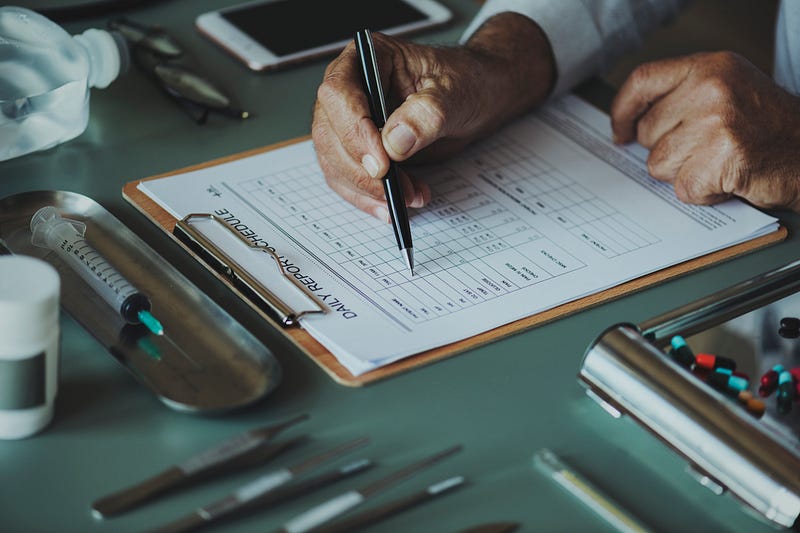
In the laboratory we use checklists and standard operating procedures to ensure we never miss a step. In research, you’ve got to develop reproducible results if you want your research to be taken seriously. Sometimes missed-steps can lead to catastrophic results.
Although it’s not life or death, our customer’s experience can benefit from checklists too.
As Michael Gerber teaches us in The E-Myth Revisited, it’s important for our customers to get the same positive experience every time they interact with our work. If we want to create that experience, we need checklists.
If we want to create a consistent customer experience we’ve got to rely on more than just our memory — we need a system.
And checklists go way beyond customer experience. We can use checklists for many aspects of our work. As freelancers and small business owners if we’re not productive we don’t get paid.
If we want to keep to our production schedule (and remain a high-quality outcome) we’ve got to use checklists.
Checklists aren’t just for groceries. As Atul Gawande shows us in The Checklist Manifesto, surgeons have saved countless lives with checklists. Pilots keep planes from dropping from the skies, and nuclear reactors keep entire cities from becoming puddles of goop.
If checklists are good enough for life-and-death, we can probably benefit from them too.
Checklist-creating is an art. If the checklist misses a step we miss a step. If you follow a map and the map takes you to California, but you wanted to go to New York, the map is useless to you. Therefore, we need a good system to ensure we don’t miss an important step.
I use a system in the laboratory that’s helped me over the past twenty years. Working on client projects that run into the tens of millions of dollars, there’s no room for error. This checklist method is as close to foolproof as I’ve come… and I discovered the method from an unlikely source — pro athletes.
In the next sections I’ll show you exactly how I build and test my own multi-million dollar checklists. I hope this simple method works for you too.
What makes a good checklist?
Good checklists hit the major milestones of a project without getting bogged-down in minutiae. Let’s say we want to make checklist for brushing our teeth. A good checklist will contain all the major steps, without patronizing the operator down to microscopic details.
How to brush your teeth:
- Put paste on your toothbrush (this solves four steps in one — collecting the supplies, opening the paste, putting the paste on the brush, and preparing the location). If we don’t complete this step we miss those four steps.
- Run the water in the sink to a trickle.
- Brush all surfaces of all teeth, using slight pressure and a circular motion.
- Spit occasionally, when mouth is full.
- Rinse brush under the running water when finished.
- Turn off water.
- Return supplies to their appropriate locations.
Now, you may brush your teeth differently, but you get the idea. The checklist hits every critical step. No critical step can be missed. If we miss one critical step the entire project will be compromised. If I forget the water, I’ll leave a mess in the sink (bad experience for the next sink user). If I don’t return the supplies to whence they came, I’ll have a bad experience the next time I brush.
Good checklists prevent us from making human mistakes.
We’re all human. We lose focus. We’ve got other things on our minds. As creators we’ve got more on our minds than most people. Good checklists help keep us from our human foibles. We bring out the list. We follow the list and execute. We get the same, consistent result every time.
Good checklists help our customers, improve the quality of our work, and save us from ourselves.
If you have to remember all the steps of an important task every time you execute, it’s taxing on your mind. You’ve got to waste valuable processing power just to do something that can be solved by a simple checklist. Instead of risking a missed-step, take all your mission-critical tasks and build checklists.
Play the tape: How I make checklists
You need a yellow legal pad and you should stand in the location of task you wish to map. You don’t need any other supplies.
I happen to be a very visual person. If you have trouble visualizing you may want to use the actual objects in your task, but I find I can make an accurate checklist without physically doing the task. In the lab I have to be able to do this, because I need to make checklists in advance of multi-million dollar experiments. I don’t have the luxury of a practice run.
It’s time to play the tape.
Playing the tape is the technique of legendary athletes. They practice the perfect scenario repeatedly in their minds (sink the shot, run the race, swim, bike, shoot, jump, or score). When we play the tape we walk ourselves through the perfect outcome in perfect conditions, with perfect results.
Stand on-location and play your own tape.
Grab your legal pad, start with your perfect process, play your mental tape and walk yourself through the task one critical step at a time. Write-down every step on the legal pad. You’ll edit and combine steps later. But while you’re running the tape you record every detail on paper. Envision yourself performing the task as if it were real. Your brain will feel like it’s real.
Once you’re finished, play the tape a second time, but only using the steps on your list.
When you go through this second, checkpoint step, you may catch a few additional steps you forgot when you played the tape the first time. Add and rearrange anything that needs fixing.
It’s time to edit.
Surgical checklists are paired-down to a single page. Flight checklists are longer, but still don’t require a thousands checked steps to get a plane of the ground.
Return to your list and eliminate any steps that must be completed automatically by completing any other steps. Eliminate any steps that won’t harm the quality of the project if missed. Combine multiple steps into a single step that covers them all (like the first step in the tooth-brushing example.
Build the final checklist.
If you plan to use your checklist multiple times, make it official-looking. Put your logo on it. Turn it into an official operations document (even if you’re a business of one). Laminate the checklist and use a dry-erase marker to check the boxes. Wipe it off for use the next day.
Playing the tape has helped me build dozens of successful checklists and I hope it works for you too.
We need your work to be at its best. Your customers deserve your product or service to be consistent every time they experience it. You deserve the peace of mind that you’re doing the work right the first time.
We’re waiting for you.


