
Buddhism and the Venture of Limited Selves
The reality of brains and minds, and the shame of Buddhist contentment.
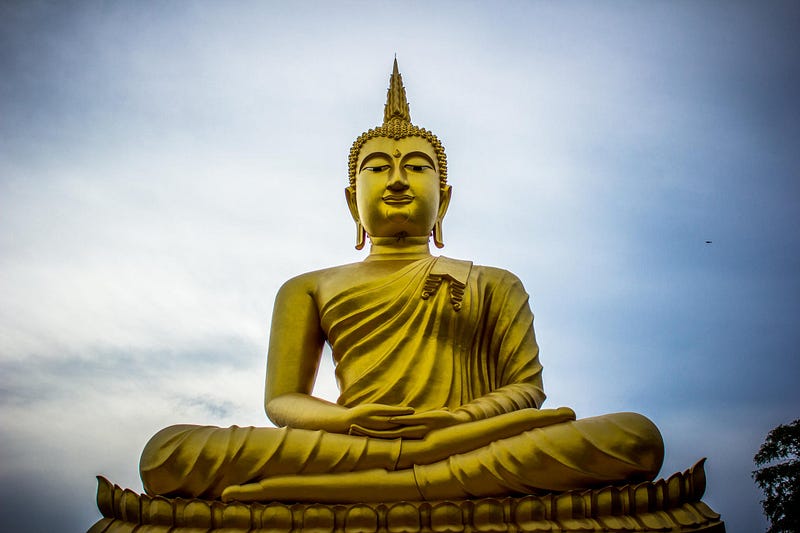
The holy trinity of Buddhism, as it were, is a trio of perceptions of certain marks of existence, namely that everything is impermanent (anicca), that mundane life is unsatisfactory (dukkha), and that there’s no permanent or essential self or soul (anatman).
If the third observation is meant to oppose Hinduism’s grandiose claims about the self, Buddhists have a valid point. But in so far as Buddhism is consistent with David Hume’s bundle theory of the mind, with the observation that there’s no mental unity at all, Buddhism leads us astray despite this atheistic religion’s grandeur.
Hume pointed out that, based on rigorous empiricism, we can’t find the self we take for granted. All we find through introspection is a series of mental states. We can infer there’s some substance underlying these impressions, just as we infer with respect to the separate external objects such as tables, rocks, and puddles, which we posit to account for the flurry of stimuli received by our five senses. But those inferences are arbitrary on strictly empiricist grounds.
Buddhist versus Scientific Perceptions
If that’s roughly the point of the anatman teaching, Buddhism runs up against the fact that our perceptions needn’t be so personal and immediate; they can also be scientific and experimental.
True, introspection doesn’t show us that we exist as substantial selves, as unified, permanent or at least persistent containers of our mental states. But our sources of data aren’t limited to introspection. We can cooperate to penetrate the nature of reality, and systematically test our hypotheses and predictions to understand patterns in our observations.
Thus we arrive at the theory that the self exists not as an immaterial soul, but as a product, especially of the human nervous system. Introspection doesn’t show us the brain, since the brain is geared to processing data flowing into our senses from the external world. Nevertheless, science shows that the self’s apparent attributes correspond to features of the brain. If you drink alcohol to excess, for example, your drunkenness has a temporary effect on your brain. In short, the brain’s enormous complexity accounts for our intelligence and creativity, and for the enormous variety of mental states and memory-based personalities.
Moreover, although the brain is hardly a permanent, immaterial spirit, the brain’s solidity makes for some psychological unity. We don’t exist just as a loosely strung-together bundle of mental states, but as a brain ensconced in the skull that — along with our gut — controls our body. Our bodies change over time as they grow and interact with the world, but it’s futile to overlook the coherence of the patterns in our perceptions of the body.
The human body is a physical thing along with all the others we find in the world. We don’t strictly sense the unity or substantiality of these things, but there’s no reason to think we make sense of the world just by deferring to fragmentary sense data. As Immanuel Kant stressed, we understand the world by processing that information with the faculties of reason. If we weren’t in the business of understanding our experience, we’d have no basis for justifying one course of action over another; for example, we’d have no defense of the Buddhist program as a sensible way of reducing our discontent.
We perceive what the philosopher Daniel Dennett called “real patterns,” a natural order we can understand or at least interpret with various “stances.” So although things vary over time, they also stay somewhat the same; they retain certain features. As Plato said, there’s unity or oneness in the multiplicity.
Thus, although the brain’s neurons are perhaps never in exactly the same state of excitation twice, they form structures that persist over time. For example, some neurons are part of the cerebral cortex, while others belong to the hippocampus.
Similarly, as Heraclitus famously said, you can’t step into the same river twice. But if on one day you encounter a river in a certain spot and you return there the next day, you’re likely to find the river hasn’t disappeared. Although our mental states are always changing, introspection nevertheless presents us with mental states, with thoughts and feelings, not with pineapples or asteroids.
As far as we can understand based on scientific methods of explanation, that consistency in what we find when we look back at ourselves is due to the unity of the brain, to the fact that atoms come together to form molecules, which merge to form simple organisms that evolved into more complex bodies which came to include organs such as the human brain, with its eighty-six billion neurons working together to give us a picture of the world.
This is the answer to both Buddhism and to radical (perhaps satirical) empiricists like David Hume. Although the human self may not be identical with an underlying deity, as in Hindu mysticism, there is such a thing as a self. A self is born, it lives and it dies in its form as a human body. The brain largely controls that body via the mind, which is a set of patterns in our beliefs and interests.
Tragic Heroism and the Hope for Brain-Based Selves
Now the ethical point of anatman is to deflate the ego. If there’s no permanent or persistent self, there’s no sense in clinging to that illusion. Thus we can end our suffering by recognizing the hidden truth that we don’t even exist as things whose cravings can all be satisfied.
Suffering is caused by ambition which is based on a misunderstanding, according to Buddhism. An enlightened person realizes that she was never really there in the first place, that she shouldn’t be disappointed by her circumstances, because there’s no such thing as a person that can be mistreated in the first place. There’s only a series of mental states, as far as the introspecting self is concerned, so the enlightened being is just a non-deluded stream of conscious states. That stream will consist of fewer disappointments, given that the latter are produced by deluded hubris and a grandiose self-image.
As far as I can tell, this isn’t wholly wrongheaded since there are unnecessary forms of suffering that are sustained by delusions, misunderstandings, and vices. But the goal of ending suffering and of attaining the tranquility or inner peace of “nirvana” does seem ignoble. Those who are happiest and most content are children, and their inner peace is due to ignorance, not to enlightenment.
Contrary to the Jesus of the Gospels, too, who said the kingdom of heaven belongs to those who are childlike (Matt.9:14), enlightenment is deep, philosophical knowledge that entails precisely an honorable kind of suffering. We ought to suffer on behalf of the wretchedness of our existential plight as natural beings. We are minds generated by brains that are encased in skulls held up by skeletons girded by flesh produced by the flurries of trillions of mindless molecules and atoms in an amoral void. That’s the picture of what and of where we are, according to rational enlightenment.
To suggest that we ought to be at peace with natural existence is to betray the countless victims of the natural order’s mindlessness. And it’s no use retreating to the Buddhist tenet of anatman, because there have indeed been such countless victims that have existed, once again, as special (living) physical bodies. Those bodies have suffered because the universe at large operates on an inhuman basis.
Children are ignorant of that fundamental inhumanity since they barely grasp the extent of the wider world. But those who are enlightened by reason have no excuse. They’re the last people we should expect to be happy. Contented adults are either too busy enriching themselves by making others unhappy (such as by exploiting people’s weaknesses in a rigged capitalist system) or have succumbed to mass delusions that are taken for conventional wisdom. In short, these tranquil individuals are either ignorant of philosophical truth, like distracted children, or they prefer the benefits of adhering to uplifting myths to the prospect of grappling with nature’s underlying absurdity and unfairness.
Recognizing that we exist as limited, fallible, embodied selves, the enlightened person should suffer in something like Romantic or existential terms, but she should also attempt to prevent those baser, pointless forms of suffering in others. This is because such a person couldn’t help but empathize with everyone’s victimhood since we’re all in the same existential boat. We’re caught in the plight of being human persons, creatures gave the accidental capacities for self-awareness and reflection, which enable us to understand that what we inevitably want is going to conflict with what nature is inclined to give us.
We want to live and to increase our range of experience, to progress as a family, a society, or as a species, and we want those things because they’re possible, because we do live as coherent, temporarily-unified objects, brains, and minds or selves. The world gives us those bodies and cognitive capacities, but the effect is tragic since we are indeed naturally disappointed with the world as it unveils itself through us. That’s the root of the Promethean resistance, of human arrogance and self-destructiveness, but also of the particular project of secular (technoscientific, political, and economic) progress.
We trust there’s honor in building an alternative world, one that better fulfills our expectations, even if in doing so we may disclose the smallness of mere human enlightenment, since the Anthropocene may doom us all in the sixth mass extinction. Nevertheless, even if human progress turns out to be a foolish conceit, there may be greater honor in that failure, in that revolt against the wilderness which is caused by a rational understanding of the existential facts of nature, than in the Buddhist retreat to a fake (inauthentic) condition of childlike innocence and harmlessness.
The enlightened Buddhist may be selfless and helpful and may eschew the mass delusions of egoism and narcissism, but Buddhist morality is confused to the extent it’s based on the quasi-empiricist delusion of anatman. Again, there are patterns in the many changes we observe, and they’re explained best by scientists who theorize that we exist as brain-based minds that suffer and that can succeed or fail in their response to the world that makes the suffering of living things so ubiquitous.


